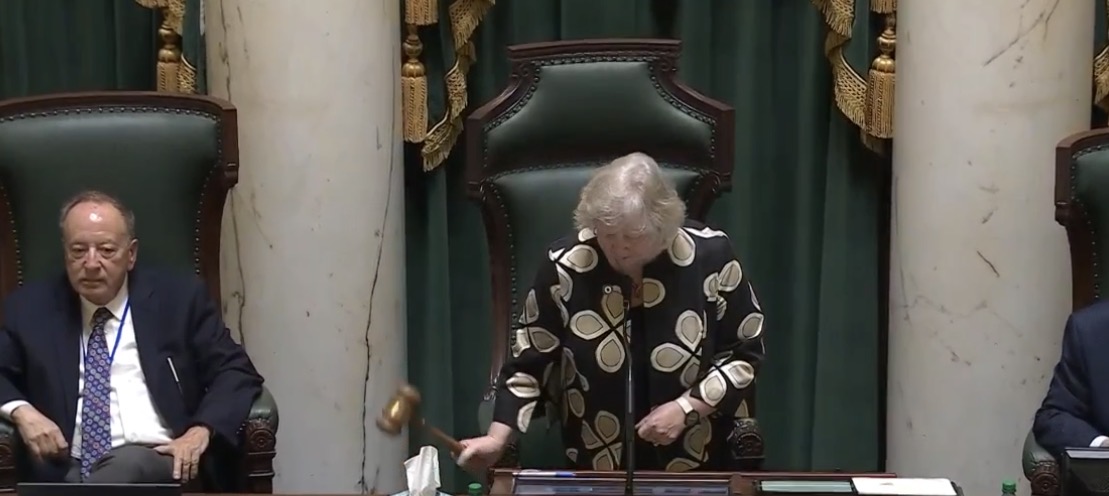
PROVIDENCE – The General Assembly officially recessed late Thursday but not before approving a number of bills.
The slew of approvals, which now go to the governor's desk, marked the marathon floor sessions in the House and Senate that wrapped up just before midnight.
Among the new laws was legislation amending the statute of limitations for claims of sexual abuse of a child, and creating a two-year window for victims to bring otherwise time-barred claims against institutions and supervisors accused of enabling or covering up sexual abuse.
There was also legislation putting a hold on any proposal for high-heat sewage solids processing at Quonset Business Park while a newly created commission studies how to safely dispose of these byproducts.
Sponsors said the one-year moratorium on the operation of any thermal waste conversion facility within Quonset is aimed at the proposed $150 million facility at the business park to convert sewage solids, sometimes called "sludge," into fertilizer using the high-heat process known as pyrolysis.
Lawmakers also approved legislation banning federal Immigration and Customs Enforcement agents from being present within 200 feet of any polling site during elections.
On healthcare, lawmakers approved 12 of the Senate’s 17-bill package, including bills Codifying Children’s Mobile Response and Stabilization Services in state law and expanding coverage; creating artificial intelligence safety guidelines related to suicidal ideation and mental health treatment; creating a 13-member study commission on medical malpractice; investing in loan repayment programs for primary care providers; and establishing new oversight of pharmacy benefit managers.
On housing, the assembly approved bills enabling cities and towns to allow pallet shelters on a temporary basis during a declaration of an emergency; establishing a commission to study potential modernization of and updates to the state’s Condominium Act; and setting maximum parking requirements for multifamily housing in areas accessible by public transit.
Other bills passed include:
- A three-year moratorium on new charter schools.
- Prohibiting any federal immigration authority from conducting a civil arrest of any person in the state without a judicial warrant or order while that individual is traveling to, attending, or directly leaving a judicial proceeding.
- Creating a commission to study the feasibility of revamping the public-school funding formula.
- Requiring all shooting ranges in Rhode Island to post, in any areas where shooting occurs, a sign that says, in English and Spanish, “WARNING: If you or a loved one is experiencing distress and/or depression, call the 988 Suicide and Crisis hotline or text “HOME” to 741741.”
- A bill redefining a felony as “any criminal offense which at any given time may be punished by imprisonment for a term of more than one year.”
- Legislation making R.I. Department of Transportation vehicle crash data public record.
- “Casey’s Law,” which adds extra penalties for motor vehicle offenses involving so-called “road rage.” For felonies, the additional penalty would be at least two and up to 15 years of additional prison time, a mandatory fine of at least $1,000 and license suspension of up to five additional years, or revocation for two additional years.
- Requiring grocery stores with self-checkouts to have a minimum of one staffed checkout for every three self-checkouts operating, with at least one of the self-checkout stations meeting the accessibility standards of the Americans with Disabilities Act.
- Changing the date of the presidential primary from the fourth Tuesday in April to the first Tuesday in March, often referred to as Super Tuesday.
(UPDATES to clarify that the bills now go to governor's desk.)
Christopher Allen is a PBN staff writer. You may contact him at Allen@PBN.com.