Every day, about 170,000 cars cross Interstate 95’s Pawtucket River Bridge. That’s almost three times the 60,000-per-day volume for which it was designed.
Preliminary designs to replace that 50-year-old bridge are still about four months away, said R.I. Department of Transportation (DOT) acting Chief Engineer Kazem Farhoumand. The preliminary replacement cost also will be released at the same time.
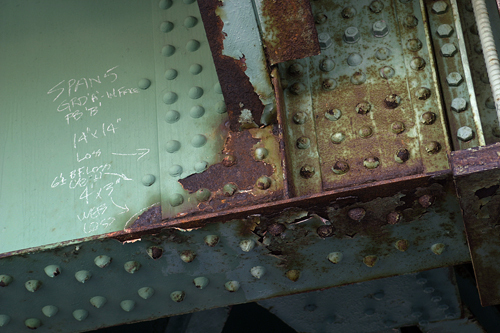
He said replacing the ailing bridge is the DOT’s only option, partially because of traffic concerns but also because of its wear. “There’s been deterioration. The deck needs to be replaced,” he said last week. “We looked at everything. The most feasible thing is just to replace the whole thing, rather than trying to repair it.”
The DOT inspects both state-owned and municipal bridges. In total, the 770 bridges in the state are each inspected once every two years. That inspection turned up structural deficiencies that caused the weight limit to be imposed on highway traffic.
Since November, when it imposed a 22-ton weight limit on the bridge, the DOT has been preparing for the preliminary design of a new bridge, he said.
The weight limit, however, doesn’t mean the Pawtucket River Bridge is in danger of collapsing, Farhoumand said.
“The reason that we post the [weight limit on the] bridge isn’t that we’re saying that a truck that is 23 tons that goes over the bridge is going to make it collapse,” he said. “There are a lot of factors of safety that go into that posting. Basically, why we post the bridge, is that we want to prolong its service life. If one truck that’s 23 tons or 24 tons goes over it, it will not have much of an impact, but if you allow heavy trucks to go over it repeatedly it shortens the life expectancy of the bridge.”
R.I. State Police Capt. Jim Swanberg said the state has increased its patrols on the bridge. There is a police cruiser there most of the time watching for overweight trucks, he said. But it is only an educated guess until a truck suspected of being overweight is weighed by portable scales the state police have that they actually know who deserves a fine.
And some manage to squeeze by just because of the heavy volume of traffic. “If you have two tractor-trailer trucks out there going side-by-side, sometimes it’s very difficult to tell which one is loaded and which one is not,” Swanberg said.
The department is hoping to give bridges longer useful lives by changing the design and materials to match the regional conditions. Specifically, new Rhode Island bridge construction will use techniques that are meant to stymie the harsh, quick freeze-thaw cycles that over-water bridges in the Ocean State go through, as well as the increased traffic in the region, Farhoumand said.
Those new techniques include using mixtures that create denser, less-permeable concrete and using epoxy-coated rebar to protect against rusting.
Many metal exteriors – including the green beams that support the new Interstate 195 bridge – are now “metalized”; instead of simply painting a bridge’s metal underbelly and framing, new construction methods call for molten zinc to be applied to exposed parts. In a way that’s similar to galvanizing, the zinc acts as a deterrent to the elements, Farhoumand said.
Those materials were not around when the Pawtucket River Bridge was built. That was in the 1950s, when interstates 95, 195 and 295 all were built. Because those expressways and bridges were all constructed at nearly the same time, it seems that their needs for renovations will coincide too, Farhoumand said.
While those bridges boast life expectancies of about 50 years, bridges being built now are expected to last for between 75 and 100 years. That includes the new Interstate 195 bridge, dubbed the Iway, which opened to eastward traffic during 2007, Farhoumand said.
“Now, we pay more attention to the maintenance of the bridge,” he said. “There’s no such thing as a maintenance-free bridge, but we try to use better design and materials.”
For DOT projects, like the Pawtucket River Bridge, design work is done through consultants. “In general, close to 90 percent or above of our bridgework is done by consultants,” Farhoumand said. “We just don’t have the manpower to do that in house.”
The Pawtucket River Bridge had been inspected during July 2007. The results of that inspection were compared with the results from two years before, which led to the November weight limit change, said Charles St. Martin, a DOT spokesman.
The collapse of the 40-year-old Interstate 35W bridge in Minneapolis in August didn’t lead to the weight limit for the Pawtucket bridge, nor did it cause the DOT to alter its inspection schedule, Farhoumand said.
“That hasn’t really changed our schedule,” he said. “We are still supposed to inspect all the bridges in our databases – that doesn’t mean just state-owned, but even locally-owned bridges – at least once every two years.” That’s been the DOT schedule for at least as long as Farhoumand’s 20 years in the department. “In 2006 we were behind and we tried to just catch up for 2007 and 2008. It was not related to the collapse, it was because we are supposed to be up-to-date.”
Now, he said, the DOT is on schedule for all of the state’s bridges. While the owners – mostly municipalities – are responsible for daily maintenance, the DOT pays for rehabilitation projects, Farhoumand said, adding that the state has many 50- to 60-year-old bridges.
Those rehabilitations include smaller projects, like a minor rehab of the Henderson Bridge – a $1.5 million project – that connects the East Side to East Providence.
As for how much the department spends per year on maintenance and repairs, Farhoumand said “we don’t have one single figure, but we try to do at least $30 million each year. … But the past few years we’ve been way over it. The Iway project, mostly a bridge project … is costing us almost $600 million.” •