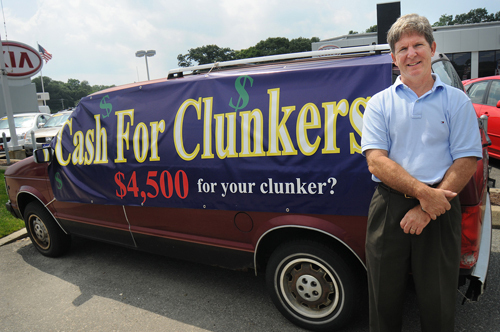
For car dealer Paul Masse, the “Cash for Clunkers” incentive program has been great for business, except for one thing.
Last week, the owner of three Paul Masse car dealerships gushed about the government program – known more formally as the Car Allowance Rebate System – saying it spurred the sale of about 80 cars in a week and had rejuvenated the car agency.
But there was this problem: As of Aug. 4, the government had not reimbursed the dealership for the $3,500 to $4,500 it had credited each qualifying car buyer.
Masse and his general manager, Scott Wellington, said the combined reimbursements were in excess of $350,000 and climbing.
Masse said he wasn’t overly concerned about eventually getting the rebates. After all, the Obama administration promised the program would continue even though “Cash for Clunkers” had already used nearly all of its $1 billion allotment and looked like it would be suspended.
Still, as the U.S. Senate debated an additional $2 billion appropriation to keep the program running, the uncertainty was weighing on the Masse Chevrolet dealership in East Providence last week. Wellington acknowledged that the car agency was considering making future sales under the Clunkers program contingent on the expected Senate approval, writing that provision into sales contracts.
“We get a little nervous when we hear the program is suspended, then continuing, and there’s going to be a vote,” Wellington said.
The “Cash for Clunkers” program clearly has been a boon for local dealerships, but its overwhelming popularity also created some headaches, too.
Dealers say they have endured countless government computer crashes, a tedious submission process for applications, unexplained rejections and unanswered questions.
“It’s been a nightmare,” said Chris Hurd, owner of Hurd Auto Mall, which had sold nearly 100 cars through the incentive program as of last week. “The unadvertised cost to the dealers is overwhelming.”
He assigned two employees to work full time scanning and uploading applications, a process that at one point was taking an hour each. About one-third of the dealership’s applications have been approved by the U.S. Department of Transportation (U.S. DOT).
And early indications are that the “Clunkers” program has been good for the auto industry.
Ford Motor Co. said last week that its July sales increased 1.6 percent from a year ago – its first monthly sales gain in a year and half – thanks in part to the incentive program.
General Motors Corp. and Chrysler LLC posted declines of 19.4 percent and 9.4 percent respectively, the smallest sales declines of the year.
During a press conference in Masse’s East Providence showroom last week, U.S. Reps. Patrick J. Kennedy and James R. Langevin said the program served a multipronged purpose, giving the economy a kick start and protecting the environment.
“The payback is coming in so many different ways,” Kennedy said.
Under the guidelines of the program, the size of the rebate is based on the gas mileage of the used car that the consumer is turning in and the one that is being purchased. If the difference is greater than 4 miles per gallon, the buyer gets a $3,500 credit; if it’s greater than 10 miles per gallon, the credit is $4,500. Once the older car – it can’t be more than 25 years old – is turned in, the engine is destroyed and the car is relegated to the scrap heap.
Outside Masse’s dealership last week, he displayed a white 1996 Cadillac – 18 miles per gallon – that was turned in under the “Clunkers” program for a more efficient Chevy Impala, which gets 22 miles per gallon, according to government calculations.
Kennedy and Langevin asserted that the improved mileage of cars purchased under the program would save millions of gallons of gasoline annually.
Masse said he calculated that if 250,000 new cars were purchased under the voucher program, it might save a trillion gallons of gas over the next decade, although he added, “I’m no mathematician.”
Then there’s the lift it’s giving to the automakers and dealers.
Wellington said the three Paul Masse dealerships in Rhode Island sold about 350 cars in July, including the 80 that were sold as part of the “Clunkers” program. That’s a 30 to 40 percent increase in sales over July 2008 figures, dealership executives said.
“It’s certainly doing its job,” said Perkins.
At the same time, Perkins said, dealers have struggled with the government Web site – CARS.gov – which has repeatedly crashed, slowing the process of applying for the rebate.
At Bald Hill Dodge Chrysler Kia, general manager James Hagan said the dealership sold 19 Dodges and 15 Kias to buyers who qualified for the “Clunkers” program. But he said because of problems with the government site, employees had to enter the paperwork on a Sunday, when the dealership is closed.
Hagan said he hasn’t received any rebates yet.
“There was a lot of interest – huge, huge interest,” he said. “[The government] wasn’t prepared for this level of interest.”
For its part, the U.S. DOT last week doubled the number of contract workers assigned to process the “Cash for Clunkers” transactions to deal with the backlog of applications that numbered in the hundreds of thousands.
Dealers said the sudden rush of vehicles off the lots will spur more orders and will get factories churning out more cars, and will require more employees.
In the meantime, some new-car lots will experience a problem they haven’t had in a while: a smaller inventory.
Hagan said dealers will likely have a shortage of vehicles for the next few months, while some factories gear up to make up for the sales spurt.
At Masse Chevrolet, Wellington said the agency has run out of the Chevy Aveo, a four-door hatchback that gets 28 miles per gallon. Another shipment was expected in a few days.
Although the sticker price was about $16,000, a combination of rebates and the “Clunkers” program could knock the price in half, Wellington said.
Masse shook his head, thinking about how the popularity of the car had waned in recent months as the price of gasoline had declined.
“We almost stopping selling them,” Masse said. •