
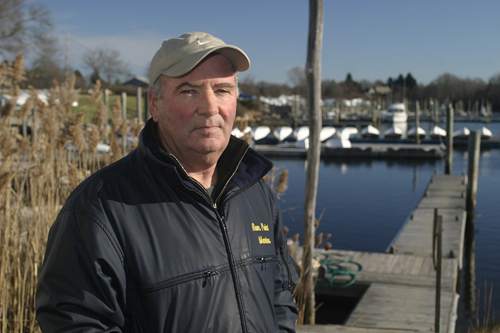
When William and Marylin Schmid opened Ram Point Marina in 1958, environmental concerns didn’t play a major part in the company’s day-to-day activities. Nor did those concerns take up much time in 1972, when their son, Curt Schmid, starting working full time at the marina.
But this month, the Wakefield marina became one of just three marinas in the state to be a certified “Clean Marina,” under guidelines created by the Coastal Resources Management Council.
“My father’s passed away, but he’d be very interested in seeing the things that we have to do now,” said Curt Schmid, who now runs the marina with his sister, Daryl Anne Anderson. “We make our living here and a lot of people enjoy that whole Salt Pond area and the ocean. It’s the right thing to do – we decided to work at it.
“I wasn’t sure if we could pass,” he said, “but we did.”
The Clean Marina Program was designed for marinas – there are more than 150 in the Ocean State – that want to surpass the state and CRMC-mandated, ecofriendly regulations. The Rhode Island Marine Trades Association has held seminars on the program.
Along with Ram Point, North Kingstown’s Allen Harbor Marina and Narragansett’s Point Judith Marina have earned the designation.
CRMC created the voluntary program in February 2007. “As a voluntary program, it’s designed to set an extra measure of protection for the coastal waters and it’s also designed to benefit the marine industry in Rhode Island,” said Laura Ricketson-Dwyer, CRMC public educator and information coordinator.0
Along with the owner and marina manager signing a “Clean Marina Pledge” and reading through the program’s 155-page handbook, marinas that want the designation have to complete a nine-page worksheet that includes a 93-point checklist.
That checklist includes information as detailed as using “phosphate-free and biodegradable detergents” and “low-toxic propylene glycol antifreeze.” But the program also has broader requirements like posting signs for the best way to handle trash, maintaining employee training records and having a spill-response plan.
“It’s an all-around good thing for the marinas, if they want to go that far,” Ricketson-Dwyer said. “It really does make them environmentally responsible and certainly we really appreciate that.”
It took Ram Point almost two years to complete the checklist, Schmid said. “A lot of it is practical things,” he said. “They are things a lot of marinas haven’t done before, like recycling all your paper products, bottles and cans. When we sand the bottom of a boat, we have to put protective tarps down” to prevent runoff.
The primary use for the program is cutting down on such paint or chemical runoff, which can be created by sanding or power-washing the bottom of a vessel, Schmid said. “Every boat that comes out of the water for the winter, we have to power-wash it.” His marina has about 165 slips, which is an average-sized Rhode Island marina. This month, the last boats are coming out of the water.
Creating an environmentally acceptable plan for washing those boats was the most costly part of the program, he said. For a “closed” system, which includes the ability to clean and reuse water used in the process, Ram Point paid about $60,000. It includes an about 10-foot-by-15-foot concrete pad.
For other marinas that cost can vary widely. A similar system can run about $15,000 to $150,000, Schmid said.
“It’s a big expense, there’s not doubt about it. We spent a lot of money last year on environmental issues,” he said. “We felt it was a good thing to do and we got our customers involved with it and, quite frankly, the other side of this is that we could be inspected at any time” by the Environmental Protection Agency or the R.I. Department of Environmental Management.
The program is in its infancy, but part of the appeal for marina owners might be taking a step forward and staying ahead of the constantly evolving federal regulations for water-based industries.
“As we have revised our regulations, I know they’ve become more stringent, more detailed,” Ricketson-Dwyer said. “An added bonus to the Clean Marina Program so far is that we have found that it helps a marina get focused on not only our regulations and the federal regulations, but in doing that they also seem to be satisfying a lot of requirements for other groups.”
With only three marinas having earned the Clean Marina designation, “you could say that there are many more to go,” Ricketson-Dwyer said.
But it’s a start, Schmid said. “I’d say a lot of other marinas are working on it now.”
Along with a signed and mounted certificate, CRMC has made an effort to make participating marinas visible. For that, Ricketson-Dwyer said, the marina gets a flag with the Clean Marina emblem – an anchor in a rope circle. That simple logo is intended to be easily recognizable and promote the program.
Once a marina earns the designation, it gets a certificate that lasts for three years.
“The regulations say a marina should reaffirm its designation every year, just to say that they are continuing their status,” Ricketson-Dwyer said. “But on our end, we need to check in at least once every three years.” •



