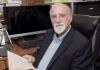
Name: Mark Formica
Position: Chairman of Citizens Bank of Rhode Island.
Backround: Joined Citizens in November 1992 as President of Citizens Bank Rhode Island. He was named vice chairman in January 1997 and chairman in February 1998. Before joining Citizens he was an executive vice president of the $9.7 billion Dominion Bancshares Corp. of Roanoke, Va., and before joining Dominion in 1991, he had spent 22 years with Connecticut Bank & Trust Co. and the Bank of New England.
Education: A 1970 graduate of Trinity College in Hartford with a degree in economics.
Age: 50
Family: Married to Linda Brunini and has two grown daughters.
Residence: Warren
PBN: If you traced the original mission of Citizens Bank when it was founded in 1828 to today, what are the changes?
FORMICA: There’s a lot that’s the same and there’s a huge amount that’s changed. Let me just start with the portions that haven’t changed: a real focus on the community and being in touch and local. If you go back a hundred years or go back as recently as when Bill Heisler was running the company or when George Graboys was running the company or Larry (Fish), there was an enormous emphasis on community activities and remaining local. Even as we’ve grown that local orientation and that community orientation is the constant. Our whole strategy in growing – I came to the company in 1992; it was slightly over $4 billion in assets, and today it is $18 plus billion in assets. We were in one state, Rhode Island, and now we’re in four states. But we’ve adopted a super community strategy, which said, we will be all the things that a big bank can be in terms of products and services and location, but we’ll retain the local community orientation, because all of our research indicates that’s what the consumer wants.
Building a Strong Data Foundation in the Age of AI
Artificial intelligence (AI) has become a key priority in the boardroom and across management —…
Learn More
When did Royal Bank of Scotland buy Citizens?
Royal purchased Citizens in 1988. We just had the 10 year anniversary of the Royal purchase.
One of the things that has always been difficult for me to comprehend – is that Citizens maintains it’s a local community bank and yet is owned by the Bank of Scotland. How does Citizens become the community bank when it is actually owned by an international company?
I think you have to look at your actions as opposed to your ownership. If you look at Citizens activities in the communities before 1988 and after 1988 there really hasn’t been any lessened emphasis on community activities and being a good citizen. You can look back, and I think George Graboys was very farsighted when he decided if he had to have a partner it would be better to have a foreign partner where Citizens could remain intact, rather than have a domestic partner where Citizens would be absorbed. I think that was a very smart move. That enabled Citizens from ’88 to this day to remain relatively independent in the U.S. and have its own mandate to stay that super community bank that we’ve always been.
We’ve seen Hospital Trust bought by BankBoston, Fleet move its headquarters to Boston. That leaves Citizens – if you discount Bank of Scotland – as the only major bank with headquarters in Rhode Island. Is that going to stay that way?
Absolutely. We love Rhode Island. We’re very loyal to our roots. If you look at the center of gravity at Citizens, we’re in four states and 5,500 employees. But 3,000 of those employees are in Rhode Island. Even as the bank has grown – you go back as recently as 1991, the bank had about 1,000 employees total, and all of those employees were in Rhode Island. Today we have 5,500 employees, but 3,000 of them are in Rhode Island. All of the infrastructure and support for the four states is hereWe’re very, very committed and have no intention of leaving this state.
Bank mergers seemed to have slowed, although you hear of mergers occasionally now. Would Citizens be a merger target?
You can never say never. But the ownership that the Royal Bank of Scotland has of Citizens, insulates Citizens to a large degree from takeover. If we were a publicly traded company any large bank could lob in a bid that would have to be considered by the shareholders. We’re a wholly owned subsidiary of the Royal. The Royal would have to have very good reason to consider such a proposal. They’re very happy – we’re the fastest growing area of their income statement. We’re now 25 percent of the Royal’s income. We’re a very stable source of income to the Royal, and they’re very comfortable having the diversification outside of the UK, where they can have a well diversified portfolio of holdings of which Citizens is one of the crown jewels.
Looking at Citizens’ future what do you envision?
We like the size that we are and when I say that, (I mean) being $18 to $25 billion in size. I think you’re going to continue to see fill-in acquisitions where appropriate, but about two years ago we changed our focus – from ’92 to ’96, ’97, the focus clearly at Citizens was acquisition. We did 14 different transactions during that period of time. The Old Stone Bank here in Rhode Island was one of those transactions. We were trying to get to a size where we had the critical mass to make investments in technology and systems.
Since ’96 we’ve had a huge focus on growing our business organically in the markets that we are already located by developing a series of initiatives. In 1996 we implemented an initiative called mission ’99. Mission ’99 was designed to grow market share in the franchise and we did. We installed a whole new product line. At that time it was the Circle Account, which is a package of services that gives the customers free checks and free ATM transactions if they combine a minimum of $5,000 in their total banking relationship. We put incentive compensation in our branch network to reward our people who did well in sales and service. That was a very successful initiative and it was followed recently by an announcement that we made called the Millennium Project. We are putting stand-up banking counters called financial marketplaces inside of our branch locations. The folks that were formerly sitting on the platform are now out front serving customers as they walk through the door. We’ve trained over 1,000 people in a very big investment called needs based selling. Essentially, in simple English, we train our people to ask the appropriate questions to determine what the needs are that the customer has around their financial aspirations and then make recommendations that would be appropriate for those needs. We find that the more we learn about a customer the more our products can be more appropriately recommended. We’ve seen an increase in the number of services that we sell as a result of the probing and the diagnostic benefit we get from needs-based selling.
We’ve opened branches on Saturday. We’re the only bank in Rhode Island that is open from 9 to 3 in virtually all of our locations on Saturday. That’s when customers want to do business. We’re installing another 100 automated teller machine locations in various non-bank locations like DB Mart for example here in Rhode Island. Very shortly – in the month of April – we’re introducing our Internet home banking product, where you will be able to do your bill paying and banking transactions on the Web.
We’re making a number of investments in the existing business, not just relying on acquisitions to grow, but looking towards service and sales excellence as a means of growing organically.
Many people in the industry suggest that the branches will be obsolete in the not-too-distant future. How long do you foresee a need for tellers and the traditional branch bank?
The answer is as long as our customers want it that way. I have been in banking since 1970. In 1970 the futurists in banking were talking about the checkless society, and that the check was going to become a thing of the past within the decade of the 70’s. In fact in 1999 we’re writing twice as many checks nationwide in the U.S. as we did in 1970. Change doesn’t happen necessarily because bankers want it to; it happens because consumers want change to happen. In the case of most banks, if you look at their overall customer base, about a third of banking customers use a branch, and about a third of banking customers use electronics exclusively. The other third use both. And so there’s a long evolution happening here. We still process, in the Rhode Island bank, over 20 million teller transactions a year. That may go down over the next decade, but it’s not going to go away. We think the branch will be here for awhile.
Does Citizens have true interstate banking?
No. We are right now four separate banks and each of the banks only accept deposit transactions on themselves. We make accommodations, where in the summer time for example on the Cape, where we have the Massachusetts bank, the Cape branches cash checks for Rhode Island, Connecticut and New Hampshire customers. We’re looking towards about this time next where we would have the systems capacity to accept deposits and withdrawals across state lines. But it is something we definitely want to do.
We’ve seen banks take on other products beyond those of traditional banking, such as insurance and financial services. How involved is Citizens in these areas?
Citizens is very involved. We have a subsidiary called Citizens Financial Services, Inc. That subsidiary is a broker-dealer and it sells mutual funds and annuities. In addition to that we are licensed as a certified financial planning organization so we can do financial planning for you and your family. As part of that we are an insurance agency in three of our four states today. We’re waiting for approval in Massachusetts. We believe as financial planning is the cornerstone, we’re able to determine what needs you have from an investment or an insurance perspective and then follow through with the sale of those products through a very large group of registered representatives. We have 65 financial consultants that are licensed in a series six, which is a license to sell mutual funds, in a series seven, which is a license to sell stock, in a series 63, which is a license to sell insurance. And they’re located throughout the New England region. We have 10 in Rhode Island. They cover four or five branches apiece. In the branches themselves we have 350 branch registered reps that have a six and 63 license, so they can sell mutual funds and insurance, and they are in each of our locations across the region. These people are trained, licensed and prepared to deal with the financial needs of our customers.
Let me give you some insight. In 1996, eighty percent of the IRAs that Citizens sold were deposit IRAs versus mutual fund IRAs. In 1998, eighty percent of the IRAs that Citizens sold were mutual fund IRAs and 20 percent were deposits. In three short years the consumer decided that the best vehicle for the IRA investment was not a deposit but rather an investment. We needed to have people who were in the bank, in our branches prepared to deal with that change in consumer demand. So we made an investment in Citizens Financial Services, Inc. to that part of our business. This is the fastest growing part of our business, and I believe it will be a significant portion of the company over the next five years as people turn away from deposits as the only vehicle for savings and more toward investments.