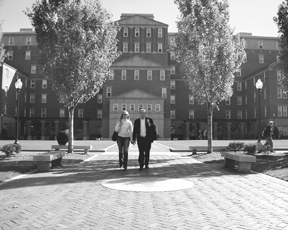
and Kevin Belmont strolling through JWU.
When Dawn Vigue graduated from law school last spring she faced a cold job market and a hotbed of competition.
Despite being new to the legal industry, the 34-year-old tax-law specialist found herself a victim of the uncertain economy and recent corporate scandals as once lucrative jobs were non-existent and former employees of “the big five” accounting firms were competing for the same positions.
So, just months after officially becoming a lawyer, she went back to school — this time for her master’s in business administration.
Your Business Has Gone Global. Has Your Insurance?
A decade ago, “doing business internationally” was mostly a large-company concern. Today, a manufacturer in…
Learn More
“I was out there with former employees of Arthur Andersen, and the other big firms,” the Charlestown resident said of her experience in the regional job market. “Finally in June I decided to go back and get my MBA. I think it will help to set me apart in my field.”
Last year more than 100,000 MBA degrees were given out by colleges and universities across the country. According to Edward M. Mazze, dean of the College of Business Administration at the University of Rhode Island, the growing statistic is proof that despite recent events MBA programs are alive and well, and students are using them as an effective tool in the global marketplace.
“There has been some talk that the MBA has lost its value… I disagree,” said Mazze. “It’s true that MBAs haven’t been able to save the economy, but it’s not stopping people from pursuing the degree. The number of applicants this year isn’t much different than last year, or two years ago. I think that was true across the state.”
In fact, most of the Rhode Island schools that offer MBA training have seen consistent enrollment over the last few years, with some like Salve Regina University in Newport and Johnson & Wales University in Providence actually seeing an increase.
Myra Edelstein, graduate program director of business studies at Salve Regina, attributes increased enrollment to a growing awareness of what it’s like to compete in the marketplace. With a large majority of students enrolled in all of the local programs already in employed, she said, many see the advanced degree as “an extra credential that will be a mark of higher level skills.”
Dean of the Alan Shawn Feinstein Graduate School at Johnson & Wales Joe Goldblatt said the degree, always considered “unique,” has continue to evolve to meet the needs of the modern economy.
“Today’s MBA is unique because it requires some level of specialization,” he said. “It provides students with a greater sense of job security, and puts them in a better position for advancement. It’s a degree that really allows them to move from one side of the board room table to the head.”
That’s what Susan Elliot is hoping for. Just months away from completing her MBA degree at URI, Elliot plans to return to corporate retail after graduation, saying that this time she will have more to offer.
“Getting an MBA is a requirement, not a choice in today’s business world,” she said. “It’s not a luxury. I am not sure that my MBA degree will set me apart. I think that you sell yourself and now I have more to sell.”
Thomas Falaherty, dean of graduate studies at Providence College, said many of his students are finding they can’t get past a certain level without an advanced degree.
“They talk about hitting this ceiling that they can’t get through,” he said. “And it seems like more and more students are realizing it.”
Maybe, Goldblatt said, it’s because of the economy. As the state’s unemployment levels rise, so to do the number of students enrolling in graduate school. The correlation isn’t a new phenomenon, he said, just one we haven’t seen in quite some time.
“If someone gets laid off, they sometimes opt to go back to school before getting a new job,” he said. “It provides a unique opportunity for them to learn new skills.”
Finding a market for those skills is beginning to be worrisome for students, Mazze said. As the laggard economy continues to slow, he said, nerves have begun to twinge. It’s a feeling, he doesn’t expect, that will go away any time soon.
“These students are much more economically literate,” he said. “They recognize that if we go to worry with Iraq it’s going to have an effect on what they are doing, whether they have a job now or not.”
And if students were worried that recent economic scandals would ruin their career, Mazze and others agreed, it was a fear that was short lived.
“I don’t think worried is the right word,” Edelstein said. “Frustrated, disgusted, angry, those might be better words.”