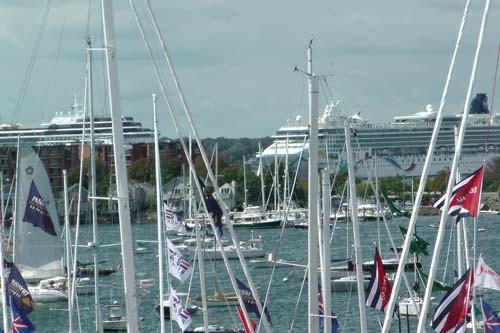
A proposal by Gov. Daniel J. McKee to increase cruise ship passenger fees in Newport has ignited a firestorm among elected officials and business leaders who worry that the administration is weakening a vital sector to prop up the financially strapped R.I. Public Transit Authority.
Detractors say they believe that some cruise lines will opt to bypass Newport for more affordable ports if state legislators OK McKee’s proposal to charge a $5 fee for each passenger on ships that dock in Newport Harbor.
That fee would be stacked onto an existing $10 fee that the city collects to pay for harbor maintenance and operations. That fee had been raised from $6 last year, with the permission of legislators.
The new proposal would bring the total cost imposed on each visitor to $15. It's estimated that a new $5 surcharge would generate about $1 million for RIPTA annually.
But at what cost?
Newport City Councilor Jeanne-Marie Napolitano has been in talks with cruise line representatives, who have made it clear that the proposed fee hikes might be the last straw, she says.
“It’s outrageous,” Napolitano said. “It’s like the state is trying to kill the golden goose.”
According to the Cruise Lines International Association, cruise passengers typically contribute significantly to port economies, each spending an average of $750 over seven days. This translates to over $100 per person at each port of call.
Cities such as Boston charge $3 per passenger, with plans to increase that to $15 by 2030. Fees vary in Portland, Maine: vessels with more than 1,000 passengers pay $18 per person, while those with fewer passengers pay $13.
Fees are not paid by passengers at the dock. Instead, cruise companies report headcounts and pay the fees. The cost is typically bundled into cruise fares.
"Cruise lines are extremely sensitive to cost, and a sharp fee increase—especially on a short timeline—puts Newport at a competitive disadvantage," said Victoria Cimino, CEO and president of Discover Newport. "The likely outcome is fewer ships, less visitor spending, and a direct hit to our local economy.”
Fearing the damage to tourism and the perception of Newport as a welcoming cruise destination, state Rep. Lauren H. Carson, D-Newport, also worries about the precedent that might be set.
“Not only did it come as a surprise,” she said. “It’s one of those slippery slopes where state government starts dipping into municipal streams of money.”
Carson, who supports RIPTA’s mission, plans to push for removing the proposal. “I’m going to be pretty vocal about this as we approach [reviewing McKee's budget proposal].”
There is also the question of implementing a fee come July 1, when the majority of cruise ships arriving this year are already booked and paid for.
The city delayed implementing its own fee hike for one year to avoid the issue that has now been forced upon them, Napolitano says.
“We wanted to give them time to prepare,” she said. “They do scheduling two years in advance, and we respected that.”
Carson agrees. “How are you going to implement this?" she asked. "Stand on the dock and say, ‘Give me five more dollars?’ ”
The city already relies heavily on cruise traffic to fund infrastructure improvements, even more so now that the additional revenue is earmarked for $20 million in projects, including improving the waterfront Perotti Park, which includes a ferry landing, and upgrading the harbormaster's facilities.
This is at a time when there is a decline in visits of cruise ships from over 50 last year to only 41 scheduled for the 2026 season.
Erin Donovan Boyle, the CEO and president of the Greater Newport Chamber of Commerce, expressed her discontent in a recent Newport This Week op-ed, saying the proposed fee is “shortsighted” and “risks undermining one of the state’s most visible and economically productive tourism assets: Newport’s waterfront.”
McKee's office did not respond to requests for comment.
But Christopher Durand, CEO of RIPTA, argues that the increased fees are essential for ensuring continued transportation services across Aquidneck Island, while acknowledging that the additional revenue would help address a deepening operational deficit.
Durand says the cost of Aquidneck Island service alone is $6 million annually, and the agency employs 60 workers and 46 vehicle operators, Durand wrote in a letter to the House Committee on Finance on Feb. 4.
For the same hearing, Newport Harbormaster Stephen Land wrote that the proposed increase would make Newport “the highest priced tender port in New England, and said cruise operators have threatened to keep the City by the Sea off their itineraries.
There are also legal implications surrounding transportation fees.
In a 2018 ruling from a federal judge in Juneau, Alaska, the court struck down the constitutionality of using passenger fees for expenditures that do not provide direct services to vessels or port facility infrastructure, citing a violation of the tonnage clause of the U.S. Constitution.
Asked whether he supports the proposal, House Speaker K. Joseph Shekarchi would only say that it “has been reviewed by the House Finance Committee, and it will be discussed further as part of the budget process. I welcome further comments from all stakeholders.”
Napolitano, who plans to testify Thursday before the Senate Finance Committee, is preparing for a fight.
“The state is playing a game here,” she said. “Every time they find a hole, they want to come to Newport. They think nobody is going to squawk. Well, people are squawking.”
Increase the bus fare, the people using the bus should be paying. Last ride I took it was only $2 bucks each way to Npt from Bristol. Even if the fee is doubled to $ 4/ ride it is still too inexpensive.