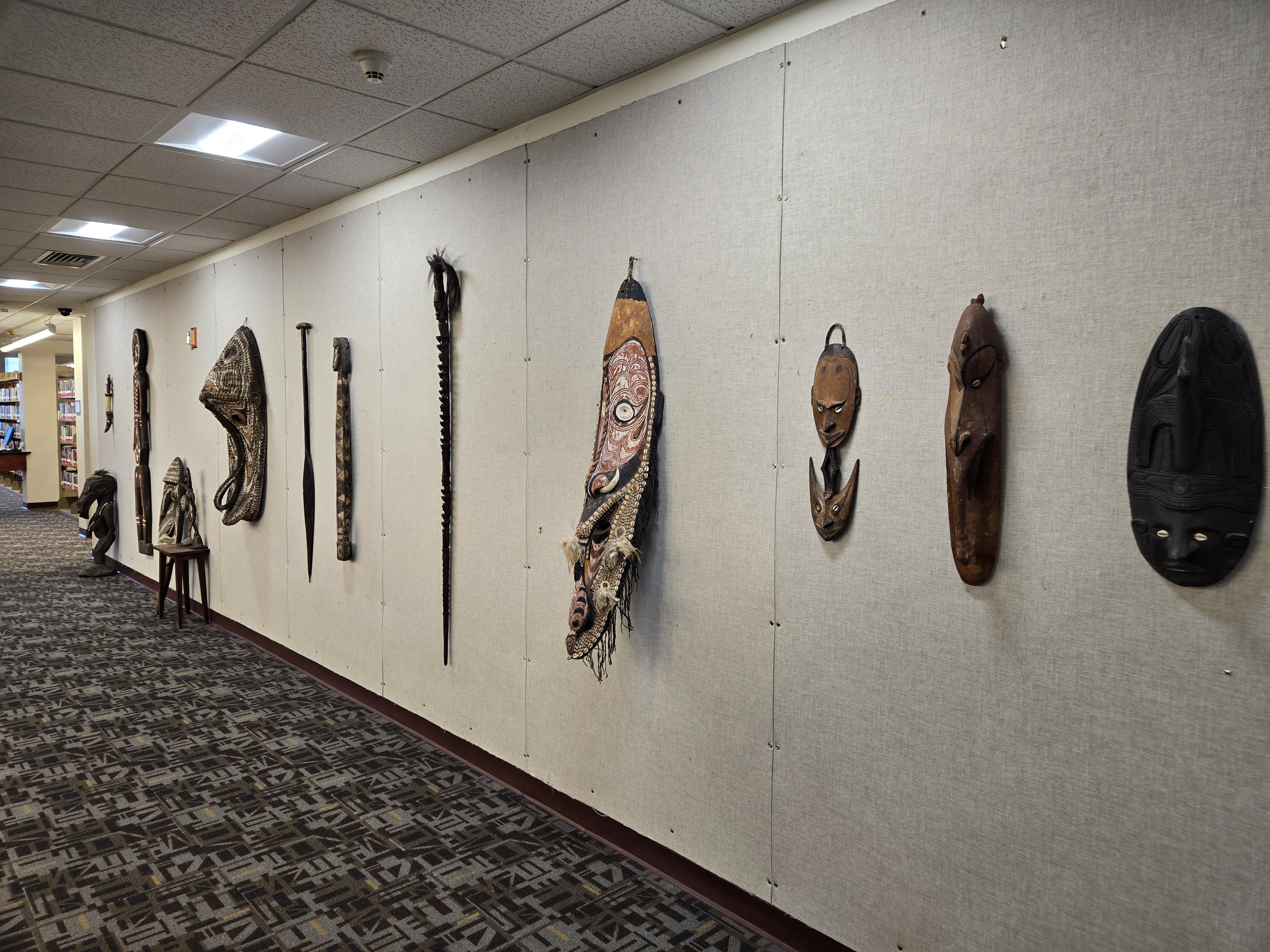
PROVIDENCE - The Museum of Fine Tribal Art, one of Rhode Island's newest nonprofit museums, boasts more than 1,000 art pieces from Asia, Africa, Oceania and the Americas.
Composed of the collection of Dr. Justin Bibee, initial assessments place the total value of about $6 million. This possibly literal treasure trove of cultural art is completely free and open to the public.
So where can art enthusiasts go to see this extensive and globe-trotting collection?
Currently, it's scattered across the country and two continents, but various pieces are on display at several Rhode Island public libraries. While Bibee continues searching for a permanent location, he aims to showcase the art where it can be seen by all.
"I prefer libraries because of public accessibility," Bibee said. "One of my rules is it must be accessible to the community, so I won't put it in a membership only institution."
Over a decade in the making
Bibee has been interested in art since his mother bought him an African mask at antique store in Cape Cod when he was 10 years old. He began his own collection in 2014 while in Morrocco as part of the Peace Corps, purchasing pieces from the artists themselves.
Upon returning to the United States, Bibee pursued his new passion through antique shops, thrift stores, Facebook marketplace and the occasional art dealer. As his collection grew, his apartment began to look more like a museum before he realized - most, if not all, of this should in fact be in a museum for others to enjoy.
"One of the goals of the Peace Corps is to continue building peace," he said. "One of those ways is sharing art to break down stereotypes."
In 2020, he officially dubbed it the Justin Bibee Collection and began reaching out to libraries for exhibit space, in part because he was running out of it at home. "During COVID, I realized I had so much art that I was tripping over it," Bibee said. "It was becoming a problem."
Some libraries don't believe him, he said. In those cases, Bibee is more than happy to back up his claims - "I just drive around in my antique jeep full of antiques."
The first exhibit was at the Warwick Public Library in 2022, followed by others including the Mt. Pleasant, Washington Park and Olneyville libraries.
"I don't think we've seen any collections that are coming from other parts of the world like this one," said Community Services Librarian Wil Gregersen. The closest example he could think of was a set of vintage postcards of Rhode Island.
The current exhibit at the Warwick Public Library is wooden masks. "We're all about the exploration of everything," Gregersen said. "I think being exposed to things firsthand makes everything so very real and much more relatable to see those masks right there in front of you."
When informed of the collection's initial estimated value, Gregersen was nonplussed. "He shouldn't be keeping that stuff in a library!" he said. Regardless, he went on to say that anytime Bibee has something new, the library is "thrilled" to have him.
Calling in experts
Bibee himself expects the collection's value to be "much lower" following an appraisal done by a professional. The initial number was arrived at after several months of cataloguing by a team of dedicated interns, who joined soon after the museum was officially registered as 501-3c nonprofit in May 2025.
"I didn't study art, I'm a human rights advocate that just fell in love with art," said Bibee, who works as the
assistant director of refugee resettlement at Dorcas International. He was recognized for his work as the diversity champion in Providence Business News Diversity, Equity and Inclusion 2024 Awards.
[caption id="attachment_513955" align="alignleft" width="169"]

DR. JUSTIN BIBEE STANDS BESIDE Japanese satsuma vase on display at the Washington Park Library. /COURTESY JUSTIN BIBEE[/caption]
As art students, the interns had the expertise to compare select works to similar pieces sold in the global art market. The resulting valuation reflects the "best case scenario," Bibee said. He noted that an official valuation will likely differ, as professional appraisals consider a wider range of factors, including provenance, condition, historical significance and current market dynamics - elements that make formal appraisal a far more rigorous and complex process.
The appraisal will have to wait until the museum can pay for it. Having officially become a nonprofit, Bibee has letters ready to go out on Feb. 1 when the grant cycle opens.
"Absolutely zero dollars in funding currently," he said. One of the main goals of 2026, in addition to finding a location, is to organize a 5K road race fundraiser.
As to what he's looking for in a location, Bibee is casting a wide net, though most likely it will be located in Providence. Display space would be ideal, but "I'll take the first place I can get," he said. As long as the art can be stored and there's space to meet with interns, it doesn't even need windows.
Ethical collecting
When not purchased from the original artist, there is a high level of uncertainty regarding where a piece came from and its circumstances.
"Sometimes you can't [trace it back to the original artist], so you name the country, tribe or culture," Bibee said. In this way the museum contributes to preserving the cultural heritage.
If a piece ends up needing to be repatriated - sent back to their country of origin - Bibee said he will happily do so. In the meantime, they are preserved.
"I used to go to thrift stores and would say 'this belongs in a museum' and felt like Indiana Jones," he said. "Taking it from the store shelf and putting it on a podium, felt like I was doing some justice."
Veer Mudambi is the special projects editor at the Providence Business News. He can be reached at mudambi@pbn.com.