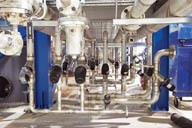
Specialized process piping has already been installed in the new facility.
Insulation production to lead to job growth
After nearly six months of construction and renovations, Aspen Aerogels is close to opening its new manufacturing plant in East Providence, and it’s starting to fill about 30 of the 70 manufacturing, engineering and managerial positions it plans to create.
A modernized health plan: Supporting cost management and the employee experience.
The Surest health plan came from a group of innovators wondering: What if health care…
Learn More
The high-tech manufacturer of a silica-based insulation used in spacesuits and oil pipelines purchased the 146,000-square-foot facility last spring in hopes of increasing production of its nanotechnology products as it enters new markets.
Based in Northborough, Mass., Aspen Aerogels chose to open a second plant in Rhode Island because the facility met specific needs, such as space requirements and high ceilings essential to its manufacturing process, said Greg Watka, plant leader.
Considering the East Providence facility had been vacant for about 12 years, it needed some major and minor improvements, Watka said. During the winter, the company focused on infrastructure improvements such as new cement footings for chemical storage tanks where raw materials will be stored.
Watka said the company also worked with the East Providence Fire Department to fireproof the building by upgrading the sprinkler system and spraying the roof and support columns with fire-resistant material. “This is going to be done in phases,” he said.
That’s why the company has started the hiring process even though the plant isn’t slated to open until the fall. Once one-third of the equipment is set up and operating, Watka said, he will need manufacturers and engineers to run it. From there they will determine what improvements could make the process more efficient.
“If we can find a better way to do it, we’ll be doing that,” he said. “Some of it is new technology.”
Watka said most of the 30 positions are “purely manufacturing,” though he is looking specifically for people with experience in the field. Workers will need to understand the concept of flow rates, for example – the flow of different chemicals used to create the aerogels.
“There’s no question that what we do is very different from other manufacturers,” he said. “We have a patented process. It’s not going to be known to anyone walking in here.”
Though there is intensive on-the-job training, candidates must also display strong computer skills because most of the manufacturing process is computerized. “They are technical jobs,” he said. “It’s not just pressing an on and off button.”
The average hourly wage is about $19.50, Watka said. The company is also hiring material handlers and manufacturing engineers to help with the initial phase.
“The second phase will look like the first phase, with whatever modifications that make the process better,” he said. “We will triple the output of what we start out with within the next 24 months.”
The R.I. Department of Labor and Training worked closely with the company to organize a job fair last week. Saul Kaplan, executive director of the R.I. Economic Development Corporation, said the state is doing “everything it can” to support Aspen Aerogels’ growth.
“We’re excited about their investment in a high-tech manufacturing facility,” he said. “It’s a great example of the innovation economy we’re trying to create.”
Kaplan said Aspen Aerogels is unique because it has taken an emerging technology – a type of nanotechnology, developing materials at the molecular or even atomic scale – and translated it into marketable products for commercial industries.
Aerogels are highly porous solids formed from a gel in which the liquid is replaced with a gas, so they’re more than 95 percent air. The basic concept was discovered in 1931, but the resulting material was brittle and unusable; Aspen Aerogels has commercialized a process that results in flexible blankets of aerogels, with many uses.
“The demand for our material is getting very, very large,” Watka said. “We’re using it for just about anything that requires insulation.”
The oil industry, for example, is starting to use aerogels to line gas and oil pipes, he said. Oil companies currently use many layers of fiberglass or mineral wool to insulate pipes.
“Our material has better insulation properties and it’s much thinner,” he said, which saves the oil companies money because they can manufacture smaller pipes and use less steel. Aspen Aerogels had to find another plant, a bigger plant, because manufacturing capability at its Northborough plant was “pretty much topped out,” Watka said.
“This is an exciting growth company,” Kaplan said. “And it’s exactly the type of growth company we want to attract.”