
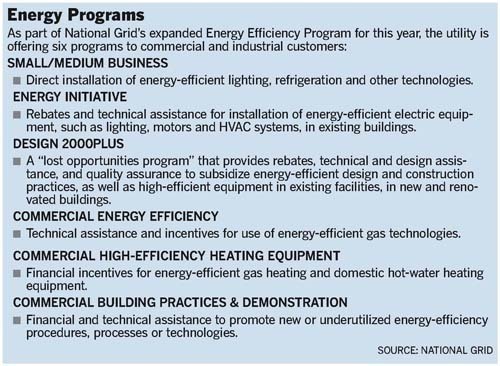
Three years after a landmark energy bill was signed into law, National Grid is rolling out an expanded set of energy-efficiency programs for commercial and residential customers that the utility says will result in energy savings of $90 million.
Although National Grid has offered energy-efficiency programs on a limited basis for more than two decades, the 2006 law made Rhode Island the first state to order utility companies to undertake any and all savings initiatives that cost less than the price of electricity or natural gas. Other states, including Massachusetts and Connecticut, have since passed similar measures.
“By investing in all efficiency cheaper than supply, this plan will create jobs, save millions, and make the state’s businesses more competitive for years to come,” said Sam Krasnow, a staff attorney for the nonprofit Environment Northeast, one of a number of advocacy groups that supported National Grid’s plan.
Under National Grid’s plan for 2009, which was approved by the R.I. Public Utilities Commission last month, the utility this year will spend about $29 million, a 57-percent increase from last year, on a variety of rebates, incentives and direct services to reduce electricity and natural gas consumption.
One local company that has taken advantage of these programs in the past is Clariant Corp., the specialty chemicals company in Coventry that produces pigments for paints, plastics, inks and other products. Clariant received more than $50,000 in rebates from National Grid for upgrading its chiller, mixer drive and HVAC system, and expects the new machines to reduce electricity costs by about $48,000 a year.
“It’s difficult for a company to approve a project that doesn’t have a two- or four-year payback, and energy projects are often really capital-intensive” said John Paul, Clariant’s environmental, safety and health-affairs manager. “National Grid grants have pushed many projects to completion as opposed to sitting on a wish list.”
The cost of the efficiency programs is estimated at about 3.6 cents per lifetime kilowatt hour, versus around 10 cents per kilowatt hour for electricity. In previous years, the state has invested just $15 million on efficiency compared with nearly $1 billion to purchase energy supply, Krasnow said.
The utility estimates that each $1 invested in efficiency will result in $3.46 in benefits on the electricity side and $1.80 in benefits for natural gas, although the cost-benefit ratio is expected to shrink over the next few years, as the programs move past the low-hanging fruit.
“The economics of it are great,” said John Farley, executive director of The Energy Council of Rhode Island, which represents large commercial and industrial energy customers in the state. “It’s a good thing.”
The efficiency programs are funded by small utility-bill surcharges; National Grid can also earn bonus payments for carrying out the programs successfully.
The 2009 program is part of a larger three-year plan to increase energy efficiency that National Grid has filed with the PUC, which is still reviewing it. The multiyear plan also includes a system-reliability component that would give the utility more power to control energy use during times of peak demand.
Karina Lutz, deputy director of People’s Power & Light, the nonprofit energy consumer group, said taking advantage of low-cost, energy-efficiency opportunities is simply common sense. “There’s no reason to ever spend money on new supply when energy efficiency is cheaper,” she said. “When energy was cheap, you could ignore it and get by. Those days are over.” •



