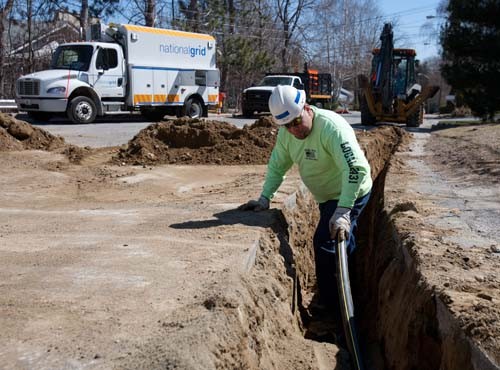
Some 5,500 miles of natural gas pipeline lie beneath Rhode Island soil. The condition of the system – parts of which date to the 1800s – worried National Grid when the utility purchased it from the New England Gas Co. in 2006.
Since then the utility has launched a multiyear effort to step up investments in repairing and replacing the pipes that carry natural gas and the systems that regulate them. In March, it received permission from the R.I. Public Utilities Commission to move forward with the latest phase, a $53.4 million project.
The Infrastructure Safety and Reliability Plan calls for National Grid to replace 45 miles of mains, more than 2,125 individual service connections and 4,400 gas meters. The company also plans upgrades at facilities that regulate gas pressure and steps to protect pipes prone to flooding. Work will occur in 18 Rhode Island communities.
“We’re going after, on an aggressive basis, the stuff we see as a problem,” said William Akley, senior vice president of distribution operations.
Under state law, National Grid must present an annual plan for reliability and safety upgrades for its infrastructure to the utilities commission. This year’s plan traces its roots to National Grid’s purchase of the Rhode Island operations of New England Gas Co., a subsidiary of the Southern Union Co.
At the time, National Grid engineers assessed the condition of the state’s gas distribution network and expressed concern.
About 47 percent – or 1,400 miles – of the distribution network is cast iron or unprotected steel piping, technology that dates back more than four decades.
In testimony filed with the PUC in December, company Vice President of Engineering Standards and Policy Susan Fleck noted that the PUC in separate cases about gas rates agreed that historically, pipeline replacements lagged. And she said that the company’s pipes contained more leaks per mile than the regional average.
In an ideal world, National Grid would replace all such leak-prone pipes tomorrow, Akley said. But financial and construction realities make that all but impossible. So, following national industry standards, National Grid developed a system ranking pipe replacement based on risk.
Pipes with known leaks – or that likely contain leaks – and lie near buildings or other public places receive the highest priority after emergencies. Then come leaks that could pose a problem further down the road and must be repaired within a certain timeframe or the problem will grow. Last are pipelines with tiny leaks that show no signs of worsening.
In 2007, it replaced 10 miles of leak-prone gas mains. It replaced another 13 miles in 2008, 25 miles in 2009 and 45 miles last year. National Grid employees and contractors are doing the actual work.
The company has also benefited from the federal stimulus, which sent money to communities to rebuild and repave roads. National Grid has stepped in with repairs to pipes under the roads at the same time, cutting costs and saving time.
National Grid will pass on the bulk of the project’s cost to its roughly 244,000 natural gas customers in Rhode Island. The average homeowner will see his monthly bill rise by about $6.36 a year. The increased cost to business owners will vary widely depending on usage. The smallest commercial customers will see bills increase by about $10.15 a year while the largest will see their bills rise by $553.78 a year. •