Considering the alternative, East Greenwich Town Manager William Sequino Jr. would prefer to see New England Institute of Technology take over a stretch of land off Division Road; developers have proposed to build more than 500 homes on part of that space.
“This would be cost avoidance, with all those people – and potentially school children – that could move in,” Sequino said last week, referring to the burden such housing developments would place on the school system and local roadways.
But NEIT, which has acknowledged that it is in discussions with at least five land owners to purchase a total of 212 acres off Division Road near Interstate 95, says it’s not a sure thing.
Philip Parsons, the school’s vice president and general counsel, emphasized in an interview that no deals are in place and a move might not happen for five to 10 years.
“This is very premature,” he said. “It may or may not happen.”
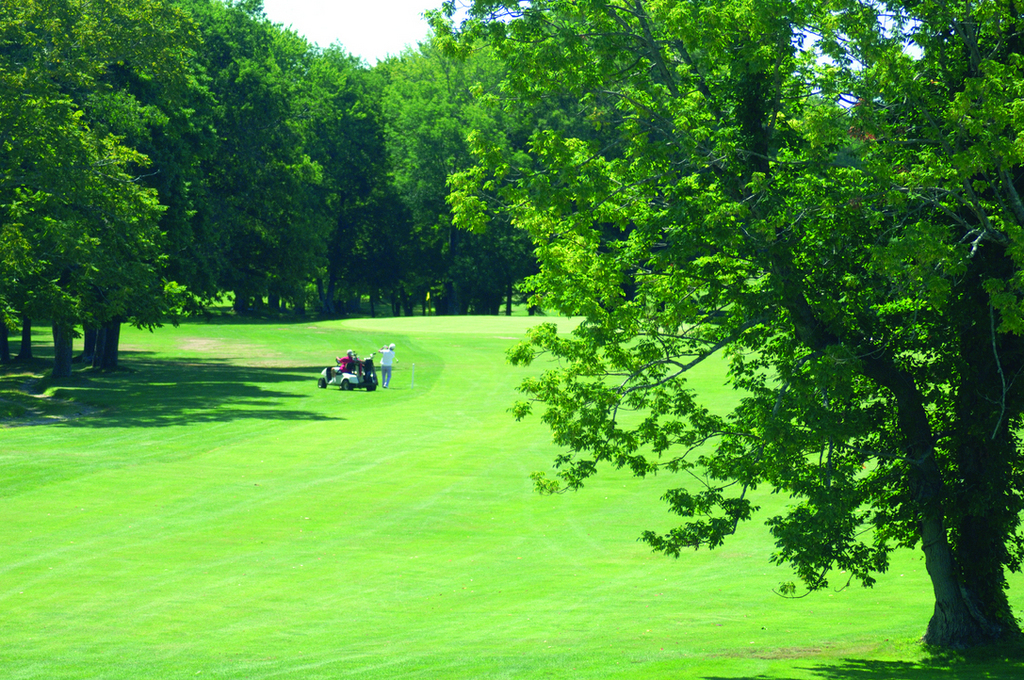
The properties involved include 73 acres of the former Rocky Hill Fairgrounds; 74 acres of the East Greenwich Golf & Country Club; and 50 acres along Division Road on which a 438-unit development called Wellington Woods had been proposed, according to Sequino.
Because all of NEIT’s students commute and most work, school officials said they liked the land’s proximity to Interstate 95 and the ease of which students could come and go.
“The location would support our commuters,” said Seth Kurn, executive vice president. “They drive to class, then after, they get back in their cars and drive to work or home.”
“It’s an ideal location for future development,” Parsons said.
Town officials have had preliminary discussions with NEIT, but the school has not outlined any detailed plans for the properties. Sequino said school officials mentioned to him that they were considering turning some of the golf course property into ball fields.
In addition to the Wellington Woods development, there had been proposals to build 80 two-bedroom condominiums, a hotel, five office buildings, two restaurants and housing for the elderly on 73 acres of the former Rocky Hill Fairgrounds.
Sequino acknowledged that if NEIT started using the property for educational purposes, it would be taken off the town’s tax rolls. But, he added, the town would be eligible for a so-called payment-in-lieu-of-taxes (PILOT) reimbursement from the state.
A NEIT campus could also ease the town’s concerns about traffic congestion along Route 2 and Division Road, particularly during rush hours. “The traffic would probably be more evenly distributed throughout the day,” Sequino said.
Even if deals are hammered out between NEIT and the land owners, however, the school would still need to obtain various approvals from the town, according to Sequino.
For example, the 50 acres that had been slated for the Wellington Woods development are residentially zoned with a one-acre minimum lot size, Sequino said. The school would be required to seek a zoning change.
Not part of the NEIT acquisition discussions is the 265,000-square-foot office building constructed last year to serve as the U.S. headquarters for Brooks Eckerd Pharmacy.
When Rite Aid acquired Brooks Eckerd in August 2006, it had no use for the $22.2 million building, which was intended to house 800 employees. It has remained empty.
A Rite Aid spokeswoman said last week that the building is for sale, but she declined to give the asking price or to say what interest it has attracted.
A spokesman for the R.I. Economic Development Corporation said the agency has fielded inquiries from five interested parties. Some have been shown the building, but the spokesman couldn’t say who those companies were.
Why isn’t NEIT interested in the building? “If you buy a building, you’ve got to be ready to move into it,” Parsons said. “We’re not.”
The potential acquisition would dwarf the school’s current land holdings: 26 acres on Post Road in Warwick, the location of the Julian B. Gouse Warwick Campus; and 33 acres on Access Road in Warwick.
It’s not unusual for NEIT to make a land purchase before a use is defined. Parsons said the school bought the Access Road property in 1994 with no plans for it.
“When the need came up, we built the automotive building,” Parsons said. That was 10 years later.
Kurn said the school has experienced “slow but steady growth” in recent years; this year’s fall enrollment should be about 3,000 students.