Cities and towns eyeing wind turbines to lower skyrocketing municipal electricity bills are joining environmental advocates to lobby for new regulations that could jump-start development of small renewable energy projects in Rhode Island.
They are focused on changing rules that govern net metering, in which municipalities and other non-utilities are paid when wind turbines, solar arrays and other renewable projects they build pump electricity back into the regional grid.
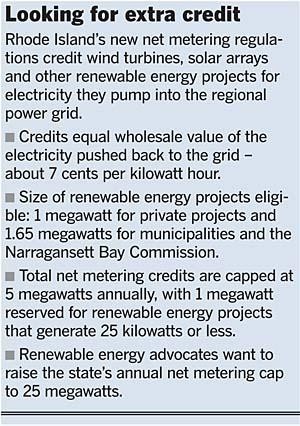
In particular, advocates are pushing to lift the current cap of 5 megawatts on the total amount of electricity that can receive net metering credits annually, an amount that totals about one-third of 1 percent of the state’s total annual electricity demand.
Raising that ceiling on net metering to a proposed 25 megawatts would essentially make the projects more profitable and thus unleash development of wind turbines and other renewable energy projects across the state, said Matt Auten, executive director of the advocacy group Environment Rhode Island.
“It’s really not any more, for the cities and towns, a question of ‘Is there an interest in doing it?’ ” he said. “It’s all about, ‘How do the economics play out?’ And net metering is one of the pretty easy tools that you can use to make projects more attractive, by giving credit to projects for pushing energy back into the grid.”
Bristol, Warren, Barrington, Jamestown, Newport and several other towns in Rhode Island are formally considering the feasibility of building wind turbines in the towns to lower municipal electricity bills.
The current net metering cap would be reached with the development of only three such projects, if they were similar in size to the 1.5 megawatt wind turbine that Portsmouth officials plan to build at a town middle school by the end of the year. (One megawatt of the current net metering cap is reserved for projects of less than 25 kilowatts).
The lack of net metering credits available to subsequent projects would act as a barrier to getting the projects financed, Auten said.
“After the first couple of projects get approved, any additional projects that cities and towns want to do would be at an economic disadvantage, compared to their neighbors, if the whole net metering cap is eaten up,” he said.
But National Grid is opposed to raising the net metering cap. In a recent filing with the R.I. Public Utilities Commission, the state’s dominant utility company said it would be forced to spread the cost of crediting renewable projects for their excess power to Rhode Island’s entire rate base. Auten disputed National Grid’s argument that raising the net metering cap to 25 megawatts would make electricity more expensive throughout the state.
State lawmakers and PUC members have been juggling the net metering issue like a hot potato. Last spring, with pressure from renewable energy advocates, the General Assembly passed a law that increased the size of renewable energy projects eligible for net metering from 25 kilowatts to 1 megawatt for private projects and 1.65 megawatts for municipalities and the Narragansett Bay Commission.
The law also raised the cap on net metering to at least 5 megawatts, but called on the PUC to determine the final net metering cap. The R.I. Division of Public Utilities subsequently endorsed a recommendation of advocates to set the cap at 25 megawatts.
On Jan. 31, the PUC issued an interim ruling that set the net metering cap at 5 megawatts, pending further study.
At the same time, the PUC ruled that renewable projects can roll net metering credits into the next calendar year, to account for seasonal impacts on generation. The decision immediately benefits the only wind turbine in the state at the Portsmouth Abbey School, which can now shift credits for electricity generated by the wind mill when the school is out of session in the summer to the winter months, when the school draws power from the grid.
In another important ruling, the PUC denied a proposal by renewable energy advocates to allow “virtual” net metering, which would enable municipalities and other electricity users to use the net metering credits generated by a renewable project to pay for power they consume at municipal facilities in other locations.
The PUC said the General Assembly had not provided the statutory support needed to establish virtual net metering in the state.
Under current rules, renewable energy projects only accrue net metering credits on the particular meter that registers electricity pushed back into the grid.
Not allowing virtual net metering discourages the development of wind turbines or solar arrays at office parks and affordable housing projects, which use separate meters to tally power consumption in each unit, said Karina Lutz, development director for the nonprofit energy consortium People’s Power & Light.
Portsmouth’s inability to transfer its net metering credits to pay for electricity it uses elsewhere will cost the town an estimated $200,000 annually once the wind turbine is built, said Gary Gump, chairman of the town’s sustainable energy subcommittee.
Portsmouth officials believe the town should be recognized as a single electricity user, even though it consumes power at many locations, Gump said. •