He’s a newspaper publisher, but last week, Paul Palange found himself playing the role of paperboy, delivering a bundle of papers to a senior center in Fall River.
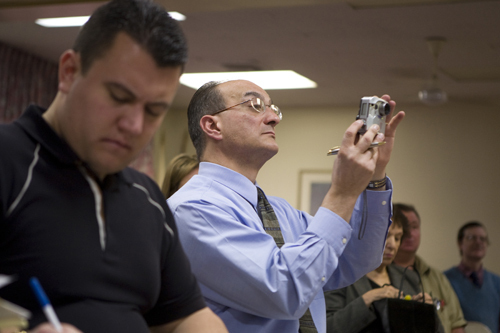
A few hours later, he switched to reporter and photographer, covering a press conference in Providence on budget cuts at Meals on Wheels.
Later still, he changed roles again, this time making several sales calls as an advertising representative.
Such is the life of the owner of the Senior Digest, a free monthly newspaper that focuses on issues and topics of interest to the over-50 crowd.
Palange, 52, of Seekonk, a former newspaper executive, has been publishing the paper for more than three years with his wife, Andria, a graphic artist. It’s pretty much a two-person show, with the Palanges reporting, editing, laying out the pages, selling ads, keeping the books, and sometimes delivering papers. (The newspaper does feature local columnists.)
“It hasn’t been easy,” Palange said. “Working for yourself is all-consuming. Sometimes, it’s brutal.”
The Digest isn’t the only local publication with a narrow focus on the older set.
Prime Time Magazine is another monthly news source, published in Warwick by Beacon Communications, which also produces several weekly newspapers, including the Warwick Beacon.
But the Senior Digest, filled with news stories, briefs and columns, is the newest media outlet attempting to capitalize on the prevailing demographics in Rhode Island and southeastern Massachusetts.
The state is home to about 190,000 people 60 or older, 18 percent of the population, according to the R.I. Department of Elderly Affairs. That percentage is the sixth highest in the nation.
It’s not exactly the age group sought by most advertisers, but Palange said last week that the paper has been a good advertising vehicle for businesses such as nursing homes, assisted-living facilities and financial advisers.
He declined to disclose the newspaper’s annual revenue.
“It’s profitable,” he allowed. “It’s just not making enough for me to retire on, not yet.”
Palange isn’t new to the newspaper industry. He started out in the late 1970s, first as a reporter, then an editor and eventually a publisher.
When he was the publisher at The Times of Pawtucket in 2004 – which was then owned by the newspaper chain Journal Register Co. – Palange started thinking about striking out on his own.
He had seen former colleagues successfully start their own newspapers with a niche focus using desktop publishing software, and had seen firsthand the advertising revenue raised by The Times’ senior-oriented supplements.
When an acquaintance with expertise in elderly affairs told him there was enough of a market for another senior newspaper, Palange’s mind was made up.
“I decided to give it a go,” said Palange. “I figured it was now or never.”
The Senior Digest came to life in March 2004, with Palange working out of an office at the New Herald Press in Pawtucket, where the newspaper was initially printed.
Producing a paper with no staff had its challenges right from the start.
The Palanges hired an outside contractor to layout the first issue, but they didn’t like the design. So both Palanges stayed up all night tearing apart pages and redesigning it, just hours before it went to press. Now Andria Palange handles the layout duties.
And the same technology that allows the Palanges to publish a paper with limited resources is also creating a problem for them: Others can do it, too.
Although he hasn’t seen much direct competition in his niche, every new newspaper or magazine offers another outlet for his advertisers.
“Every time you turn around, there’s someone starting another publication,” Palange said.
The Senior Digest prints about 20,000 copies each month, and they are delivered to senior centers, assisted living facilities, nursing homes, town halls and grocery stores throughout Rhode Island and Southeastern Massachusetts.
Palange — who started out with a business partner but eventually bought him out — is doing everything he can to create an edge over the competition, at one time even sponsoring his own radio show on Sunday mornings. The show has since gone off the air.
Nevertheless, he said the newspaper is doing well enough that he has hired a part-time sales representative and is about to hire another one soon.
And despite the difficulty of owning his own paper, he particularly enjoys one aspect of the job: “I wish I could do the reporting full-time,” he said. •