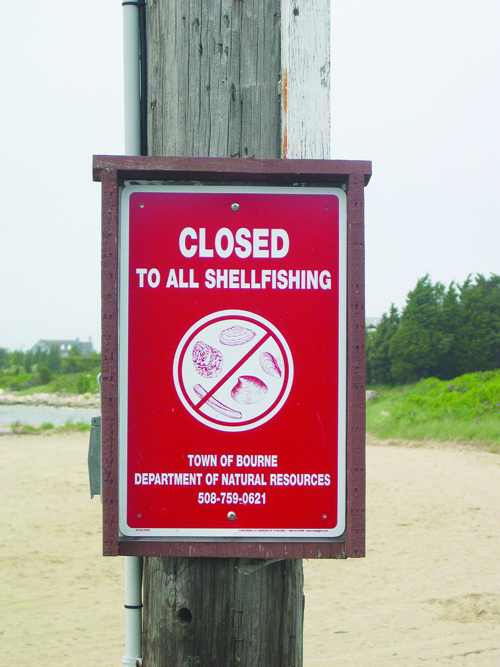
Scientists at Woods Hole Oceanographic Institution on Cape Cod predict that harmful algal blooms this year in the waters off Massachusetts and Maine could rival the 2005 bloom, which was the worst in at least 30 years and caused losses of about $18 million to the Bay State shellfish industry.
At both the Mass. Woods Hole Oceanographic Institution in Massachusetts and the R.I. Department of Environmental Management, the yearly algal bloom testing began in April. This year, those scientists have a new outlet for their results – a National Oceanic and Atmospheric Administration Web site that’s intended to keep researchers connected on a national level, said NOAA spokesman Ben Sherman.
The Web site is also intended to keep municipalities and businesses that are tied to the shellfish industry informed, according to NOAA. There’s good reason, too: each year harmful algae blooms cause about $50 million in losses to the national fishing industry, according to Woods Hole scientists.
Along with news and updated information about the current blooms, the NOAA Web site – www.oceanservice.noaa.gov/redtide – will also link to Woods Hole’s algae bloom Web site, which offers updates on blooms in Massachusetts, said Judy Kleindinst, spokesman for the Biology Department at Woods Hole.
Outbreaks of high-toxicity algal blooms – sometimes called “red tides,” a misnomer for New England’s blooms, which aren’t red – aren’t common in Rhode Island, said Joseph Migliore, a principal biologist for the Water Resources Division of the R.I. DEM.
Each week, starting in April, Migliore’s division collects water from around the state for testing. Water with high levels of toxic dinoflagellate – in New England, that’s a microscopic alga called Alexandrium fundysnse – signals that the toxicity might make its way into the shellfish population, which feed on those organisms, Migliore said.
So when a water sample is found to have 15 or more organisms on one microscope slide, the state requires testing of shellfish in the area. The DEM Division of Fish and Wildlife’s Marine Fisheries section collects those shellfish, which are then sent out to a team of scientists for pathology reports, said Dennis Erkan, a marine biologist with that division.
In Rhode Island, however, it is rare to reach the level of toxicity at which shellfish collections are required, he said.
“I believe [the algae are] present in Rhode Island waters virtually at all times,” he said last week, “but we haven’t had the conditions suitable to cause the problems they’ve had in Massachusetts and Maine and other areas to the north.”
Although it’s not clear exactly why some annual algal blooms are of a higher concentration than others, the salinity and temperature of the water are factors, Erkan said. “And it seems to like to bloom in the spring, after we have heavy snow-melts into fresh water sources,” Migliore said.
“If those conditions are right, and the shellfish are filter feeding based on the increase in temperature … because the toxin doesn’t wash out at a high rate, that’s why you could have a prolonged closure going on,” Erkan said.
Water with more than 1,000 toxic microscopic algae per milliliter will usually warrant a closure, Migliore said.
In a statement earlier this month, Donald Anderson, senior scientist at the Oceanography Institution’s Biology Department, warned shellfish farmers in Massachusetts that such closures are likely.
They may want to “shift the timing of their harvest or postpone plans for expansion of aquaculture beds,” Anderson said, adding that seafood restaurants “might make contingency plans for supplies of seafood during the summer.”
But in southeastern Massachusetts, such closures are rare, and they’re unheard of in Rhode Island, Migliore said.
“I’ve been working in the shellfish division for the last 20 years and while we’ve seen the organism here, we’ve never seen it in toxic levels,” he said. •