More than a year after Rhode Island’s economy began sliding into recession, the impact is being acutely felt at the state’s nonprofit organizations.
With corporations and the state government tightening their belts, leaders in the nonprofit sector say they are leaning more heavily on individual donors to make up the difference.
The Rhode Island Foundation estimates that there are roughly 6,000 nonprofit groups in the state. But foundation spokeswoman Melanie Coon said it is impossible to make a general statement about their overall health.
“If you know anything about the nonprofit sector in Rhode Island, it’s that if you’ve talked to one organization, you’ve [only] talked to one organization,” she said. “It would be dangerous to make sweeping generalizations, and also, so much does depend on the sector people are dealing with.”
The foundation – which saw the value of its own endowment decline by 26.8 percent last year – runs an educational program, the Initiative for Nonprofit Excellence, and Coon said a downturn offers an opportunity for organizations to examine their sustainability and become more creative.
Another local nonprofit, The Providence Plan, runs a program called New Roots Providence that provides development support for faith- and community-based organizations in Bristol, Kent and Providence counties. Applications for the program are up 50 percent this year, and it plans to expand to Washington and Newport counties in 2010, said Nzinga Misgana, New Roots’ director.
Like Coon, Misgana sees opportunities amid the recession’s challenges, because it forces groups to look for ways to partner and share costs. “And that’s exciting,” she said, “because even in good times, that can release more money to go to the community.”
“But of course,” she added, “we can never, ever, ever come up with enough money to replace the millions of dollars that are being lost to us.”
Social service organizations are being especially challenged, as demand grows on the state’s social safety net at the same time that donations are becoming more scarce.
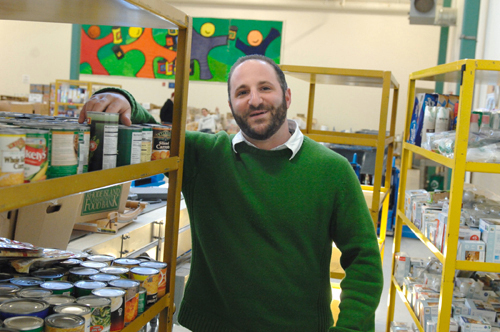
The Rhode Island Community Food Bank, which distributes food to 285 pantries in nearly every community in the state and offers related programs, served 24 percent more people in December and January than it did a year earlier, spokesman Michael Cerio said.
The increase poses a management challenge, but the food bank can draw on 25 years of experience to deal with it, he said: “We’ve become very confident in our ability to forecast at least inventory, and how to spread out purchasing dollars to make sure we have a continuous stream.”
In December, the food bank was grateful to receive a $166,000 emergency grant from The Rhode Island Foundation – but it followed a $192,000 cut in state aid, and the food it paid for is already gone, Cerio said. In-kind donations from the local food industry are down, too, as companies streamline due to the economy.
Officials at the food bank are also concerned about meeting the needs that arise next summer, when demand increases because school breakfast and lunch programs are closed. But Cerio said he is confident individual donations can make up the difference.
“All in all, Rhode Islanders are generous – when they see a need, they do everything they can to help,” he said. “We just ask that people keep others in mind.”
The Roman Catholic Diocese of Fall River is dealing with more demand, particularly from adults with young children, at its own food pantry in New Bedford. “The numbers from the latter part of 2008 were incredible,” said diocesan spokesman John Kearns.
The diocese is preparing for the launch next month of its annual Catholic Charities appeal, which is the main source of funding for its Catholic Social Services offices and programs. Kearns said it is too early to tell what impact the recession would have on the drive, but he hopes parishioners will “remember that there are folks whose situations perhaps are worse than ours.”
“It always requires a lot of sacrifice, and maybe this year a bit more … but we have to take into account that others are faring much worse,” he said.
A similar scenario is playing out at Crossroads Rhode Island, the state’s largest homeless shelter. The new 41-bed women’s shelter that Crossroads opened last April, along with an overflow room that can accommodate 15 more women, is over capacity every night, according to Karen Santilli, the organization’s vice president of marketing and development. More families are seeking shelter, as well.
The at-risk population served by Crossroads was “living close to the edge before,” she said, “and now, with the cutbacks and job loss, the housing market – it has really impacted the people coming to us.”
Last year, Crossroads saw the amount of money it gets from the state cut by half, and the organization is bracing for further cuts this year. But thanks to corporate and individual contributions “we had a good year in 2008, despite how difficult it was,” Santilli said. “We have amazing donors.” That has continued thus far in 2009, with a January campaign raising $30,000 from 600 frequent supporters.
Santilli said it is difficult to cut expenses because Crossroads is already an “incredibly lean” organization. Still, she hopes the shelter will continue to stay open around-the-clock. “I don’t want to make a statement that [reduced hours] would happen, because it could send panic into the community,” she said. “We don’t want to have to close our doors, and we hope we don’t have to do that.”
Other types of organizations are also feeling the pinch. The Providence Youth Student Movement (PrYSM), an eight-year-old organization that offers GED classes, leadership development and other outreach programs for young Southeast Asian-Americans in the city, has quickly won admirers around the state. But it, too, is being forced to cut back.
“Even from foundations who’ve been supporting us, we’ve received letters, some stating they are suspending grant-making for a year, others saying they’re suspending it indefinitely, others just saying they’re continuing [to make grants] but reducing them by 20 percent to 30 percent,” said PrYSM executive director Kohei Ishihara.
PrYSM recently moved into a larger space on Elmwood Avenue, but had to seek in-kind donations in order to furnish it. The group’s four staff members have had their salaries cut by 10 percent, and Ishihara’s was cut even more, from $37,000 to $30,000.
Ishihara said it was important to him to take a larger hit not only as a sign of solidarity, but because “it was also me who convinced these people to do something that really changed their lives. They could be going into other professions, they could be pursuing graduate studies, they could be making more money, and they have instead committed themselves to [PrYSM].”
The good news, Ishihara added, is that donations from individuals have not fallen, and in order to stave off more cutbacks, PrYSM plans to step up its fundraising this year. “Instead of gambling with foundations and the stock market, we’re gambling on our supporters and people in Providence,” he said. “I think that’s a safer gamble, but it requires a lot more work.”
Artistic organizations are not immune, either. An October survey of 31 arts groups by the R.I. State Council on the Arts found that 72 percent had seen their donations drop and 58 percent were selling fewer tickets. The impact has been even more severe at small institutions with budgets of less than $1 million, of which 89 percent reported a decline in contributions. As a result, 57 percent of the groups said they planned to cut programs this year. •