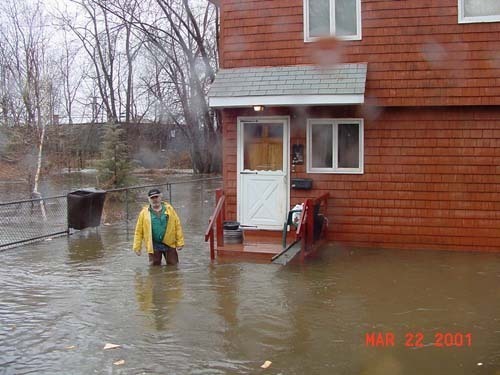
Working with money earmarked by U.S. Sen. Jack Reed (D-RI), a federal agency recently completed a study aimed at stopping flooding of the Pocasset River in Johnston and Cranston.
The Pocasset River Floodplain Management Study was conducted to determine the causes of increased flooding of the Pocasset in recent decades and forecast the level of flooding that could occur in the event of a major hurricane, said Frank Vogel, the assistant state conservation engineer for the U.S. Natural Resources Conservation Service (NRCS), the conservation arm of U.S. Department of Agriculture.
Sedimentation and erosion, along with increased development along the Pocasset River, have resulted in persistent flooding of the 13,200-acre watershed. Seventy percent of the watershed is in Johnston, 29 percent is in Cranston, and 1 percent of the watershed is in Providence, according to NRCS.
Through the years, flooding along the Pocasset River has damaged homes, businesses, roads and bridges, costing hundreds of thousands of dollars. The flooding also poses environmental and health hazards associated with chemical spills and sewage backup from flood waters rapidly entering homes and businesses.
“It’s been ongoing for, oh gee – 20, 30 years, easy,” Vogel said. “And of course with the increase of urban development, that makes the problem worse, because the more building and construction that goes on the more runoff you get. Therefore that increases peak flows in the Pocasset, which results in more flooding.”
NRCS conducted the floodplain management study with help from a consultant and in partnership with officials in Johnston and Cranston. It will now be used to form the basis of a comprehensive watershed management plan for the Pocasset River that NRCS expects to complete by the end of the year, Vogel said.
The plan is being carried out by Johnston and Cranston officials, the R.I. Department of Environmental Management, the Northern Rhode Island Conservation District, and the R.I. Emergency Management Agency.
Recommendations the plan will make include elevating or flood-proofing certain properties, installing dikes and storm basins to control flooding, developing early flood warning systems and restoring watershed wetlands.
But in six critical areas where flooding is most frequent and severe, floodwalls seem like the only solution, Vogel said. Such floodwalls – steel sheet pilings that are sometimes covered with concrete – would be put up along portions of Willow Brook, Reservoir Avenue, Dire Avenue, Fletcher Avenue, Park Place Apartments and Rotary Drive.
If all of NRCS’s recommendations are implemented in the final watershed management plan, the total price tag would be about $30 million, Vogel said. Federal money would be pursued to fund some of the work, but Johnston and Cranston would be responsible for contributing as well.
Improved flood control resulting from the watershed management plan would prevent damage to homes and businesses, save homeowners and businesses money, bolster the local economy, protect the environment, and eliminate health risks caused by flooding, said Sen. Reed in an April 15 press release that announced the completion of the floodplain study.
“This study, along with a nearly completed watershed plan, will determine the extent and severity of the flooding; develop new floodplain maps for the Pocasset River; and begin to offer solutions to help mitigate and prevent flooding,” Reed said.
Reed, a member of the appropriations subcommittee that oversees federal funding for watershed programs, secured more than $500,000 in federal funding in recent years for the NRCS to carry out the floodplain study and to complete the watershed plan.
“On behalf of NRCS, I would like to thank Sen. Reed for his help in making the watershed plan and study possible,” said Roylene Rides at the Door, the NRCS’s state conservationist in Rhode Island, in a press release. •