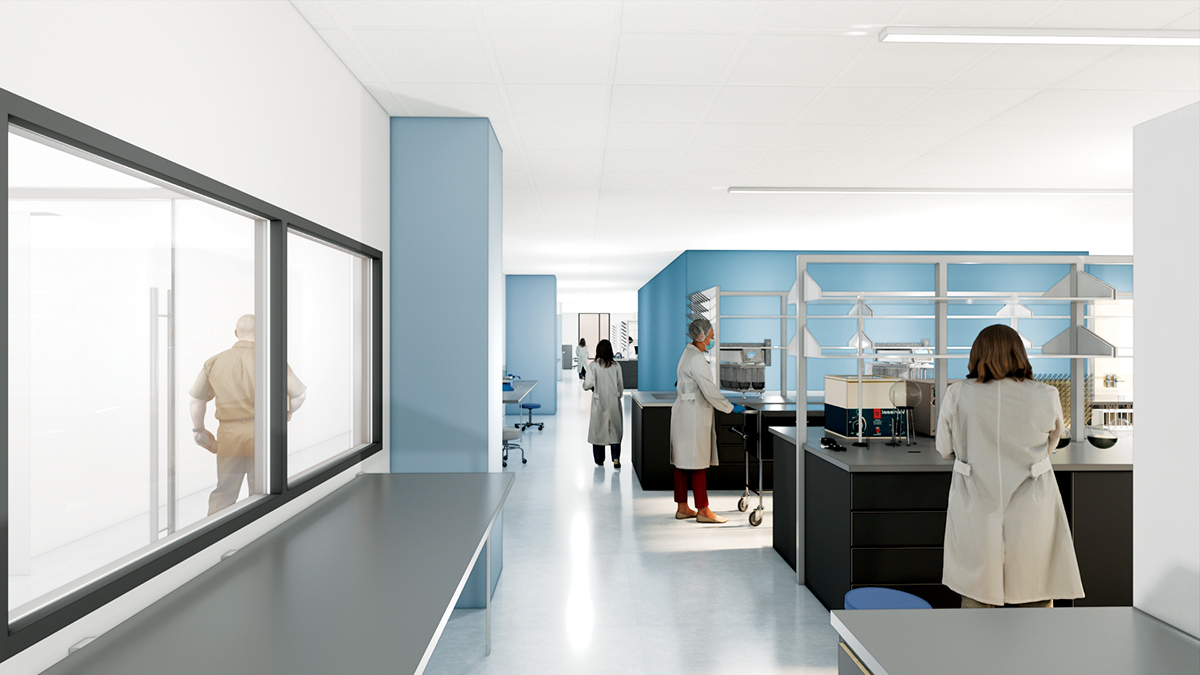
As Rhode Island’s life sciences industry continues to take shape, John Flavin wants the state’s first incubator wet lab space to feel different from traditional research workrooms.
Older lab spaces tend to be dark, with researchers from different teams isolated from each other. But Flavin wants anyone stepping off the elevator and into Ocean State Labs, located on the fourth floor of a new building at 150 Richmond St. in Providence, to feel welcome among the buzz of researchers assessing samples, performing experiments and discussing their life sciences findings with each other.
That’s why Flavin, CEO of Portal Innovations LLC, the Massachusetts firm in charge of managing Ocean State Labs, wanted an open layout, with a lot of windows – both to the outside and into different rooms so researchers can see what others are working on.
“We call it science on display. We like people to walk through the space and see stuff going on and connect to it,” Flavin said, adding that this sense of openness is particularly important in cities where the life sciences industry is just getting started. “Breaking down those barriers is an important factor.”
The layout of the 30,000-square-foot lab space, which is still under construction, also includes what Flavin calls a “town hall,” a spacious gathering area for researchers to get coffee and socialize with fellow lab workers. There are also video screens for pitch presentations.
“There’s a lot of dots that are going to get connected on a regular basis with a regular cadence,” Flavin said. “It’s more than a lab in the sense that you’re creating a watering hole.”
Ocean State Labs is just one part of the new seven-story, 208,000-square-foot life sciences building dubbed PVD Labs, located in the I-195 Redevelopment District. The property will be anchored by 80,000 square feet of the R.I. Department of Health’s new labs.
Plans call for Ocean State Labs to host about 20 to 30 companies, offering individual bench space, private lab suites, areas for shared equipment, as well as offices to host meetings. About 60% to 80% of space is expected to be filled within a year of Ocean State Labs’ official opening in January, according to Dr. Mark Turco, CEO of the R.I. Life Science Hub, a quasi-public agency created in 2023 to build the sector in Rhode Island.
The lab, one of the hub’s efforts to boost the state’s emerging life sciences industry, represents a partnership among leaders in government, academics and the life sciences industry and offers crucial infrastructure to make the state a national leader in the sector, Turco says.
“It will be a rigid regional landmark in life science innovation and strengthen the vibrant transformation taking place here in Rhode Island’s innovation district in Providence and across the state,” Turco said during an event in September announcing Ocean State Labs’ first five tenants.
So far, the hub has allocated $9 million of its $45 million allocation from the fiscal 2023 state budget. Brown University has invested $13 million over 10 years to lease 30,000 square feet of space at 150 Richmond St., which it will sublease at no cost to the hub to house Ocean State Labs. Meanwhile, the I-195 Redevelopment District Commission has agreed to contribute up to $1 million for the buildout of the incubator lab.
Dr. Wafik El-Deiry, scientific founder and chairman of P53 Therapeutics Inc., one of the lab’s first five tenants, says one of the lab’s best features is its location adjacent to Brown and its medical school, where he is on the faculty. P53 is researching a new kind of therapy to target p53, a gene that makes a protein responsible for protecting cells from becoming cancerous.
Ocean State Labs offers an opportunity to prepare P53’s findings for commercialization while keeping access to all of the research resources available at Brown, says El-Deiry, who is director of the university’s Legorreta Cancer Center.
He says the labs are meant for early-stage companies and offer basic equipment for experiments, mostly smaller tools kept on a benchtop. Anything more involved would need to be purchased or found at Brown.
“We feel very comfortable being so close to so many facilities where everything we need can be done,” El-Deiry said.
But P53 was also drawn to the labs because of the available office space, according to co-founder and CEO Dr. Wolfgang Oster. This space allows P53’s leaders to meet with potential partners in areas such as manufacturing and marketing.
For MindImmune Therapeutics Inc., a company developing a treatment for Alzheimer’s disease, the labs offer researchers more elbow room, says Frank Menniti, the company’s chief science officer.
Right now, Menniti and MindImmune’s team are brushing shoulders with other researchers at their lab at the University of Rhode Island, where the company was founded.
Menniti isn’t certain if the company will give up its URI lab space, but the company is already starting to make connections with fellow tenants at Ocean State Labs, including P53 Therapeutics. And El-Deiry has put Menniti and MindImmune’s leaders in touch with another researcher who works down the street.
While the Boston area is a formidable hub for scientific research, Menniti says he prefers Providence because he believes it offers an equal level of academic and research institutions but is easier to navigate.
“Cambridge is not all it’s cracked up to be,” said Menniti, who attended the Massachusetts Institute of Technology. “This seems like a much better place to be able to thrive.”