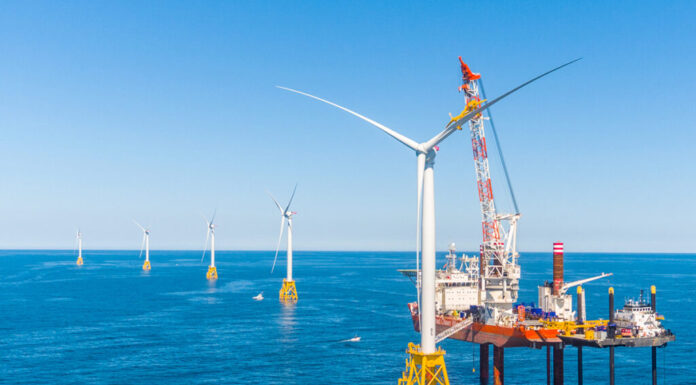
PROVIDENCE – Attorney General Peter F. Neronha, with Conn. Attorney General William Tong, filed a federal lawsuit Thursday challenging the stop-work order for Revolution Wind.
Also on Thursday, Orsted A/S, the Danish developer behind the offshore wind project, filed its own complaint in the U.S. District Court for the District of Columbia challenging the stop-work order.
Neronha’s lawsuit, filed against the U.S. Department of the Interior and the Bureau of Ocean Energy Management, argues that the federal stop-work order on Revolution Wind is unlawful. It specifically claims the decision violates the Administrative Procedure Act and the Outer Continental Shelf Lands Act, citing a lack of reasoned decision-making and disregard for state interests.
Both states are asking the court to overturn the order and prevent the federal government from halting the project.
“You don’t just take agency action by saying ‘this ends now,’ that’s not how government works,” Neronha said. That’s inviting surrender, and I’m not wired to surrender. Injunctive relief is the only way to bring this project back on-line.”
The Revolution Wind project, located in federal waters 17 miles off the Rhode Island coast, received the stop-work order from the U.S. Department of the Interior's Bureau of Ocean Energy Management on Aug. 22.
After weeks of silence Orsted hinted at pursuing legal action
on Wednesday. On Thursday, it officially announced it had started those proceedings by filing the complaint, which will be followed by a request for a preliminary injunction, the offshore wind developer said.
"BOEM lacked legal authority for the stop-work order and that the stop-work order’s stated basis violated applicable law," Orsted said in a statement. "The project is facing substantial harm from continuation of the stop-work order, and as a result, litigation is a necessary step."
Orsted did not give a timeline as to when it expects to request a preliminary injunction.
However, courts often schedule preliminary injunction hearings weeks or even months after filing, depending on the jurisdiction, case complexity, and the court’s workload, according to the American Bar Association.
Meanwhile, Neronha said he hopes the state’s lawsuit will receive injunctive relief from the court “in a matter of days, weeks at most, but hopefully not a matter of months.”
Thursday's announcement noted that Revolution Wind obtained all necessary federal and state permits in 2023, capping a rigorous review process that spanned more than nine years.
The project had been cleared with approvals from key federal agencies, including the Department of Defense, Coast Guard, Army Corps of Engineers and National Marine Fisheries Service, Orsted said.
The company added that Revolution Wind has already invested and committed billions of dollars in reliance on those approvals.
Revolution Wind is now 80% complete and was on track to deliver 704 megawatts of clean energy to over 350,000 homes in Connecticut and Rhode Island by 2026. ISO New England, the entity responsible for operating the electric grid in the region, has warned that delaying the project would increase risks to reliability.
The project has installed all offshore foundations, nearly 70% of turbines, and is nearing completion of both export cable and substation work. Revolution Wind supports more than 2,000 U.S. jobs, including more than 1,000 union workers who have logged 2 million hours.
The project is a major part of Orsted’s broader investment in American energy, infrastructure, and a supply chain that spans 40 states, the company said.
(UPDATE: Details and comment from Neronha's lawsuit added through out.)
Matthew McNulty is a PBN staff writer. He can be reached at McNulty@PBN.com or on X at @MattMcNultyNYC.