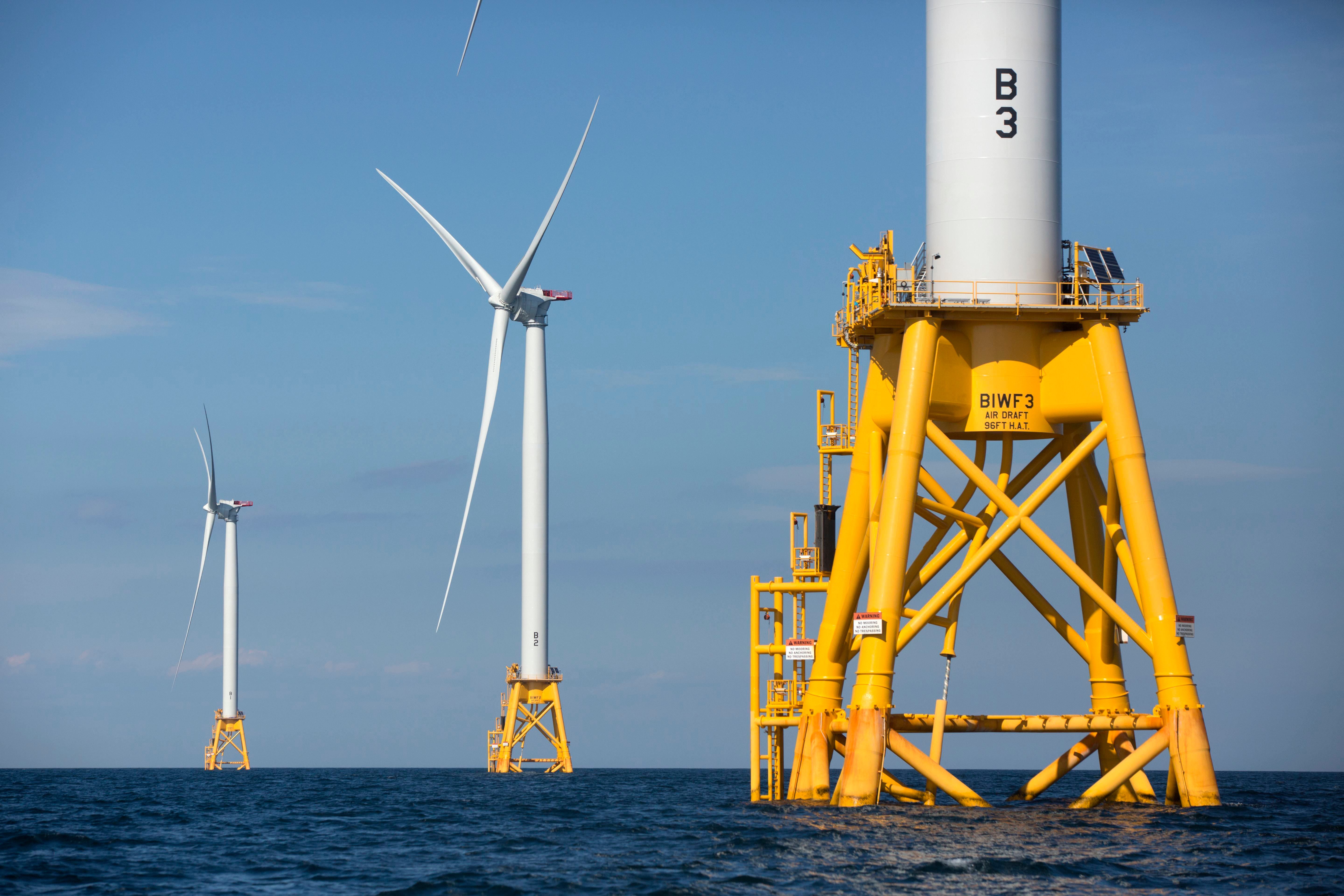
With skyscraper-sized turbines already spinning off Rhode Island’s coastline, Revolution Wind remains on track for completion in the second half of the year, co-developer Orsted A/S confirmed during its first-quarter earnings report Wednesday.
But the Danish renewable energy giant has shifted its focus to Europe and Asia amid continued efforts by the Trump administration to block renewable energy growth in the U.S.
Rhode Island's Market Has Changed. Developers, Builders, Investors and Sellers Must Change With It.
By Emilio DiSpirito IV License Partner | Engel & Völkers Oceanside Leader | The DiSpirito…
Learn More
“We are, of course, dependent on the market,” Trond Westlie, Orsted’s chief financial officer, said during an hourlong call with investors Wednesday morning. “Political uncertainty in the U.S. still prevails.”
Including uncertainty over federal incentives. Orsted still expects its U.S. projects, including the 704-megawatt Revolution Wind, to qualify for the 10% bonus tax credits authorized under the 2022 Inflation Reduction Act for renewable energy projects using certain percentages of domestic products. But the new presidential administration’s efforts to dismantle Biden-era tax and energy incentives, simultaneously pausing new permits and paying off developers to abandon their projects, could mean bigger than expected losses for Revolution Wind, company executives acknowledged on Wednesday.
The $5 billion project is already 94% complete, with 60 of 65 turbines installed. Preliminary power tests to the regional electric grid began in early March, with the full 704-megawatt nameplate capacity expected to hit Rhode Island and Connecticut by the end of the year, providing enough wind energy to power 350,000 homes across both states. Potential writedowns in the project value won’t affect the cost to Rhode Island ratepayers, which are set under a 20-year agreement inked in 2019 with then-utility provider National Grid.
But potential impairments further diminish Orsted’s interest in expanding its U.S. portfolio, despite the increasing demand and opportunities for renewable energy presented by the Iran War.
“As the world enters our second global energy crisis in five years, it is clear that the dependence on imported fossil fuels comes at unexpectedly high prices for society,” Rasmus Errboe, Orsted CEO, said during the investor call. “Even if hostility is rapidly brought to halt, we can expect global energy supply and energy markets to take a long time to normalize.”
Gas prices jumped to about $4.53 a gallon on average nationally Wednesday morning, ahead of new reports by Axios suggesting the U.S. and Iran might be reaching a deal to end the war.
Longstanding infrastructure constraints that constrict the supply of natural gas to New England have long left the region especially vulnerable to market fluctuations in energy prices, prompting local leaders to embrace renewable energy as a more predictable, and affordable, alternative.
Connecticut’s Department of Energy and Environmental Protection projects that New England ratepayers will save $500 million a year on wholesale energy costs from Revolution Wind.
But the state’s green and blue economies were abruptly thrust into jeopardy under President Donald Trump’s second term. Twice in 2025, in August and December, federal regulators ordered work to stop on Revolution Wind, citing national security concerns. Both stop work orders were overturned by a D.C. federal judge in response to lawsuits by Orsted, and the attorneys general for Rhode Island and Connecticut.
The anti-wind blowback has already had permanent effects on Orsted’s balance sheet. The company reported project impairments of $76.9 million and $10 million in the third and fourth quarters of 2025, respectively, tied largely to the federal suspension orders. A $40.9 million project impairment was reported in the first quarter of 2026, but still ended the three-month period with a $1.7 billion recoverable amount thanks to initial tax equity contributions from project investment partner Global Infrastructure Partners.
Across its portfolio, the company reported a first quarter profit of $342.7 million, 46% less than the first three months of 2025.
However, the $1.5 billion profit before interest, tax, depreciation and amortization exceeded prior forecasts, driven by higher than average wind speeds and more projects beginning to generate power. The average first quarter wind speeds were 11.4 meters-per-second, compared with 10.4 meters-per-second one year ago.
Orsted maintained its existing expectations to finish the year with $4.4 billion in earnings before interest, tax, depreciation and amortization, with gains in offshore wind compared with 2025.
Looking ahead, Denmark, South Korea, Taiwan, Australia, and Poland all have scheduled upcoming auctions for offshore wind development projects. The U.S. does not.
“As the refocusing of Ørsted continues, we’re ready to invest in value-creating opportunities in Europe and select markets in [the Asia-Pacific region], where we see encouraging and concrete progress from governments and regulators in relation to upcoming tenders,” Errboe said in a statement.
Orsted’s shares fell 3.5%, to $8.45 per share, after U.S. markets opened Wednesday.