Between rapidly shifting tariffs, freezes to federal grant funding and changing U.S. Food and Drug Administration policies, R.I. Bio Director Glenn Robertelli acknowledges that 2025 was a turbulent year for the life sciences.
But at the local level, Robertelli says, the sector has managed to ride out the storm.
“Here in Rhode Island, despite the headlines on the national side, I would sum it up in one word – momentum,” he said.
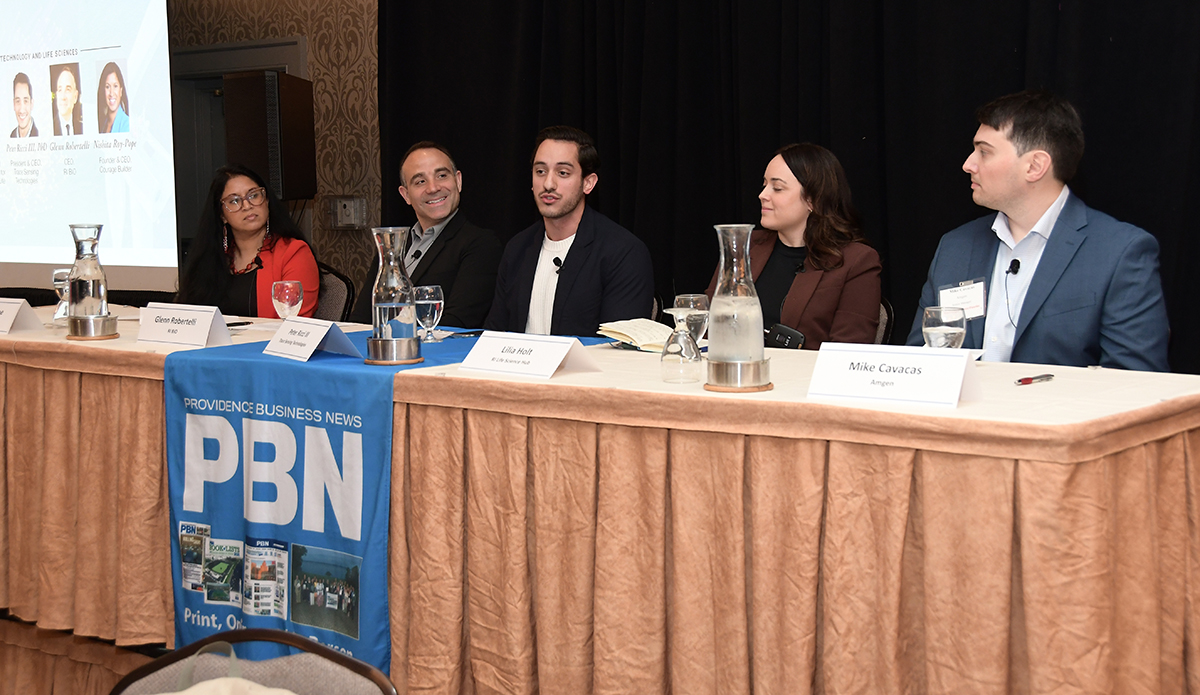
Robertelli spoke on the second of two panels at Providence Business News’ 2026 Emerging Industries Summit, held March 11 at the Providence Marriott Downtown.
Joining Robertelli on the panel were Mike Cavacas, senior manager for Amgen Rhode Island’s solution preparation operations and manufacturing capacity strategy; Lilia Holt, interim president of the R.I. Life Science Hub; Peter Ricci III, CEO and president of Trace Sensing Technologies Inc.; and Nishita Roy-Pope, founder and CEO of Courage Builder.
Among Robertelli’s reasons for optimism, he points to regenerative medicine company Organogenesis Holdings Inc., which last May signed a lease at 100 Technology Way in Smithfield with plans to invest $100 million into the planned biomanufacturing site.
Providence-based genome mapping company Nabsys Inc., meanwhile, raised $21 million in its equity funding round, led by Hitachi High-Technologies Corp.
And there’s room for more biotech companies following the February opening of Ocean State Labs, Rhode Island’s first dedicated incubator space for the life sciences. So far, Holt said, the labs have “eight foundational members.”
Ocean State Labs – established in 2023 under state legislation and managed by Chicago-based Portal Innovations – fills a needed gap as Rhode Island attempts to establish itself as a hub for the life sciences, Robertelli said.
“If you were developing something organically or spinning something out of a university, you would have to go up to the Boston ecosystem to do that work,” Robertelli said. “And it’s a great point to attract companies here [and] to retain companies that are formed here.”
But the first few years of the R.I. Life Science Hub haven’t gone without a hitch. Earlier this month, Mark Turco, the hub’s inaugural CEO and president, abruptly announced that he would resign from the role just over one year into a three-year contract.
Holt, who served as the hub’s vice president of strategic initiatives, has stepped into the interim leadership role as the hub conducts another nationwide CEO search.
Meanwhile, Holt isn’t worried that the disruption will stall progress.
“I’m very excited to keep the momentum of what the R.I. Life Science Hub has done,” she said, describing the quasi-public agency as being at a “pivotal point.”
The hub’s most recent arrival, Irish medical technology company SymPhysis Medical, announced shortly after Turco’s departure that it will establish its U.S. headquarters at Ocean State Labs.
And while other areas of the country – including nearby Boston and Cambridge, Mass. – have struggled to fill vacant lab spaces in recent years, “Rhode Island is at a place where we’ve actually been able to scale,” Holt said.
The hub has also allocated funds to more than 40 different companies and organizations for business attraction and development efforts, Holt said.
Robertelli is confident that the Ocean State Labs space will attract researchers who don’t want to make the commute to Boston.
But when it comes to Rhode Island’s relationship with the biotech giant, Robertelli says that “collaboration versus competition is the key.”
“Each area has its own strengths and weaknesses,” he said, with Rhode Island standing out in areas like neuroscience, diagnostics and biomedical manufacturing.
“Those are the strengths we should build upon,” Robertelli said, “and not compete with other states or ecosystems but collaborate with them.”
Panelists also stressed the need to foster interest in life sciences careers among students as young as kindergarteners, as well as among those whose interests or college majors may not align with the typical biotech associations.
Roy-Pope is working to forge those connections through Courage Builder, her education and workforce development startup. The company connects young people with industry experts and hands-on engagement opportunities, regardless of their academic focus.
“We’re taking students who have a stereotypical view of what life sciences might be and broadening them,” Roy-Pope said. “We have to start early, make it relatable, make it fun, meet people where they are, get people hooked and then we keep building it as they go.”
With innovation, “sometimes it starts with a 10-year-old and making sure they see the path forward,” she added.
“I think it really starts with the students,” Ricci said. “We have some of the best universities in the country here. In order for those students to be really incentivized to become first-time founders and engage with people like Glenn and Lilia, I think we need to start engaging that curiosity to grow startups,” and to keep them within the state as they scale, Ricci said.
Cavacas also noted the importance of engaging students across disciplines, advising young people to “stay adaptable and curious” when it comes to life sciences careers.
“At Amgen, we have biology, engineering, science, automation, communication,” Cavacas said. “All of those required digital skills, but then also cross-functional skills.”