WARWICK – When Rhode Island College professor Tim Henry thinks about artificial intelligence, the modern technology brings an ancient myth to mind.
Specifically, Henry, who teaches in RIC's computer science and information technology department, thinks about the Greek mythological figure Prometheus introducing fire to humanity, but at great personal cost.
“If we don’t understand what the risks and dangers [of AI] are, we’re going to burn down the forest, and we’re going to create a lot of damage,” Henry said.
But Henry doesn’t believe that caution should stand in the way of groundbreaking advances.
The solution is that educators “need to incorporate the risks of having fire” into their curricula, he said.
Henry spoke as part of a panel discussion, titled “How AI is – and Will – Reshape the Future,” on Thursday morning at Providence Business News’ Cybersecurity, AI & Tech Summit, held at the Crowne Plaza Providence-Warwick.
The panel also featured Donovan Brady, director of solutions and architecture at RapidScale, a Cox Business company; Arnell Milhouse, co-founder and CEO at yconic; and Joyce Ofili, information systems specialist and business systems analyst at Amgen. The moderator was Chris Parisi, host of the AI Wave Podcast and founder of Trailblaze Marketing.
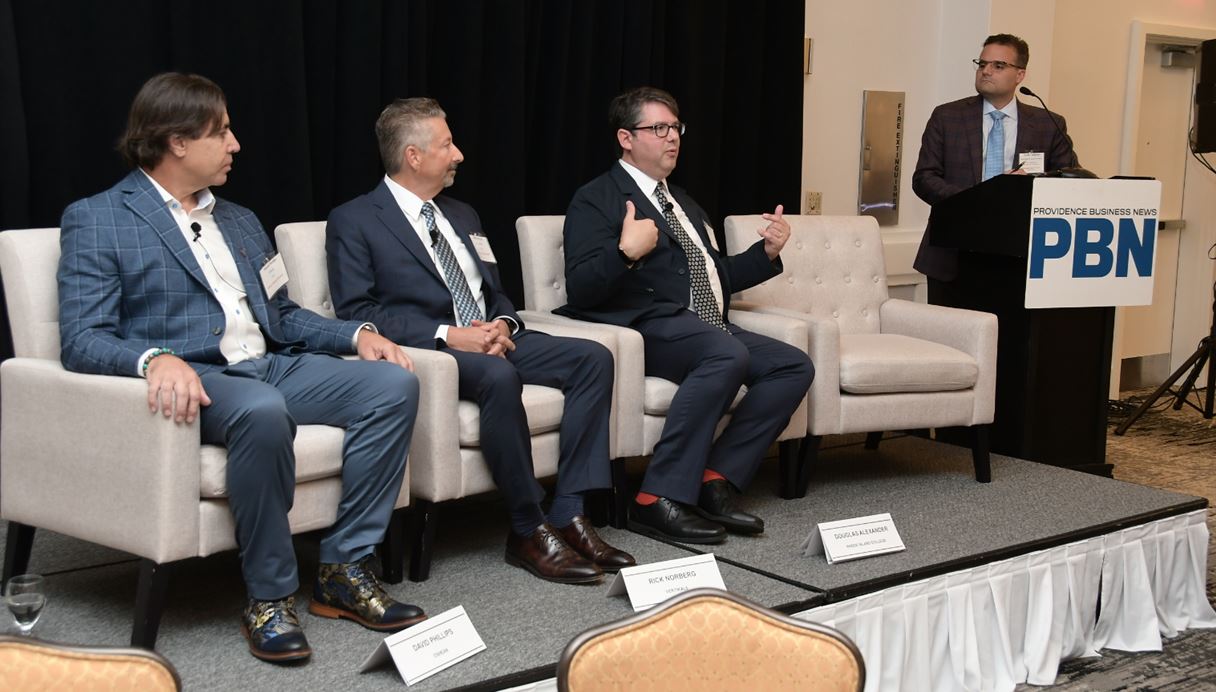
An earlier panel, “Safeguarding the Future of Innovation,” included Douglas Alexander, director of the Institute for Cybersecurity and Emerging Technologies at Rhode Island College; Rick Norberg, CEO at Vertikal6 Inc.; David Phillips, chief information security officer at OSHEAN Inc. Normand Duquette, senior vice president at Starkweather & Shepley Insurance Brokerage Inc., moderated.
Across both discussions, the topic of advances and risks associated with AI featured prominently.
To Norberg, AI “is the wild, wild west right now, filled with promise, danger and uncertainty in every direction."
As such, Norberg said, companies must exercise caution when feeding information to AI and large language models, or LLMs. While some companies may promise that their LLMs will not be used to train data models, for instance, Norberg said that at the moment, that’s not a promise businesses should trust.
Alexander agreed, cautioning, “We cannot throw out all the principles we know and have learned and have been espousing about cybersecurity when it comes to incorporating AI into our work processes.”
“We need to take a real skeptical eye,” he said. “But we also need to take these tools to understand what they’re good for.”
Parisi highlighted a dramatic increase in the number of people using AI regularly and said that the technology has hit a point where it’s “no longer a toy,” as many believed it to be in its earlier rollout. Employers must now look to using it for practical solutions in everyday life, he said.
Brady addressed fears that AI will take people’s jobs, making an analogy to agriculture: Tractors didn’t replace farmers, he said, but tractors made the work easier and more efficient when working in concert with human oversight.
“The tool is just a tool,” Brady said. “It’s not some magic wand. It’s not going to replace you. It’s not going to replace a human.”
Ofili expressed a similar sentiment and emphasized the need to help the workforce become comfortable with AI.
“AI is here to optimize processes, not actually take your job,” Ofili said. But to do that, company leaders and educators must loop employees and the future workers in on technology advances and tailor the tech to specific needs.
“At the end of the day, you don’t want to have technological solutions, and then the staff capacity is at an all-time low,” she said.
Hearkening back to the ancient world that Henry highlighted, Milhouse said that in the modern day, “we don’t have the luxury of taking time to advance” between inventions and discoveries.
“We have to take risks,” Milhouse said, “because in our journey to the moon, how many rockets did we blow up? A lot."
“No one wants to be the first one to fail,” he said, but companies can exercise caution while continuing to push forward on the latest technology.
“Create a sandbox within your company,” Milhouse said. “Create an air gap lab where you can experiment. You don’t have to test with live data. You can [use] simulated data to do that. We’re doing tons of that type of work, and it is massively important that there’s a greater sense of urgency to do this.”
(CORRECTS spelling of Arnell Milhouse, co-founder and CEO at yconic throughout.)
Jacquelyn Voghel is a PBN staff writer. You may reach her at Voghel@PBN.com.