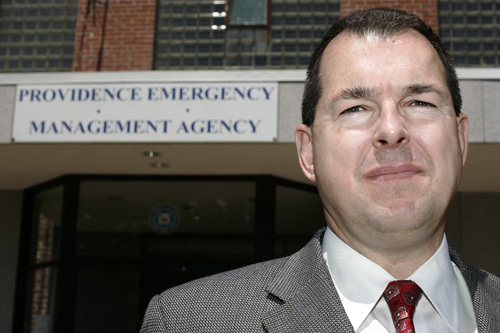
Peter Gaynor started work as director of the Providence Emergecy Management Agency on Feb. 25. He was hired following the Dec. 13 snowstorm that paralyzed the city and led to the firing of the city’s PEMA director.
Gaynor is preparing to oversee the most comprehensive hurricane-planning exercises ever conducted in Providence.
PBN: What were your most pressing priorities when you took the helm at PEMA?
GAYNOR: The three priorities were to do a hurricane exercise before the hurricane season … to re-establish those relationships within the community that are important to Emergency Management, like the Red Cross … [and] rebuilding our volunteer population.
A modernized health plan: Supporting cost management and the employee experience.
The Surest health plan came from a group of innovators wondering: What if health care…
Learn More
PBN: How important are volunteers to PEMA’s work?
GAYNOR: The pool of paid first responders is pretty slim. So in order to supplement that you really need to have a robust, dedicated cadre of volunteers, and we don’t have that – we have more now, but we didn’t have that at least to my satisfaction when we first got here. So we’re really trying to rebuild our volunteer program and make it more focused on the way we recruit volunteers. … The hardest part is once you find them and train them, you’ve got to keep them, and you’ve got to keep them enthusiastic about the thing they first volunteered for.
PBN: Lack of communication across the city and the state was blamed for many of the problems that occurred during the Dec. 13 snowstorm. How much was PEMA really responsible for that?
GAYNOR: We have done a good job notifying the fire department, the police department – I mean, that’s kind of the standard practice. What we haven’t done well is notifying all those other groups, like local businesses, major employers, maybe some state agencies that reside in the city of Providence. There are some big populations that, I don’t think intentionally, but we’ve overlooked making them part of the solution.
PBN: In the event of a hurricane or other natural disaster, what role can or should the business community play?
GAYNOR: For the most part at least early on it’s passing information, and then maybe being part of solutions. Especially if you’re a business owner, you don’t want to have the city or the state make a decision that affects your business, and if that’s the way it’s going to be I think most business owners would rather be part of the solution than being force-fed.
We’ve already made outreach to the [Greater Providence] Chamber of Commerce, and we’re trying to include all the businesses they talk to on a daily basis in this system. So we would send a message, and then early on if there’s feedback about how we could do it better, then we would be more than willing to review and consider some suggestions.
PBN: How are the city’s budget troubles impacting PEMA?
GAYNOR: The good thing about the emergency management budget is … half of my budget is funded by the federal government. So yeah, I’d like to have more money and I’d like to have more people, but at least you have that contribution from the federal government.
PBN: Can you explain the hurricane exercises you’ll be doing in June?
GAYNOR: From June 3 to June 26, we’re going to [do] a series of different things. First, we’re going to do a notification exercise. …
And then on June 5 … we’re going to do an orientation of all the city employees that will have a role in the [new Emergency Operations Center] should we activate it. It won’t be fully functional from the time we do it on the 5th, but we’ll be a little bit closer by then.
June 10 is our tabletop exercise, where we get all the leaders from the city, from all the departments … and we invite in observers … and we walk through a hurricane scenario. … At the end of that, we’re going to do a mock press conference with all the city public safety people – the mayor, the police chief, fire chief and myself.
On June 14 we’re … going to do a shelter exercise with about 130 volunteers that are newly trained for the Red Cross. In the event that we had to open a Red Cross shelter, we’d have these volunteers ready and they would run the shelter for us, so we’re going to test that. Also on that day, we’re going to open and close the gates of the hurricane barrier … and we’re going to run the pumps, just to make sure it all works.
And we’re going to do an evacuation of the Port of Providence, all the tenants, on June 4. … The last thing we’re going to do is a damage assessment on June 18. …
Then once we collect all that data we send out our detail-assessment teams, and if it’s bad enough and it meets federal criteria, we would get federal funding. •
interview
Peter T. Gaynor
POSITION: Director of the Providence Emergency Management Agency and Office of Homeland Security.
BACKGROUND: Gaynor, a retired United States Marine lieutenant colonel, entered civilian life following a 26-year career in the Marines. In his military career, Gaynor held several positions responsible for managing crises and emergencies. He worked at the Pentagon during and after the Sept. 11 terrorist attacks, directing the operations of the Marine Corps’ Crisis Response Center; directed combat operations and managed casualty evacuations and the recovery of downed aircraft and missing aircraft personnel in Iraq; and also managed security operations for the president at Camp David.
EDUCATION: B.A. in history from Rhode Island College, 1986; M.A. in national security and strategic studies from the Naval War College, 2001.
RESIDENCE: Jamestown
AGE: 49