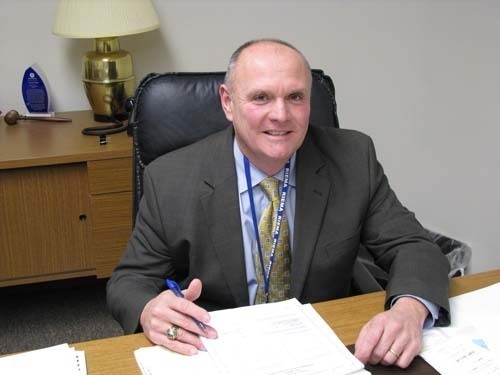
After 30 years in public safety, J. David Smith knows the importance of the business community in times of disaster. Smith, a former police chief in Westerly and Narragansett and public safety director at Roger Williams University, says businesses are often the first to lend a hand to emergency responders, and getting companies up and running again can be a first step to a return to normalcy.
Smith, now the executive director of the R.I. Emergency Management Agency, spoke to Providence Business News about the steps that companies can take before a disaster hits.
PBN: How much contact do you have with the business community in your planning for emergency situations and disasters?
SMITH: One of the things that we believe is vital to our ability to prepare and mitigate against any manmade or natural disaster — along with proper planning and preparation and exercising those plans — is communication. One of the things I really have to admire is the interest and willingness of the various directors of chambers of commerce here in the state to take time out of their day to field calls from us [and] come here to meetings as we prepare together. I think the results are noticeable.
PBN: What is the most common type of disaster or emergency that could hit a business?
SMITH: Statistically, fire is the most common of all business disasters. Each year, there are thousands of deaths and injuries and billions of dollars of damage resulting from business fires.
Rhode Island's Market Has Changed. Developers, Builders, Investors and Sellers Must Change With It.
By Emilio DiSpirito IV License Partner | Engel & Völkers Oceanside Leader | The DiSpirito…
Learn More
PBN: What should companies do to prepare for the possibility of a fire striking the business, aside from the obvious like installing sprinklers?
SMITH: Some of the larger industries have full-time, code-compliance officials or risk managers completely focused on it. But even the [one-person business] should be attentive to being code-compliant and having a plan in place and [to] actually exercise that plan at least once a year.
PBN: Businesses should run drills?
SMITH: Absolutely. The literature suggests at least once per year. I think a lot of that is dependant on the ability of the business to manage something like that. The more the better.
PBN: But what about a retail business or a company in which a lot of customers are present?
SMITH: You wouldn’t hold a fire drill, say, at the Dunkin’ Donuts Center during an event just to see how everyone would react, but it is appropriate for [the center’s management] to make sure that everything is compliant, that the exit lighting is in good working order, and [the vendors, office staff and management] themselves drill an evacuation.
Also, businesses should understand who their employees are. It’s really essential to understand if you have a special needs population, or physical handicaps or a language barrier – do they all understand what the signs mean? It’s essential that in quiet times you identify who they are and make reasonable accommodations so they can get out as quickly and safely as anybody else. You really have to know your staff.
PBN: What other things should businesses think about in advance of an emergency?
SMITH: It’s important to know things in advance, knowing what your responsibilities are, what your coverage needs to be, and making sure your structure is sound and how it can withstand certain levels of wind, rain and other things. Or in the case of chemical storage, if there is some kind of chemical leak, what precautions have been taken in advance? Do the people who handle those chemicals, are they aware mixing certain chemicals will result in [a certain] kind of reaction? Is there first aid equipment nearby? It’s advised that when it’s possible and practical, get a program in place where you get your employees trained in CPR and first aid. That makes a work force proud, where they see the value of that, and it has value beyond the four walls of the business.
PBN: Is there a generic disaster-preparedness checklist that fits all businesses and all emergencies?
SMITH: It’s hard to do a one-size-fits-all [checklist]. … We try to put out the message that preparedness starts with the individual. So even though it’s a business environment, the preparedness, training and equipment and capability still are best served to the larger [entity] if each individual is prepared.
There needs to be a crisis communications plan in the business environment. If there is a crisis, how do you get that message out to the people? Do you e-mail everybody? Do you call them? Is that practical? What if people are on vacation?
One of the things that can be extremely disastrous to a business climate … is cyber terrorism. Cyber security is taking on more and more importance as we become more and more dependent on our information systems.
There’s another concept we’re trying to reinvigorate … a citizens’ emergency-response team. Many clubs, business and now college communities are expressing an interest in it. It’s a group of specially trained individuals who understand the background of emergency management. [They] train and work together and understand the nuances of their environment and can be ready to go if something happens.
PBN: How important is talking to employees beforehand?
SMITH: It’s part of the individual preparedness and communication, building that network. Then people can react almost instinctively and know what to do. If you’re going to evacuate the business, do you know where to evacuate? A lot of times people know how to get out, but sometimes that’s not enough. How far away do you need to be? How do you make sure that you can be accounted for? You can assemble outside in a predetermined location, and there could be a quick assessment if someone is missing.
PBN: What steps can a company take to ease the aftereffects of a disaster and speed up the recovery or even continue operations?
SMITH: What we’re doing as a state is actually continuing to develop those plans. We’ve been ranked nationally by Congress about eighth in the country and first in New England for our continuity of operations and continuity of government. Businesses need to apply the same planning. What is their continuity of operations? Who are those essential employees? Will you be able to continue to do business if, for example, there’s a pandemic and 30 percent of your work force can’t get into work? How do you do that? Can people work from home? Or have you realistically planned to prioritize your work product, change the assembly line or suggest that for the next six months, we’re going to produce 20 items as opposed to 30 products? And at what point is it unsafe to continue to try to run an assembly line? And if you are temporarily shut down, the best thing the business owner and manager can do is provide for the well-being of your co-workers and their families.
What arrangements have been made for long-term utility outages? There’s an ice storm. It’s taken power lines down, and you’re not going to have power for a month. What do you do? Have they looked at renewable energy so they’d be off the grid and less impacted by it? Have they backed up their files? It could be devastating when a business has one set of accounting files and all of a sudden it’s been hacked into or [there’s] a lightning strike and everything’s gone. •