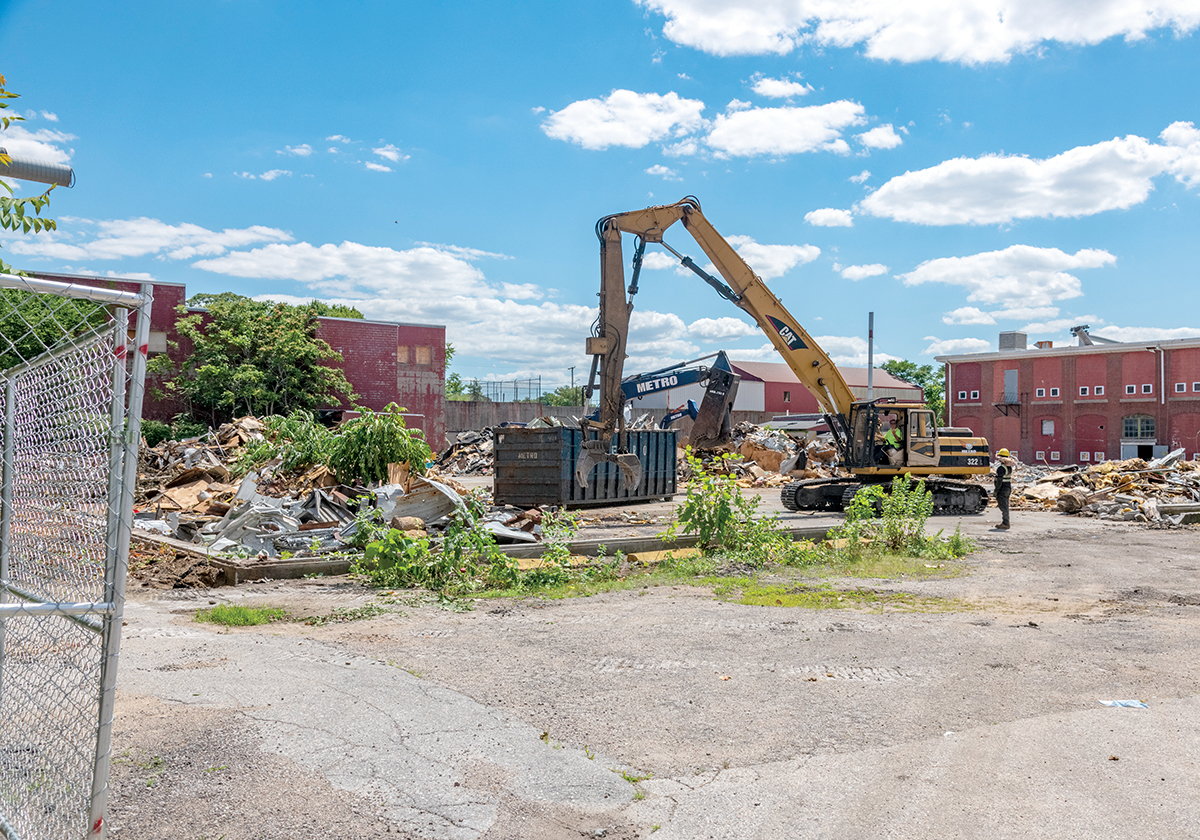
FOR THE FIRST TIME since Microfibres Inc. went out of business in 2016, the former fabrics factory at 1 Moshassuck St. in Pawtucket appears poised for redevelopment, with demolition underway to prepare for a 160,000-square-foot distribution facility.
But while supporters of the project, which has preliminary plan approval, say it will bolster the city’s revenue and add new jobs, some residents in Pawtucket and nearby Providence fear the economic opportunity will come at the cost of heavy truck traffic that could endanger pedestrians and cyclists, and that a proposal by the developer,
JK Equities Inc., to acquire an abutting athletic field will take away from the neighborhood’s limited recreational spaces.
JK Equities envisions a “last-mile distribution center” at a 3.5-acre site that will include a warehouse and direct-to-customer shipping operations, according to the company’s website.
Workers are on-site already, tearing down the 194,000-square-foot brick factory that was built in 1940, according to Pawtucket city records. The new building – dubbed the Blackstone Distribution Center – will feature up to 41 loading docks, 32-foot ceilings, and a 45-foot radius area for trucks to turn around.
Jordan Karlik, JK Equities co-founder, declined to provide further comment.
Plans for the site, which is located less than a mile from the Providence border, has stirred controversy in both cities.
Pawtucket City Councilman Clovis C. Gregor, who represents the neighborhood where the former Microfibres site is located, agrees the industrial property is in dire need of a new use, but he says the developer’s effort to purchase and rezone the athletic field, called Morley Field, threatens to eliminate the neighborhood’s recreational space.
“My feeling is that the kids in the Fifth District deserve the same rights and opportunities to green space, recreational space and opportunities as kids their age in the other districts,” Gregor said.
The field was also partially funded by the National Park Service, which protects its status as a public green space. To sell the property for commercial uses, the city must replace the field with a recreational area of at least the same size and in the same neighborhood.
The city has agreed to sell the 5-acre field to JK Equities for $550,000 if it can meet these conditions, but Gregor has his doubts this can happen. “This district where the park is located doesn’t have a lot of space that you can turn into a replacement site,” he said.
Morley Field has other problems. The city, which still owns the 94 Moshassuck St. property, last month discovered “volatile organic compounds” in the field. The developer will be responsible for removing these compounds if the deal goes through, according to city spokesperson Emily Rizzo.
The proposal has also raised alarm in Providence, where some say increased truck traffic would work against plans to redesign nearby North Main Street to increase safety for pedestrians and cyclists and bolster public transit.
“Big trucks like that have much bigger blind spots,” said Liza Burkin, lead organizer of
Providence Streets Coalition, which lobbies for safer street designs. “It’s just incompatible with a vision of North Main that involves more cycling, walking and public transit use.
“And [it] will definitely send more air pollution into the neighborhood around it,” Burkin added.
Timothy Rondeau, a Providence Planning Department spokesperson, declined to comment on the development’s potential cross-border effects. An online petition created by Providence City Council Ward 3 candidate Bradly VanDerStad had over 260 signatures in opposition to the distribution center, as of June 29.
But others, including the
R.I. Commerce Corp., see the economic opportunity. In December 2020, the agency granted a $3.75 million tax credit to JK Equities under the Rebuild Rhode Island program.
JK Equities has also been approved for the Rhode Island Ready program, in which the state provides up to $200,000 in technical assistance to get qualified industrial-zoned sites ready for use.
“Rhode Island faces a significant lack of vacant industrial space, hampering economic development in that sector,” said Adam Isaacs-Falbel, a policy and special projects analyst at R.I. Commerce.
With the state’s vacancy rates for modern industrial buildings at a historic low – 1% to 2%, according to the New England Real Estate Journal – the distribution center “will help to ease that strain in a great location in Pawtucket,” he said.
The project will also “bring activity to a long-vacant site” while contributing to an increased tax base for Pawtucket, and to revenue and gross domestic product for the state, Isaacs-Falbel says.
Pawtucket officials say they expect the facility to create more than 100 jobs.
Rizzo says a traffic-impact analysis was completed in March 2021 for the area around Moshassuck Street. That study proposed updates such as off-peak hour delivery, signal intersection redesigns, and was also sent to Providence officials, Rizzo says.
Gregor says he hopes those recommendations can alleviate potential problems.
“I know some people have concerns regarding noise, traffic, the potential for that,” he said. “We also have the benefit of economic development in the area, which is always a good thing. But it shouldn’t be at the expense of the children of the district.”
While Gregor opposes the developer’s attempt to acquire Morley Field, he says the former Microfibres site has been in urgent need of redevelopment.
“The property is a complete eyesore,” Gregor said. “I can’t wait for this place to be done.”