PAWTUCKET – Every year in the United States, about 325,000 people die from sudden cardiac arrest – the nation’s leading cause of death.
Unlike heart attacks, which involve clogged blood vessels that lead to heart muscle death, sudden cardiac arrest is an electrical issue – electrical impulses in the heart become rapid or chaotic, and the heart stops without warning. The mortality rate is more than 90 percent.
About half these incidents occur outside a hospital, according to the American Heart Association, and even if a defibrillator is available, CPR is often the life-or-death factor.
The problem is, it’s hard to do chest compressions just right – not too hard, not too lightly. A 2005 study found CPR is delivered at the right pressure less than 40 percent of the time.
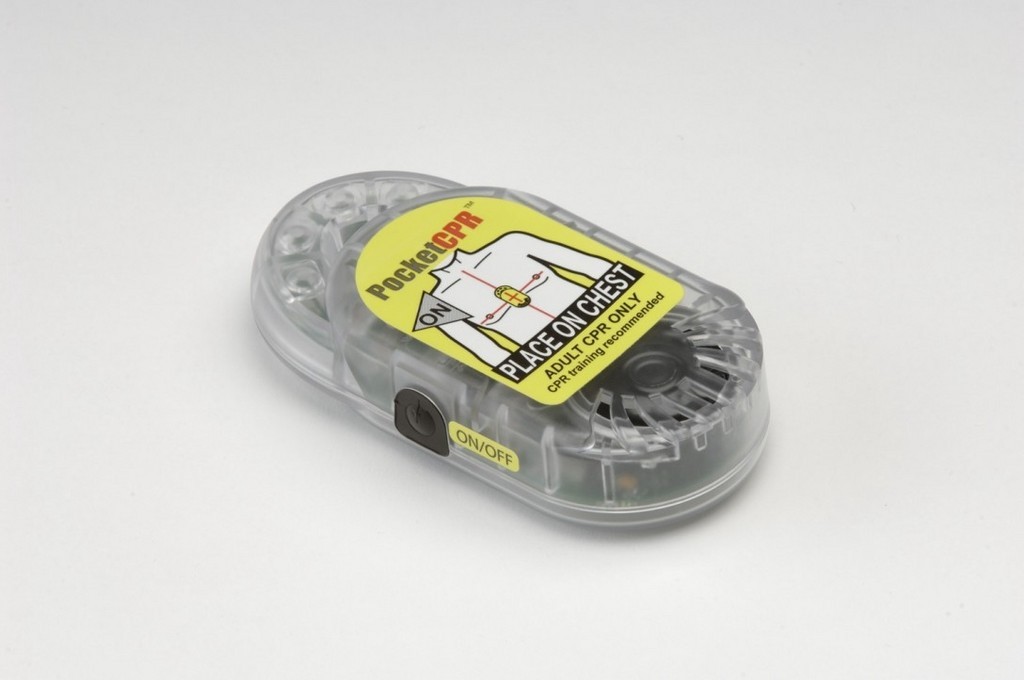
Bio-Detek Inc., a wholly-owned subsidiary of ZOLL Medical Corp. (NASDAQ GS: ZOLL), has come up with a solution: the PocketCPR, a small, battery-operated, portable device that gives the user feedback while giving cardiopulmonary resuscitation.
The U.S. Food & Drug Administration gave its clearance earlier this year, and the PocketCPR went on the market in early spring, with a suggested list price of $199. The potential market, as company President Mark Totman put it, is any place where sudden cardiac arrest happens.
High school sports coaches might want to keep one on hand, as would fitness center owners.
Given the relatively high incidence of sudden cardiac arrest, and the extremely high mortality rate, Totman said, “ultimately I see the market as being very broad, including all american households, [just as they have] smoke detectors.”
So far, Totman said, the PocketCPR is unique in the market. The same technology, called “Real CPR Help,” is used in other Bio-Detek and ZOLL products, so a person using an AED from ZOLL who has to give CPR would get feedback on the compressions.
But across America, he said, there are more than a million AEDs with no built-in CPR feedback, and the PocketCPR would complement them well, because more than half the time, when an AED is used on a person in sudden cardiac arrest, CPR will be needed first to get freshly oxygenated blood into the heart and prime the muscle for the electric shock.
“What we see in the movies is somebody goes flatline and they grab the defibrillator, and they put on the paddles, and they deliver a shock,” he said. “That is not what happens in the real world. CPR is needed first. … The two are absolutely critical to be combined.”
So far, Totman said, use of the PocketCPR has been shown to improve survival rates five- and even six-fold. But it’s a “brand-new” product, and it’s just beginning to get around.
A local instructor is using it in his CPR classes, and the devices are gaining more and more users nationwide. This month, in a small coup for Bio-Detek, the Arizona Department of Health Services announced it would use the device in a statewide campaign to teach sixth- through 12th-graders how to correctly perform CPR, aiming to have the children, in turn, be able to show their family members.
In an initiative called “Your Hands – Their Heart,” the state is distributing kits with a short training video and a specially modified PocketCPR device this month to about 1,800 schools. The effort is expected to teach CPR to about 100,000 people.
“As SCA is the No. 1 cause of unexpected deaths in the United States, it is imperative that our citizens are educated on the proper way to perform continuous chest compression CPR, so they gain the confidence to assist in the event of an emergency,” said Dr. Ben Bobrow, medical director of the program. “Effective and immediate bystander CPR,” he added, “can triple a victim’s chance of survival.”
In an interview, Totman stressed the potential benefits of the PocketCPR as a tool in educating all Americans about this issue. “I see an enormous opportunity to make people aware of sudden cardiac arrest as a problem,” he said.
Bio-Detek Inc., a wholly-owned subsidiary of ZOLL Medical Corp., is a Pawtucket-based manufacturer of electrocardiogram, pacing, defibrillation and multi-function electrodes. For more information, go to www.bio-detek.com. For more information about PocketCPR, visit www.pocketcpr.com.