When it comes to the internal communication systems in both of this year’s
presidential nominating conventions, Bob Salvatore says it all comes down to
having the right frequencies.
Salvatore, owner of Warwick-based CyberComm Inc., is already at work devising the final details of the wide-area network his company will provide to the Democratic National Convention (July 26 to 29 in Boston’s FleetCenter) and the Republican National Convention (Aug. 30 to Sept. 2 in New York City’s Madison Square Garden).
Using a mix of antennas and frequencies, CyberComm will be responsible for putting a system in place to keep 2,000 portable hand-held units at each convention in contact. Each location will have eight internal groups and eight external groups – with the users broken down into categories such as candidates’ handlers, transportation, sound and lighting technicians or security personnel.
Building a Strong Data Foundation in the Age of AI
Artificial intelligence (AI) has become a key priority in the boardroom and across management —…
Learn More
“Having the frequencies to handle all those different groups is the most challenging part of it,” Salvatore said. “And we have those.”
Motorola operated the CyberComm facility in Warwick until early 1996, when Salvatore, who had been working as a technician, bought the facility and two other locations in the Boston area. The frequency the communications will travel over is what Motorola owns.
“It was a case where one of these huge, Fortune 50 companies was looking to sell off some viable assets,” said Salvatore of the localized sales and service operation. It was Motorola who was originally approached by the Democrats looking for a way to handle internal communications in and around their convention. Motorola passed the call on to its partner.
“They approached us looking for a solution,” Salvatore said. “And we were the only ones who could offer a solution in the Boston area.”
The PassPort trunking system that CyberComm will put in place at both convention sites allows separate groups to talk to each other within a system and makes it possible for “one-to-many” communications.
After presenting a proposal to the Democrats, Salvatore figured placing a call to the Republicans certainly couldn’t hurt. In 2000, when the Republicans held their convention in Philadelphia, the city had recently purchased a wide-area network system that the GOP was able to use. The Republicans were actually the first to sign on to a deal, providing detailed schematics for Madison Square Garden and highlighting areas of the venue where it was essential to have good coverage.
While the Democrats hemmed and hawed for sometime over whether or not they had the money, they signed on with CyberComm with barely a month to go until their convention.
“All of a sudden, they found the money and last Monday (June 28), finally said go,” Salvatore said. “Really, I don’t think we’d have been able to do it if they’d waited any longer. To manufacture the equipment, finalize the design and installation of the system – 21 days to get up and running is what we’re really going to need.”
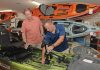
Wandering through locker rooms and walking the rafters among championship banners has begun as part of coverage testing at both the FleetCenter and Madison Square Garden. It will take about a dozen technicians to get all the equipment installed, and over the course of the four-day conventions technicians will be on-site and on-call if any problems arise.
Salvatore said all would have to be fully credentialed and are now in the process of going through extensive background checks. The system also has to be tied into a number of communication channels monitored and accessible by federal agencies including the FBI and CIA.
Salvatore said his company’s next big marketing push would be to market similar systems to companies with a mobile fleet. But the “bread and butter” of Salvatore’s business remains the roughly 150 police stations and 125 fire departments that operate the their internal communication systems through CyberComm.
The company also works regularly with colleges, hospitals and transportation companies that need more than an isolated communication system. In Rhode Island, the company provides services to several state agencies, such as the Department of Transportation and the Rhode Island Public Transit Authority, as well as fixed-end maintenance on the State Police’s system.
Only recently has the company begun to see a steady flow of funds as more towns actually get homeland security money in hand to upgrade their own communication systems.
Salvatore said he sees the two jobs as perfect case studies which can hopefully provide his company with a little boost, enhancing both its image and its revenues (each of the two contracts is worth about $500,000). He declined overtures from both sides to provide the systems on a “trade” basis, not seeing much business sense in getting a chance to hobnob with delegates at parties.
Altogether, the four sales and service facilities that Salvatore owns (he bought a fourth location several years ago and has since relocated another couple of the operations), employ about 45 technicians and salespeople. Each facility has its own garage bays to equip and fix vehicle systems.
The convention staff will be pulled from all of CyberComm’s facilities, which, besides Warwick, include a facility on Route 44 in Taunton, Mass., (near Cape Cod), in Dracut, Mass., (close to the New Hampshire border) and in Waltham, Mass., (by Route 128 and the Massachusetts Turnpike).