Paul Lwin was flying a 40-year-old EA-6B Prowler over the mountains of Afghanistan as a U.S. Navy pilot when he realized the U.S. defense industry was overdue for innovation.
It was a digital mission designed to jam enemy radar and communications, he said. Yet the supporting infrastructure on the Prowler was limited and outdated.
The year was 2013. But even then, Lwin, a commissioned naval officer who emigrated to the U.S. from Myanmar at age 10, said he already saw the promise of artificial intelligence. AI was still in its early stages, but Lwin recognized its potential as a transformative force in warfare.
Closing the gap between a defense industry slow to modernize and the rising strategic power of artificial intelligence became Lwin’s new mission.
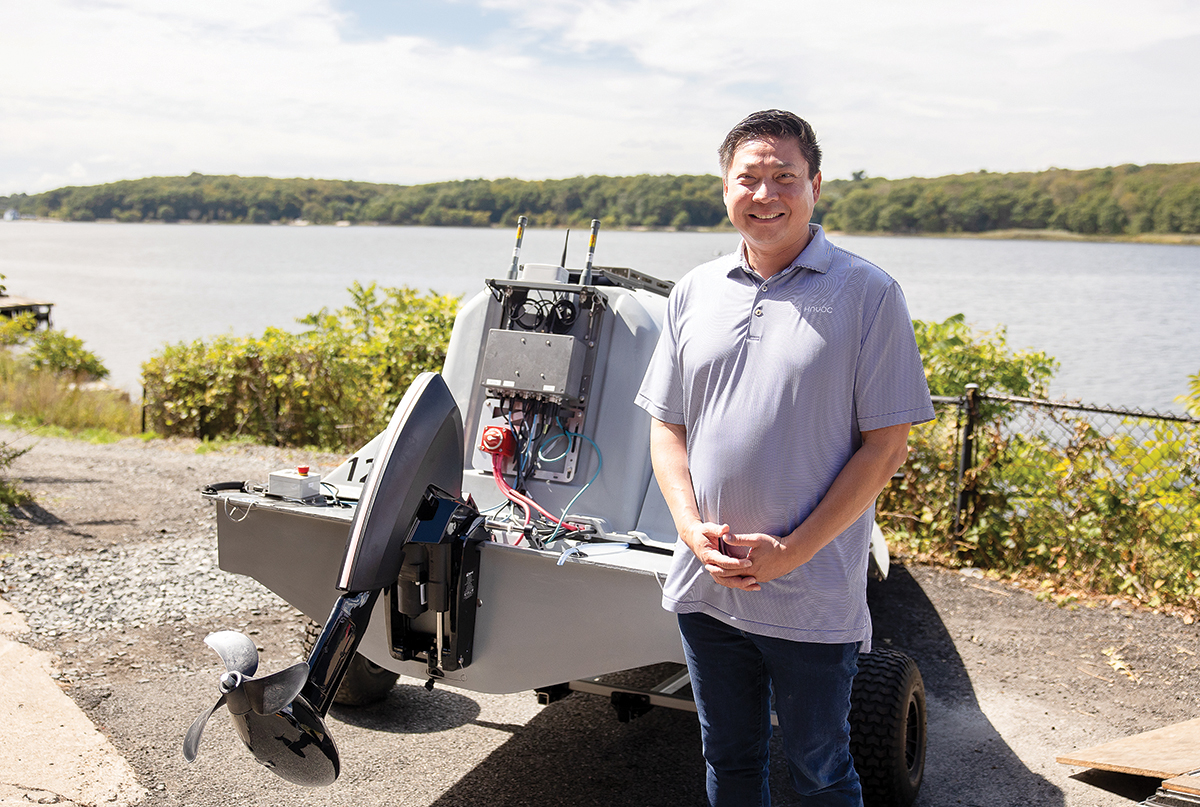
Last year, he co-founded Havoc AI, a software-first defense startup that builds AI-powered uncrewed surface maritime vessels. These robotic ships are capable of operating autonomously or in swarms, with one person overseeing dozens at a time. The software’s maritime and military applications are endless, Lwin said.
“We needed the private sector to innovate the Department of Defense,” said Lwin, CEO of Havoc AI. “How could we do better? Startups and Silicon Valley are answering that question, and it’s helping the entire nation’s defense.”
In January 2024, Lwin and Joe Turner launched Havoc AI. With just three engineers, they built a dozen autonomous vessels and put them to the test in a 10-day Department of Defense exercise.
“They wanted to buy all 12,” Lwin said. “And they told us they needed thousands more.”
Within six months, the startup started earning revenue, Lwin said.
By September, Havoc AI had closed an $11 million seed round led by Scout Ventures and Trousdale Ventures, with participation from a handful of national security-focused investors. The capital helped scale both the team and production, Lwin said.
Havoc AI now has 82 employees.
At its core, the Rhode Island-based startup is a software company currently building its own fleet to prove the concept.
It’s already built a total of 75 robotic vessels in the 20 months since it launched, 32 of which have been deployed to Department of Defense customers in various locations, including Europe, the United States East and West coasts, and Hawaii.
The startup’s cutting-edge technology has even caught the attention of defense giant Lockheed Martin, which has partnered with Havoc AI to fast-track the deployment of autonomous naval vessels – boosting the startup’s profile as a game-changer in modern naval warfare.
But Lwin said Havoc AI doesn’t plan to stay in the shipbuilding business long term. The ultimate goal is to power any vessel, no matter who builds it, with the company’s autonomy software.
In the meantime, the company is scaling up. It’s already built a 42-foot and a 100-foot-long automated vessel. Those vessels are being produced at scale, according to Lwin.
“The defense space is in a boom now,” Lwin said. “There is so much innovation going on, and it’s happening right here in Rhode Island.”
Still, the real goal isn’t just shipbuilding and Lwin’s vision for the software goes beyond the Navy.
“We want to get this onto all ships,” Lwin said. “We’re not making magic ships here. Eventually, we want all shipbuilding companies to employ our AI software.”
The company is looking to apply the software to the commercial boating market soon.
OWNERS: Paul Lwin and Joe Turner
TYPE OF BUSINESS: Maritime AI software
LOCATION: 310 Bourne Ave., East Providence
EMPLOYEES: 82
YEAR FOUNDED: 2024
ANNUAL REVENUE: WND