After more than 200 years in business, Providence Washington Insurance Companies
announced late last month that it is calling it quits. The company has stopped
writing new policies but will honor existing business.
A mix of financial losses and the inability to raise new capital was cited as the company’s demise.
Providence Washington announced plans to gradually reduce its work force of 235 employees in line with the reduced amount of work. The company hasn’t offered any estimates as to how long that timetable will run. The company employs 165 people in its various Rhode Island locations and said it would assist with the outplacement needs of employees affected by the decision.
A modernized health plan: Supporting cost management and the employee experience.
The Surest health plan came from a group of innovators wondering: What if health care…
Learn More
Brian McArdle, an analyst with insurance rater A.M. Best who has followed Providence Washington for more than a year, said he didn’t think the change of fortune for one of the country’s oldest insurers was due to mishandled reserves or poor management, the more likely culprit was recent asbestos litigation.
Policies written in the late 1960s and 1970s – likely a staple of Providence Washington’s portfolio – have begun to drain the company’s reserves with costly payouts.
“They were dealing in asbestos at a time when the proven risks weren’t what we know at this point,” McArdle said. “The emergence of those claims made them vulnerable.”
Providence Washington saw its policy-holders’ surplus fall from $92 million at the close of 2002 to $59 million at the close of 2003. As of March 31, the surplus had dropped another $6 million, and left the company unable to raise new capital. Those figures, coupled with net losses of $7 million in 2002, $35 million in 2003 and $7 million through the first quarter of this year, led Providence Washington to anticipate a downgrade from A.M. Best.
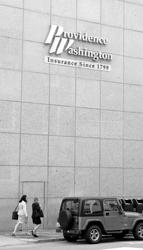
John Macliver, president of MPM Property Management, which manages the Providence Washington Plaza building on South Main Street, said the insurer has a five-year lease that ends in 2006. Macliver said the company would have the opportunity to consolidate its space before their lease ended. Providence Washington operates on the third floor and a portion of the fourth floor.
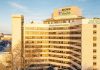
Known as the Rubik’s Cube building for its blocky design, the 141,000-square-foot building is one of less than a handful of “Class A” buildings downtown, less than 20 years old with many amenities.
“We don’t anticipate any real changes in the near term,” Macliver said.
While the building had continued to be known as Providence Washington Plaza, Macliver said that title had been an unofficial one. The building was renamed 121 South Main St. when Quincy Mutual Fire Insurance Co. paid $22 million for the 11-story building at the start of 2002.
Providence Washington paid $17.4 million for the property in 1991. At the time of the sale, Providence Washington officials said they had sold because they wanted to put more emphasis on its core business of property and casualty insurance.
Dennis Charland, executive director of the Independent Insurance Agents of Rhode Island, said there are likely two large factors that led to Providence Washington’s demise. Along with expensive asbestos litigation, Charland said over the last several years, the entire industry has been “besieged” by a soft market.
Insurance cycles are closely tied to the stock market, Charland said, which can often hurt smaller independent insurers partly because those companies are forced to invest heavily in stable mutual bonds during uncertain economic times. Bigger companies often have more flexibility with their investment dollars which adds to the surplus needed to write new policies. Insurers are required to keep a certain percentage (usually just over 100 percent) of a surplus on hand to cover all their issued policies.
Without a buyer for the company, Providence Washington’s board of directors agreed to cease writing new and renewal business while continuing to serve the company’s existing commercial and personal lines.
“Taking this action is in the best interests of the company’s policy-holders, claimants, reinsurers, creditors and shareholders,” said CEO Jeffrey Mack, who was named to the position by the board, in a release. “Over the past year the management team of Providence Washington and its board have worked very diligently to turn around the business and have explored various strategic options in order to avoid today’s decision.”
Boston’s OneBeacon Insurance Group has already set up agreements to acquire the renewal rights for many of Providence Washington’s small mom-and-pop clients, which had long been the company’s forte. For 2003, 70 percent of Providence Washington’s business was in commercial lines and the other 30 percent was in personal lines. Charland said OneBeacon taking on those small-business package policies would relieve major concerns for many businesses around the state.
While certainly a shame to see Providence Washington cease new business, Charland noted that the last decade has seen many small carriers go by the wayside, among them names like American Universal Insurance Co. and the Pawtucket Mutual and Narragansett Bay Mutual insurance companies. Pointing to big names like Royal Insurance Co., Kemper Insurance Companies and Commercial Union Insurance Companies, Charland said much like the banking industry, major insurance carriers are also beginning to consolidate.
Analyst McArdle said while other insurance companies certainly battled with asbestos claims, they were apparently more successful at other capital-raising initiatives, allowing them to withstand large legal hits.
“I think it’s one of those things where the management was a decent group of people,” he said. “It’s horrible, but I think they finally took a look at their capital, which had weakened considerably, and read the writing on the wall. Without any prospective suitors or investors, they had no other choice.”
Charland said, “I’m concerned about the people. Some dynamic people, who are very active in the local community are going to be forced to leave the state. There’s a lot of talent I’m disturbed to see that we may be losing.”