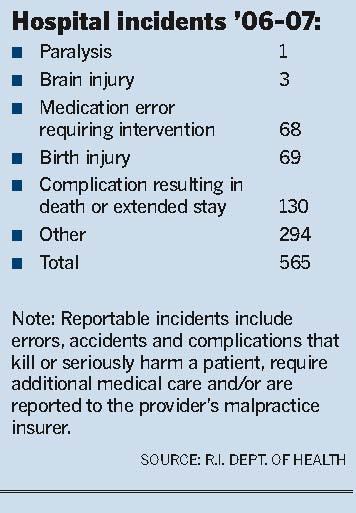
When a patient in a hospital is accidentally injured or when a medical error causes serious complications or requires additional treatment, the hospital must report it within 72 hours.
In 2006 and 2007 combined, 565 such incidents were reported to the R.I. Department of Health, most of them not involving death or serious, permanent harm.
But for every error that caused harm, how many more did not but should still not have occurred? How many patients got the wrong drug, or the wrong dose, but did not get sick? And how many errors were caught just in the nick of time, before the syringe or the knife went in?
Those are the kinds of errors that a proposed new “patient safety organization” would track, along with the already-reported incidents, aiming to find patterns and correct problems.
“In terms of being able to take a lesson learned today, disseminate it quickly, and effect change collaboratively across the state, there’s no mechanism to do that right now,” said Dr. Robert S. Crausman, chief administrative officer of the state Board of Medical Licensure & Discipline. “We’re hoping the PSO will do that.”
Tracking medical errors and near misses is not a new concept, and it has been done within individual institutions for decades – at Rhode Island Hospital and other Lifespan institutions, for example, it goes back at least a quarter-century, officials there said.
But the PSO now being considered here, as outlined in bills now before the General Assembly, is based on the federal Patient Safety and Quality Improvement Act of 2005, which specifically envisions regional, confidential, voluntary, liability-free reporting systems.
The idea is that the more data collected on errors, the more the medical profession can figure out what is a fluke or an individual mistake versus a common problem or pitfall.
“There are probably 10 times as many near misses” as errors, Crausman noted.
Sometimes all it takes is one big, high-profile mistake to identify an issue. As an example, Laura Adams, president and CEO of the Rhode Island Quality Institute, cited a case in another state in which a patient was killed because an intravenous line was put in his feeding tube.
Yes, someone made a mistake, she said, but “why is it engineered such that an IV tube and a gastric feeding tube even connect?” Change the design, she noted, and you could save lives.
Other times, however, it is difficult to tell whether something was a freak accident, or a larger problem, said Dr. Mary Reich Cooper, vice president and chief quality officer at Lifespan. Take MRIs, she noted. Stories have circulated for years in the hospital world about the machines’ powerful magnets sending objects flying across a room – a dangerous but, most people thought, rare occurrence. Yet when the Joint Commission, which accredits hospitals, collected and analyzed national data, it found the problem was widespread enough to warrant a national alert, which it issued this month.
To get all this information on errors, however, there is a tradeoff: The federal law specifies, and local health care leaders agree, that the reporting has to be completely confidential. Don’t expect to learn from the PSO that Hospital X makes twice as many IV-related mistakes as Hospital Y, or that Dr. Z almost killed two patients last year.
To the extent that errors are already reported through the existing system, obviously they will continue to be, but if a doctor sends a long, detailed note to the PSO explaining her mistake, and then she is called before the Board of Licensure or she is sued for malpractice, that note or anything else she says to the PSO cannot be used against her.
Dr. David R. Gifford, the state health director, said those confidentiality safeguards are essential to the PSO’s success. “We still have the enforcement angle [through the existing system],” he noted – “but we don’t have the improvement side.”
And that is the part where everyone sees the most potential for the PSO: in taking the data and using it to correct problems, collaboratively. The PSO itself would be a contractor chosen by the Department of Health, but Gifford envisions an advisory council working closely with it (some see it as an actual part of the PSO) to respond to the data and recommend solutions.
Dr. Nicholas Tsiongas, president of the Rhode Island Medical Society, said the doctors’ group supports the legislation, though it has provided some feedback on specific details. The Quality Institute also backs the concept and will be offering its input; Lifespan is involved as well. •