
In late July, R.I. Economic Development Corporation Executive Director Saul Kaplan received a phone call from a top executive at FM Global. The business, Rhode Island’s largest privately held company based on revenue, was evaluating options for a new headquarters, including the possibility of moving out of state.
Within 48 hours, Kaplan organized a meeting with Gov. Donald L. Carcieri; W. Michael Sullivan, executive director of the R.I. Department of Environmental Management; and Jerry Williams, director of the R.I. Department of Transportation.
They all wanted to keep FM Global in the state and the tool they employed was a little-used program to expedite permitting called the state Certificate of Critical Economic Concern (CCEC).
“We, as a leadership team, committed that we were going to focus on providing a predictable and expedited process, so that they could have a predictable decision-making process,” Kaplan said.
The availability of the program led to FM Global’s decision on Dec. 13 to stay in Rhode Island and build a $60 million, four-story headquarters in Johnston. The RIEDC also decided to make the expediting process easier for other qualifying companies.
“In fact, we are now going to announce a new set of regulations,” Kaplan told Providence Business News last week. “And working together with FM Global is the key to the changes we’re going to propose.”
The way the CCEC regulations are now written, there is a fee for the company. And there aren’t set size guidelines for determining if a company can qualify for expedition through state and local permitting.
But the guidelines that the EDC will propose in January – and which might be in place as early as February – will scrap the fee and will apply to companies with more than 100 high-wage employees and a building plan of more than 50,000 square feet.
“What we did was use FM Global as an example of the kind of company and the kind of project that we wanted to offer expedited review to,” Kaplan said.
For FM Global, the permitting process – including DOT transportation and DEM wetlands evaluations – was quick enough for it to approve the new Johnston headquarters. With its groundbreaking scheduled for spring 2008, the project is expected to be completed by mid-2009. Expediting permitting was essential, because that opening will coincide with the expiration – in July 2009 – of the 25-year lease at FM Global’s Atwood Avenue headquarters, said Kaplan.
In a transaction completed this year, the Atwood Avenue office was sold to CapLease, a New York-based real estate manager (READ MORE), that since then has been leasing the office back to FM Global, Zenofsky said. CapLease officials could not be reached last week for comment about the future of that property.
The commercial-property insurer’s new headquarters and campus will sit on a 93-acre parcel off Central Avenue which the company has owned since building its original headquarters in 1973.
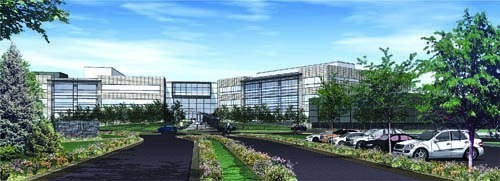
The new headquarters is slated to have a glass-and-brick facade and an adjacent tri-level parking garage. With a smaller footprint than the existing headquarters – just across Central Avenue – the design will allow for much of the parcel to remain woodland – mixed with paths and at least one park – which made neighbors happy, said Steve Zenofsky, FM Global spokesman.
And the building is set to meet U.S. Green Building Council’s LEED standards, said Donald Oldmixon, vice president and real estate manager with Hobbs Brook Management LLC, the Massachusetts firm managing construction.
“That certainly is a good business decision,” he said. “It gives you a more energy-efficient building going forward, and with oil at $100 a barrel, you can always assume that it’s going to offer a payback.”
The design also allows for possible FM Global expansions. It could handle an extra 400 employees – a level of growth that the company might reach within the next few years, Zenofsky said. Now, about 800 are employed in Johnston, 100 of whom are residents of that town.
Since finding out that FM Global was considering relocation, Johnston officials had been on edge, said Mayor Joseph Polisena. He said it would have been an economic loss for both the town and the state if the company relocated to Massachusetts, as was considered.
“If we lost them it would be a devastating time for the town,” he said. “They were thinking of moving – going up to Route 128. They told me that about four months ago and my heart sunk.”
The company didn’t ask the town or state for tax credits, Polisena said, adding, “They ask for nothing, they just want to be good neighbors. And they have been extremely good neighbors.”
But FM Global – a $4.5 billion company that employs 4,700 internationally – is eligible for Rhode Island sales tax abatement for construction material costs. Kaplan said that incentive was put in place in 1999, when FM Global was created by the merger of the Allendale, Arkwright and Protection mutual insurance companies.
“But in relation to our agreement this time around, we didn’t ask the state for anything special,” Zenofsky said, adding: “the state didn’t offer us any incentives, nor did we ask for them.”
Aside from expedited permitting, the support of the Johnston community was important for FM Global’s decision to stay in Rhode Island, Zenofsky said. That’s why it held a meeting early this fall with its residential neighbors.
FM Global wanted to tell neighbors about the new Johnston headquarters before it finished the planning process, Oldmixon said. The company was looking for opinions of the new design – and the neighbors were “surprisingly” supportive, he said.
A meeting like that was exactly why Johnston officials wanted to keep FM Global in the town, said Polisena.
“They wanted to make sure the neighbors were comfortable,” Polisena said. “And the neighbors were extremely comfortable. The company answered all their questions openly and truthfully.”
And for the state, keeping FM Global local was a victory – and it demonstrated the potential for the expedited-permitting program for retaining and attracting big business, Kaplan said.
“It showed how, when we bring the whole power of the state together in a highly-coordinated way, we can keep and grow high-wage jobs in the state,” he said. •












The state better wake up. There is no reason why permits take as long as they do. Between the building officials and the fire officials it is a crime to have to put up with their bullshit. Many years ago a building official in Cranston was accidentely hit with a 2 X 4 and ended up in the cellar of a house he was inspecting. After months of recuperating he returned to work a different person. Lets hope a builder is not pushed to the point that he injures someone. The sooner a permit is issued, the sooner people can get to work and the sooner the building goes on the tax rolls.