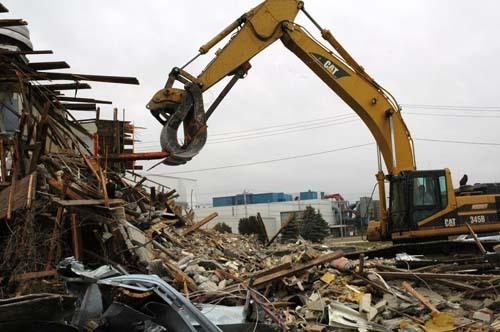
The Navy buildings that once covered 150 acres at what is now Quonset Business Park are finally gone. The recent removal of the final two barracks symbolized the ongoing transformation of the onetime Navy base into a center for business and economic development.
On Dec. 13 the Quonset Development Corporation – a subsidiary of the R.I. Economic Development Corporation – completed its removal of 213 Navy buildings, which combined had totaled more than 2.3 million square feet and had covered 150 acres.
And the land under them has never been more expensive.
Since 2002, the cost of one acre in the Quonset Business Park has doubled – jumping from about $75,000 to $150,000.
“The value of the park – reflected in the selling prices of the parcels – has doubled, reflecting the good work that’s been done there to improve the infrastructure, improve access to the park and begin to build the park out in a high-quality way,” said Saul Kaplan, EDC executive director.
The park attracted $320 million in new developments – including the Quonset Gateway and a 150,000-square-foot facility for Atlanta-based Nickol Commercial – during 2007, topping the $300 million invested in total during the last five years.
Based on the past year’s growth, the park might not take the full 20 years – until the early 2020s – that were predicted for total build-out, Kaplan said.
“If you look at what’s left, there are about 530 acres that are developable parcels,” he said. “And the largest one of those parcels is only around 50 or 60 acres.”
Those 530 acres are the remainder of the 3,047 acres that were part of the Quonset and Davisville Naval bases. Along with being positioned to draw high-value business, “if you put it in context of the total 3,000 acres that were transferred from the Navy, we’re headed toward the finish line,” Kaplan said.
Success in marketing parcels in Quonset – drawing in larger companies – will lead directly to the creation of more high-wage Rhode Island jobs, he said.
When the Navy base closed in 1974, about 5,000 civilians lost their jobs, according to the QDC. Since 2002, the number of workers employed in Quonset has jumped from about 6,000 to 8,200.
The 2003 master plan for the park is now being re-worked, with the first revisions likely to be ready this January.
Originally, it was estimated that at full build-out the park’s businesses would employ about 18,200 workers. Now, operators see potential for an additional 10,000 jobs.
“I think the park is very well positioned to achieve that” goal, Kaplan said.
In designing the business park, the layout of businesses by use may lead to eventual success of the port as an economic hub, Kaplan said. While businesses close to Narragansett Bay are heavy industrial, the $144 million Gateway development, which broke ground in November, is a mixed-use project that will bring 391,900 square feet of office space to the head of park.
The Gateway will have enough room for 1,200 employees. And that project will include 333,960 of retail space.
The Gateway “could serve as a catalyst for not only the park, but the surrounding area,” Kaplan said. “That’s part of why the values of the parcels are going up.”
When the influx of workers and business has finally slowed, the EDC estimates that about 46,000 cars will travel to the site daily.
Importing and exporting operations at the eastern edge of the park, along Narragansett Bay, have grown during the past year. Cars were unloaded from a train there for the first time this fall – but state officials and Gov. Donald L. Carcieri have spoken out against creating a deep-water container port at the site.
Kaplan said such a container port doesn’t make economic sense for the state.
“We’ve done the economic analysis that suggests it could cost anywhere between $500 million and $600 million in order to put that infrastructure in place,” Kaplan said. “And the share [of New England shipping] we would have to get to get a return on that investment would result in a two-mile-long train of containers coming out of Quonset every day.” •