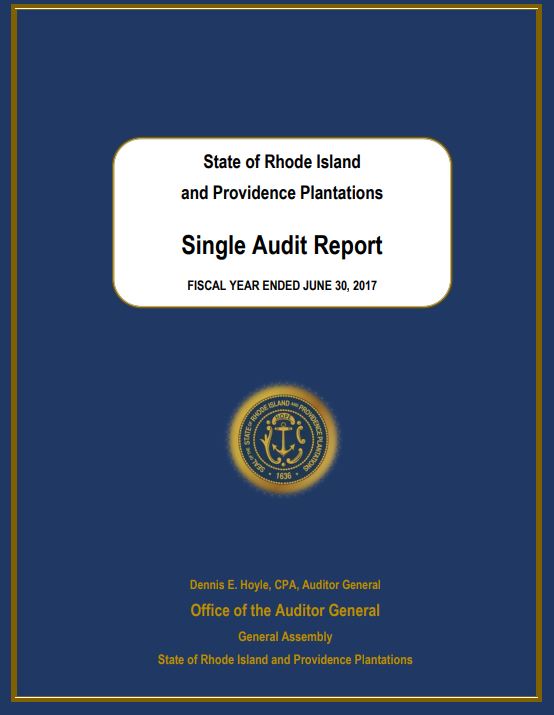
PROVIDENCE – The lack of a state government strategic plan to replace and enhance key financial systems is but one conclusion reached in the fiscal 2017 Single Audit of the State of Rhode Island, conducted by R.I. Auditor General Dennis E. Hoyle and released Monday.
The audit developed 79 recommendations related to the state’s administration of federal funds, and in addition to the issue raised concerning replacement and updating to what the state considers to be key financial systems, Hoyle’s report pointed out that there was no plan to ensure that critical legacy systems will be able to support state operations.
Your Business Has Gone Global. Has Your Insurance?
A decade ago, “doing business internationally” was mostly a large-company concern. Today, a manufacturer in…
Learn More
The annual audit is required by federal law to receive federal funding.
Much of the audit’s findings related to federally funded programs including Medicaid, the Children’s Health Insurance Program, the Temporary Assistance for Needy Families Program and the Supplemental Nutrition Assistance Program.
Specifically, the problems were mostly related to the implementation of the new RIBridges eligibility system that affected the availability and reliability of data needed to prepare timely and accurate federal reports. The system, an eligibility portal, is part of the Unified Health Infrastructure Project.
For instance, the audit found a discrepancy in Medicaid and CHIP eligibility in different state systems. In fiscal 2017, the state claims and capitation payment system saw 16,000 more recipients than the RIBridges system.
Meanwhile on Monday, The Rhode Island American Civil Liberties Union noted that Deming Sherman, the special master assigned to handle the state’s UHIP deficiencies, reported that the state’s compliance of SNAP benefits decreased in February, due to “a problem in the procedure by which applications are scanned, indexed and registered in order to be processed by the eligibility technicians.” Sherman said that he was working with Deloitte Consulting, the contractor of the computer system that is continuing to work with the DHS to remedy the system’s problems.
The implementation of the RIBridges system and the integration of separate systems has weakened controls and added to the state processing complexity, according to the audit report.
The audit also found that the state was not complying with timely determination of eligibility requirements for Medicaid applicants requiring long-term care services.
The audit criticized the Executive Office of Health and Human Services, saying it “lacks strong oversight procedures regarding fiscal monitoring and contract settlement for its managed care organizations.”
Another focus of the report was the state’s information technology security. The audit found the state has not sufficiently addressed information technology security risk, which it notes is an increasing concern due to the state’s increasingly complex computing environment.
It recommended that the state ensure its IT security policies and procedures were current, well communicated and complied with. For instance, the report found that the state had not tested its disaster recovery plan during the fiscal 2015, 2016 and 2017 years.
The auditors characterized 47 of the 79 recommendations as significant deficiencies in internal control for both the state’s financial statements and findings related to the administration of federal programs.
A year prior, the audit had 73 recommendations, including 45 significant deficiencies in internal control.
The audit also found in fiscal 2017 that 43 of the recommendations were related to the handling of federal programs and 36 were made about the state’s controls over financial reporting and information technology.
In terms of the state’s fiscal position, the report found the state’s net position was a $138.1 million deficit, a $192.2 million improvement from fiscal 2016.
Of this amount, $4.6 billion was reported as unrestricted net deficit, $1.3 billion as restricted net position, and $3.2 billion as net investment in capital assets.
Other details from the audit:
- The report recommended the Department of Human Services improve controls to ensure compliance with the period of performance requirement for the Low Income Home Energy Assistance Program
- Auditors recommended better monitoring of Community Development Block Grant subrecipients and enhanced procedures for cash management and reporting requirements
- The audit found the R.I. Department of Labor and Training did not make necessary changes to its Unemployment Insurance system to allow for the imposition of penalties on overpayments due to fraud
- The audit recommended the R.I. Department of Transportation enhance its quality insurance program to ensure required materials tests are performed and documented consistent with Highway Planning and Construction program requirements and RIDOT policy
Chris Bergenheim is the PBN web editor.