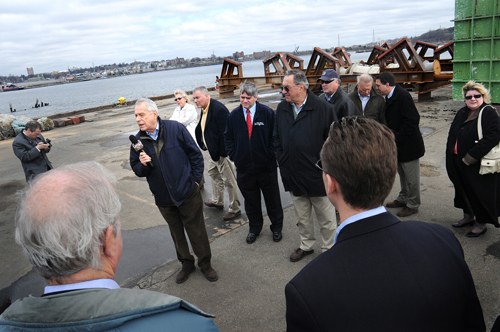
Aboard a chartered R.I. Public Transit Authority bus on an early spring day, Providence Director of Planning and Development Thomas E. Deller presented the city’s case for wanting new nonindustrial uses for waterfront property along Allens Avenue. As the bus passed an idle property just north of Thurbers Avenue, Deller motioned out the window toward the unkempt property’s rusty chain-link fence and a garage with graffiti on its bay doors.
“We look at this and say, ‘This is valuable property for creating jobs,’ ” Deller said, addressing a General Assembly commission studying the potential for economic development at the state’s industrial ports. “We need to figure out how to make it happen – this has been sitting like this since at least 1985.”
Deller’s argument for mixed-use zoning along Allens Avenue – currently zoned for waterfront/industrial uses – isn’t new. It’s been the mantra of the city since the early 1990s, when then-Mayor Vincent A. Cianci proposed rezoning some of the 244-acre Allens Avenue industrial corridor. That never happened, but the land is part of the 15 percent of city property designated to help Providence grow its tax base and economy, Deller said.
Last year, the city held a series of public-planning charrettes to see whether residents and businesses would support the rezoning Deller argued for to the commission. It is unclear when the city will act on the zoning proposals, but the 12-member General Assembly commission is weighing in with a report on not only potential uses for Providence’s waterfront but also ports across the state.
The state’s other industrial ports include Narragansett’s Galilee and North Kingstown’s Quonset Point, said Sen. William A. Walaska, a Warwick Democrat and commission co-chair.
“Our job is going to be to identify the highest and best use of this property,” he said, adding that along Allens Avenue there seem to be some business, but also a lot of underutilized land.
Sen. David E. Bates, a Bristol Democrat and commission member, said it’s time to start thinking about the ports as a statewide economic issue.
“It’s time to take the parochialism out of it,” Walaska added.
The commission also intends to take a step toward finding out the actual market for commercial waterfront land in Rhode Island. “We’re going to look at opportunities that are out there for these ports,” Walaska said. “We have to make sure we have businesses that want to come here and utilize the facilities.”
At least one commercial property broker, Frank Jacques, agreed.
On the same day as the commission’s Allens Avenue tour, Jacques, principal of F.L. Jacques Company Inc., said he has a potential buyer for 434 Allens Ave., an 11.68-acre waterfront parcel that’s zoned for industrial use. That’s the parcel just north of Thurbers Avenue that Deller earlier in the day had pointed out to commission members.
Jacques declined to name the potential buyer, but said the company initially would bring 60 industrial jobs to Providence. He said he’s worried the company might be scared away by the city’s proposal. It wouldn’t be the first time that a company has pulled out of a deal for the property – that’s happened twice since the early 1990s, when the city started pushing for mixed use along the corridor, Jacques added.
But from the city’s point of view, the property north of Thurbers Avenue – including the property Jacques is marketing – won’t attract waterfront industry as well as the Port of Providence, to the south of Thurbers Avenue. That’s because much of the shoreline in the northern area is between 200 feet and 300 feet from the federal shipping channel, Deller said.
The 150 acres owned by ProvPort, as the private Port of Providence business entity is known, were built out into the Narragansett Bay between the 1930s and 1950s – so that the shoreline would abut the 40-foot-deep federal shipping channel and be able to bring in ships with drafts up to 34 feet.
But the area north of Thurbers Avenue wasn’t built out, he said. Deller said any industrial company looking to buy most of the property north of Thurbers Avenue would have to factor a dredging cost into the purchase.
“Someone would have to dredge. Someone would have to pay for it. The federal government will only dredge the federal channels,” Deller said. “When they dredged the channel a few years back, every property owner was given the right to dredge – some did, some didn’t.”
“The one thing we need at a port, to be able to bring in more cargo, bring more business, is we need land,” Waterson said, adding that the city is negotiating with ProvPort for the use of a 12-acre former landfill that’s adjacent to Save The Bay’s headquarters. “It’s contaminated – [ProvPort] would come in and cap that, put four inches of asphalt over the top of it.”
But the expansion of business in the port will depend heavily on the infrastructure that it can offer. For that reason, Waterson said, he’s looking to reconfigure the rail line that now runs into two dead ends on the property; creating a loop by moving Three Flags Scrap Metal Co.’s storage yard and extending the tracks. He also would like to bring in two new cranes, at a price tag of about $24 million.
All together, Waterson pegged ProvPort’s needs at about $27.84 million for infrastructure and equipment improvement.
There hasn’t been much contention about maintaining the industrial use of land at ProvPort – which now generates about $16 million in local and state taxes – and that’s where the city wants to direct industrial growth.
“It’s about jobs – it’s about tax base,” Deller said.
But Jacques, the broker, disagreed that a mixed use would be the best way to grow jobs in the area north of Thurbers Avenue.
“We don’t need any more condominiums, we don’t need any more retail,” he said. “What we need in this state [are] jobs.”
Within about six months, Walaska and the rest of the commission should make a recommendation on the future of that waterfront. When they release their report, it will likely lead to legislation.
“We don’t know where we’re going to go or if we’re going to do anything,” he said. “But it’s not my intention to spend six months meeting and touring ports if nothing’s going to happen.” •