Daren MacDonald considers himself an environmentally friendly person – a man who recycles at home and cares about where his waste goes. But when it comes to his day job managing Tazza Caffé in Providence, MacDonald says it would simply cost too much to recycle.
“In theory it’s great, but sometimes with the cost you have got to decide, do you want to keep your business or do you want to be environmentally friendly?” MacDonald said.
MacDonald said the city charges the 145-seat restaurant and music venue so many fees and taxes that there’s nothing left to hire a recycling service. His focus these days is on keeping the café on Westminster Street profitable, not where his patrons’ trash goes.
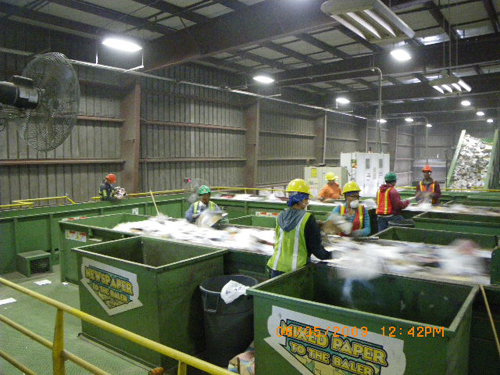
A Rhode Island law enacted in 1996 requires all businesses to recycle. But enforcement has been lax, and, with today’s turbulent economy, separating aluminum cans from glass bottles has fallen off the radar for some.
“Some people are trying and want to do it, but it’s expensive and the economy is off,” Carlo Izzo of Izzo Disposal in Johnston said.
R.I. Resource Recovery Corporation Executive Director Michael O’Connell said small businesses in particular feel the crunch when faced with an extra charge for recycling.
“If you have a separate roll-off container in your business location, and if you now have to pay for two roll-off containers instead of one, that’s where you now have a problem,” he said.
O’Connell said small businesses can be hard pressed to justify the additional expense unless they harbor an environmental philosophy. And even large businesses are feeling the pinch after prices for commodities plunged this year, and as a result, processors of cardboard, paper, glass and the like pay less for the waste of big manufacturing corporations.
Andrew Ellison, an accounts receivable manager at Waste Haulers, said the dive meant the company started paying last year to dispose of cardboard, rather than receiving $100 a ton for it. To compensate, Waste Haulers, headquartered in Cranston, raised prices on its recycling pickup service, which in turn discouraged some customers concerned about their wallets from recycling.
Since then prices for cardboard have recovered and now Waste Haulers, one of the largest waste management companies in the state, receives about $35 a ton for cardboard. But now there’s a new problem.
Trash disposal costs have tumbled. O’Connell said incinerator companies in Massachusetts and Connecticut are lowering their prices in an effort to attract trash needed to feed their burners. The incinerators are competing for garbage during a weak economy that is producing less of it. Nationally, the amount of waste generated has fallen about 20 percent in the last 18 months, O’Connell said. Trash coming into the state landfill in Johnston is off 30 percent.
Cheaper trash disposal prices mean recycling looks less appealing. But Ellison said smart executives realize that recycling often lowers costs over time, especially in the restaurant industry. Ellison said he knows one restaurant owner who is exploring recycling after realizing she fills half her Dumpster with recyclable cardboard.
“We see quite a few people going in that direction because they think they can save money, and they’re right,” Ellison said.
Tracking how many businesses actually recycle is difficult. Rhode Island law does not require commercial recyclables to go to Johnston, so no central collection statistics exist. In addition, the R.I. Department of Environmental Management (DEM), charged with enforcing the state’s recycling law, lacks reliable statistics, said DEM’s Commercial Recycling Coordinator Alyson Silva. DEM also has been slow to admonish those businesses with 50 or more employees that fail to file the required annual recycling report. Silva said DEM officials plan to change that in the coming months.
The reports could shed light on non-traditional recycling, such as the service offered by Newport Biodiesel. The company picks up, for free, waste vegetable oil from restaurants and turns it into biodiesel fuel. Normally it costs restaurant owners $20 to $50 a barrel to dispose of the oil, and the average eatery produces about two barrels a month, said Chris Benzak, a managing partner at Newport Biodiesel.
Besides monetary savings, restaurants participating in the program also trumpet themselves as environmentally conscious and their name goes on Newport Biodiesel marketing materials.
And because the service doesn’t cost anything, Benzak said the number of participating restaurants has remained roughly steady, even with the economic drop.
“People are very enthusiastic about it,” Benzak said. •