PROVIDENCE – Eliminating the North American Free Trade agreement without a replacement would have a significant negative impact on the Rhode Island economy, according to a report by Trade Partnership Worldwide LLC for Business Roundtable Thursday.
The report estimates that the short- to medium-term impacts and long-term impacts of such a move would impact the United States’ overall economic output between -0.2 percent to -1.2 percent.
ISO 9001:2026: A Practical Opportunity to Build for What’s Next
For Rhode Island manufacturers, ISO 9001 has been much more than a certificate on the…
Learn More
The report divides its impact into two trade scenarios that could follow the termination of NAFTA. The report said that the immediate impact would be more drastic and severe than a long-term impact. State-specific impact only represented numbers from the short- to medium impact.
Numbers were based on the most recent NAFTA trade data, which was from 2016.
The first scenario is that the United States raises its tariffs on Canada and Mexico to Most Favored Nation tariffs, which are a base rate tariff on all nations in the World Trade Organization. In this scenario, Canada and Mexico would also apply the MFN tariff on the U.S., but not on each other. This was called is Scenario A.
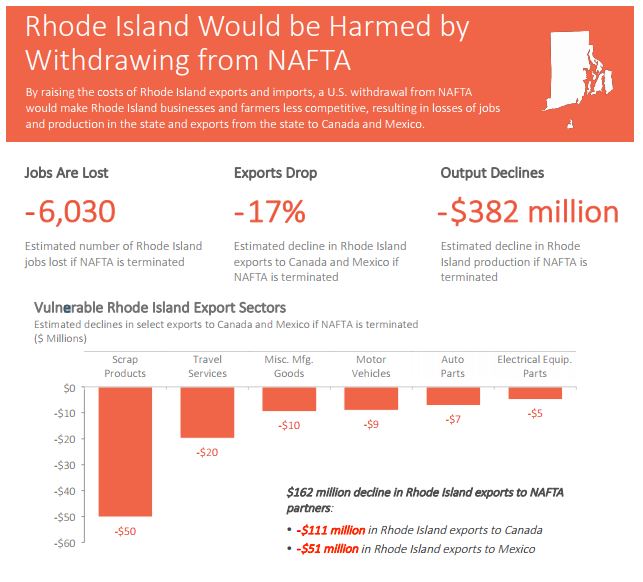
The short- to medium-term impact of Scenario A, which is an estimation of the 1-to 5-year impact, Rhode Island was estimated to lose $382.2 million of economic output. In Scenario A, the model suggests that Rhode Island exports to Canada would decrease by $110.7 million while exports to Mexico would decline by $51.2 million. Exports to the rest of the world would decline by $47.2 million.
Scenario A was also estimated to cause employment in Rhode Island to decline by 6,028 jobs.
The largest economic impact in the sate would be to the scrap product export sector, which could expect a $50 million decline. The second-hardest hit sector would be the international travel sector, which the report said could decline by $20 million.
The specific products expected to impacted by NAFTA include exports of eyewear, and jewelry and parts to Canada, and static converters to Mexico, all of which the report said would see an increase on tariff rates.
In Scenario B, the U.S. would raise Canada and Mexico’s tariff rates to MFN rates, Canada would also apply MFN rates to the U.S. However, in this more extreme situation, Mexico would apply Bound tariffs, or the highest tariff rate a country has agreed not to exceed in an agreement with the WTO. The impacts on the U.S. and local economy would nearly double that of those seen in Scenario A.
In this simulation, Rhode Island would lose $747.8 million in economic output in the short- to medium-term. In Scenario B, the model suggests that Rhode Island exports to Canada would fall by $80.1 million, while those to Mexico would experience a $175.7 million decline. Exports to the rest of the world would be expected to drop by $122.3 million. Employment decline as a result of the trade implications are estimated to be more than double that of Scenario A at 12,183 jobs.
Sector specific impacts for Rhode Island were not provided for Scenario B.
The report also concluded that the decision to terminate NAFTA would mostly benefit non-NAFTA members, specifically, China, South Korea, Japan and Germany. The study also notes that, “the cost of ‘nontariff measures’ were not included” in the analysis as well as the costs of employment transition or the costs of unemployment that would result from the increase in trade barriers and is therefore “conservative” in its estimation of the negative economic impacts.
Chris Bergenheim is the PBN web editor.