State officials hope a report released Monday highlighting the Newport Naval
Station’s impact on the economy will serve as ammunition in staving off the
Department of Defense’s next round of base realignment and closures.
The report issued by the Rhode Island Economic Development Corporation recognizes the survival challenges the Newport Naval Station faces doing highly specialized work in a state where the cost of doing business isn’t set at a bargain price.
The EDC hopes renegotiated utility contracts, coupled with the uniqueness of the work being performed at the local base (more specifically, at the Naval Undersea Warfare Center), will cancel out factors such as the wages the federal government pays to workers in an area with a higher cost of living.
Selling Luxury Real Estate Requires More Than Exposure
By Emilio DiSpirito IV License Partner | Private Office Advisor Engel & Völkers Oceanside www.DiSpiritoteam.com…
Learn More
The congressionally authorized “base realignment and closure round” will result in the closure of bases and facilities that are determined to have overlapping or inefficient functions. A year from now, the secretary of defense will submit a list of locations that are to be closed. Based on the four past rounds (the most recent in 1995), presidential and congressional approval of the recommended closings is usually granted by Thanksgiving.
“The short answer is that every base is vulnerable,” said Richard Reed, chief administrative officer of the EDC.
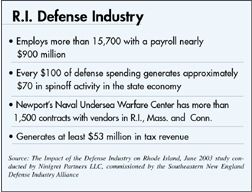
With a payroll of nearly $900 million according to a 2003 report issued by Ninigret Partners, the defense industry is a huge part of Rhode Island’s economy. Factoring in National Guard and Reserve Unit pay, along with military pensions, the dollar figure swells to more than $1 billion. Another $500 million of economic activity is generated by “spinoff” effects of dollars spent by the military or prime contractors.
Reed said a year ago Gov. Don Carcieri asked the group to begin preparing for the upcoming round, knowing that the Pentagon would be collecting targeted data throughout 2004. Last summer, the 15-member Rhode Island BRAC 2005 Commission began working on recommendations for the local naval base and considering the impact the defense industry has on Rhode Island’s economy.
Along with the naval station in Newport, Reed said other area bases that could be affected are the Groton Submarine Base and the Niantic Army Depot in Connecticut, as well as the Hanscom Air Force Base and the Otis Air Force Base in Massachusetts. But that doesn’t take into account the thousands of subcontractors, such as those in Quonset Point, who would feel the ripple effects of any defense downsizing in the area. According to the same 2003 study, NUWC alone has more than 1,500 contracts with outside vendors in Rhode Island, Massachusetts and Connecticut.
Reed said nationwide, estimates put the military with 20 percent more infrastructure than needed and said there are expected to be some tough decisions made in the next round of base cuts. “The low-hanging fruit has already been picked off in the late ’80s and early ’90s,” he said.
What makes the Newport base so special, Reed said, is the presence of NUWC, globally recognized as a leader in underwater defense systems. The commission’s recommendation paper mentions a study commissioned by the chief of naval operations in Newport that found the local base had among the highest overhead costs of any of the Navy’s military laboratories. Though historically, NUWC placed fourth in the 1995 BRAC “Navy Military Value Rankings” of dozens of facilities across the country.
There are valid questions about whether the center could ever be relocated and still have access to the intellectual capital it currently employs and whether a move would make sense after investing so much in the Newport facility.
At the same time, Reed said NUWC is located in a place that has several disadvantages including expensive housing, higher wages and utility costs and cited San Diego as the only other area with a comparable environment. And under the current administration, Reed noted that the military is being encouraged to run itself as more of a business – seeking out solid return on investment dollars and looking to curb operating expenses. He said if moving the operation south might be cheaper, the move is something the government would have to weigh against possible disruptions to the program.
In some senses, Reed said the Rhode Island base can feel secure about its positioning in the second tier of stations beside a handful of other locations with unique labs and functions, such as Mississippi, South Carolina and Washington. Due to the sheer density of the defense industry in top tier states such as California, Texas, Florida, Virginia and Hawaii, Reed said there is no way to compare the comparatively small operation in Rhode Island – though the industry’s effects do contribute relatively heavily to the state’s total economy.
The EDC has already participated in three measures over the last year, including reducing the naval station’s electrical rates through a settlement with Narragansett Electric and re-negotiating the station’s waste tipping fees at the Central Landfill in Johnston. The group is also in the process of working on a new agreement with the city of Newport, which delivers the base’s water supply.
Another factor in next year’s report may be jointness, a relatively new concept in the military that refers to allowing greater inter-service connections, allowing easier communication between the Air Force, Army and Navy.
“It’s going to drive a lot of what’s going on in the military now,” said Reed, who mentioned hardware decisions that are already being made in anticipation of integration improvements that will be made over the next several decades.
Right now, the bulk of the underwater research and development being performed at NUWC really only relates to the Navy. “That’s where the ability to conform to jointness standards gets a lot more problematic,” Reed said. “Its greatest asset is also its greatest liability.”
Bearing those negatives in mind, Reed said the EDC has already begun working with NUWC in three areas, looking to commercialize more of their intellectual property and partner with private firms; coordinate with other armed services on providing communication systems that do work together; and concentrating on possible homeland defense systems, which would count toward jointness requirements.
The EDC commission is now following up on meetings with the Rhode Island congressional delegation and will send off a confidential memo by June, outlining tactics they may want to consider as the BRAC 2005 winds its way through the federal bureaucracy. Greg McCarthy, press secretary for Sen. Jack Reed, said that next year’s report is something that has remained on the senator’s radar screen since the last report was released.
“The whole thing with the base closing commission is that it’s something that has to be stayed on top of over the long term,” McCarthy said. “The senator has been in contact with all the facilities and working to get the funding they need to stay state of the art.”
Reed said the presidential election at the end of the year should have very little to do with the final report, although he has heard rumblings from Washington, D.C., that the report could be delayed until 2007. Personally, Reed said he believes a delay might make sense, especially as the wars in Iraq and Afghanistan continue.
“The $64,000 question is how do Iraq and Afghanistan affect (the report) in the long term,” he said.
A legislative package is already winding its way through the state General Assembly, which will improve the benefits offered to members of the Rhode Island National Guard, which has filled only 86 percent of its personnel allocations. Reed said the bills would improve on insurance and education offerings and bring Rhode Island’s program up to par with Massachusetts and Connecticut.
He said bringing up the percentage of billets filled, to the mid-90s and showing a strong retention rate would show that the recruiting base would be able to support any realignment outside of the local area. The EDC has also been in contact with other legislators around New England, stressing that the Rhode Island delegation, along with those from Connecticut and Massachusetts, have a better chance to make their cases against the likes of larger groups from Texas or California.
The full report of the Rhode Island BRAC 2005 Commission is available off the group’s Web site at www.riedc.com.