It was once called the staff of life. It is one of the two staples Rhode Islanders panic over being without when a snowstorm is forecast. Culinary schools devote courses to it. And many who dine out often, including some professional restaurant critics, use it as a yardstick to measure an eatery’s quality.
Bread.
These days, it costs a lot more. This is causing concern among many restaurateurs who are developing strategies to keep their overhead down in the current inflation-stressed yet weakening economy. At a recent restaurant trade show I attended, one of the busiest booths was that of a major Northeast baker who was besieged with chefs and proprietors all desperately seeking a way to manage the soaring cost of their breadbaskets. Questions included the advisability of changing the formula or size of the loaf. Some are considering charging their dining customers for bread. The first basket is on the house but if more is requested, it would appear on the bill.
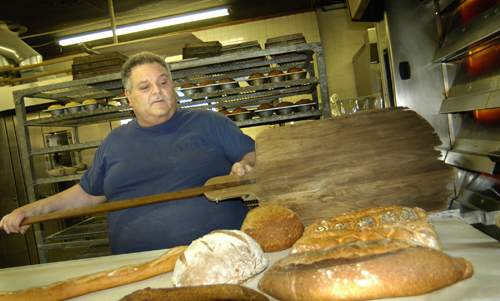
One local baker, Buono’s on Hartford Avenue in Providence, has taken a stand and will not change its recipe or reduce the weight of the signature Italian bread. Arnold Buono, his brother Frank and father-in-law Dan Amadio have been baking bread for restaurants and their retail bakery customers since the 1980s (Editor’s note: Bruce Newbury’s radio show is sponsored in part by Buono’s).
Arnie Buono describes the current situation in bread baking as “tender.”
The problem starts with the threefold increase in the price of flour over the past year, as a worldwide shortage of wheat works its way down to prices. The rising bread price is also tied in with the soaring cost of fuel, not only the transportation costs of trucking the unbleached, unbromated flour Buono’s insists upon, but also because of the increased use of ethanol in fuel.
“Ethanol is made from corn which is used to feed chickens. As the price of corn goes up, it costs more to feed them, which drives up the cost of eggs.”
Buono’s retail bakery customers are asking constantly about the situation. Are they buying less bread? Buono describes sales as flat. He is selling fewer egg biscuits and wine biscuits these days, which he says is a sign of tough economic times. At the same time, his wholesale business has remained strong.
Buono’s customers understand the current pricing situation. To head off misunderstandings, a letter was sent to all his customers explaining the increase in wheat prices at the beginning of this year.
But the steep rise in costs is affecting all aspects of the business. Buono’s California Mountain Bread, a dense, sweet loaf filled with figs and walnuts now costs more due to a sharp increase in the price of walnuts from California – Buono describes the price now as “out of sight.”
He has had to be creative to keep his artisan bread customers – and their wallets – happy. Last weekend, he was baking for the first time an old-fashioned New England bread known as Anadama, a yeast bread flavored with molasses and cornmeal.
One of Buono’s restaurant customers, Ezio Gentile of Sogno in Cranston, is fighting the bread battle on the front lines. At his Italian restaurant, waitstaff are now asking customers if they would like bread and about 30 percent decline the offer. Gentile speculates this may be a dividend from the ‘no-carb’ craze of a couple of years ago, but he is not complaining.
Back at the bakery, Arnie Buono is optimistic. “We’re talking about something that grows in the ground. In a year or two the wheat situation will resolve itself [with better harvests].”
What may take longer, if it ever is resolved, is the man-made stress on the food chain that results from turning food into fuel. •
Dining Out with Bruce Newbury (bruce@ brucenewbury.com) can be heard on TalkRadio 920 WHJJ-AM Fridays at 6 p.m. and Saturdays at noon.