In accepting this award, largely what I’m doing is accepting recognition for work done by others, work done by the people sitting at that table over there as well as the others at NABsys who couldn’t make it tonight.
In particular, I’d like to recognize Dr. John Oliver, vice president of research and development and NABsys co-founder. John has a deeper understanding in a larger number of disciplines than any other scientist I know, and his acumen has been key to the continued success of NABsys. So, as always, John, thank you for making me look good.
The NABsys team has now grown too large to name everyone independently, but to give you a sense of the type of team we’ve put together, I’ll tell you about the person we hired yesterday. He has two Ph.Ds. He is a tenured professor. He has two other degrees from Caltech. We hired him to focus on a particular problem, a problem on which he has just published a textbook, probably the only textbook in the world on the topic, as it happens.
He lives 1,000 miles away. He’s married with children and he was very eager to accept our offer, leave his tenured position, and move his family to Providence.
So the question is, what is so compelling as to prompt this kind of behavior?
I’d like to try and explain it this way.
The NABsys team has figured out a way to use semiconductor technology to build chips that can analyze individual DNA molecules. Imagine chips that look like the computer chips in your laptop or in your smartphone, but that can read DNA molecules electronically as they flow through the chips. These chips can get information from DNA that no other technology can get.
We believe that this technology will allow the scientific and medical communities to develop the same confidence in treating systemic diseases like cancer that we now enjoy when treating infectious diseases. While people do of course still die of infections, when you get sick or when you scrape your leg, it doesn’t occur to you that you’re likely to die. We believe that it is possible to achieve this same level of confidence when it comes to cancer.
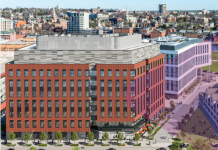
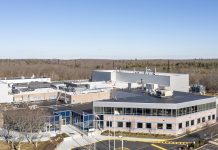
A couple of weeks ago, Gov. Lincoln D. Chafee and many others attended the grand opening of our new R&D facility on Clifford Street in Providence, on the edge of what many are calling the Knowledge District. Now NABsys is known nationally and internationally in our field, and I’m frequently speaking to people in the life sciences field, in biotechnology, from other parts of the country and other parts of the world, and almost invariably they ask me, “Why are you in Providence, Rhode Island?”
Part of that answer relates to the fact that I’m from Rhode Island. I grew up in Warwick and East Greenwich, and I’ve lived in Providence since starting college. Part of it relates to all the things that are great about the city and the state. A lot of it has to do with all the things that aren’t great now but that could be great. Things like the economy. The reason I know that they can be great is that they were once great.
When I walk around downtown Providence, the architecture reminds me of Rhode Island’s historical position as one of the wealthiest places on the planet. This wealth derived from the state’s leadership position with respect to the technology of the day, manufacturing.
While it may be difficult to tell right now, given the state of the world’s financial institutions, we are in fact, as a nation and globally, on the verge of another technology-fueled economic boom that is expected to result in a greater increase in global GDP than either the Industrial Age or the Information Age before it. It is called the Biotechnology Age. Its arrival results from the fact that science, and particularly biology, has advanced to a point where knowledge is increasing at an exponential rate.
I had lunch today with a mentor of mine, a gentleman who won the Nobel Prize for one of the truly great discoveries in physics. He talked to me about how many of the problems that were thought to be completely intractable when he was young have now been solved.
In that vein, I’d like to thank the NABsys team members again for dedicating their considerable intellectual resources to solving the most challenging and most important problems in science. And I’d like to thank the organizers, as well as my fellow award winners, finalists and nominees for their determination that innovation can indeed solve any problem. •
Dr. Barrett Bready is the president and CEO of NABsys Inc. This piece is an edited version of his acceptance speech at the Providence Business News 2011 Innovation Awards ceremony, during which he was named Innovator of the Year.
Beyond Cash Donations: How New Forms of Giving Are Transforming Not-for-Profit Accounting
Evolving Funding Landscape for Not-for-Profits Not-for-profit organizations are being asked to do more with less,…
Learn More