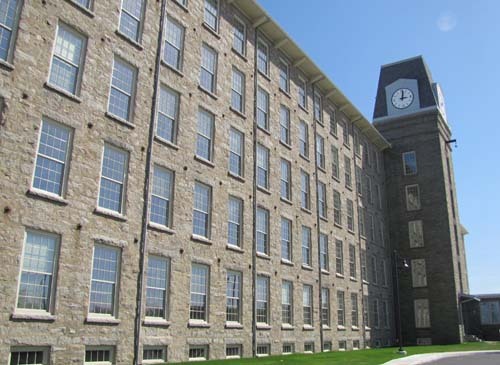
The $43 million conversion of a Tiverton mill into residences and the $13 million restoration of AS220’s Mercantile Block in downtown Providence are two of the real estate developments undertaken in Rhode Island last year due in large measure to financing from Bank of America’s community-development initiative.
The nation’s largest bank, based in Charlotte, N.C., Bank of America in 2008 announced its intention to devote $1.5 trillion to community development throughout the United States over the next 10 years. Financing is in the form of loans and investments in communities that the bank said have been underserved in the past, with a focus on low- and moderate-income populations and minority customers.
“The importance of extending credit and making direct investments into America’s underserved communities cannot be overstated as our nation’s economic recovery depends on the stability of these neighborhoods,” said Andrew D. Plepler, an executive who oversees the bank’s global, corporate, social responsibility and consumer policy.
During 2009, the bank provided $168 billion in community-development lending and investments, according to a one-year update the bank issued in May. Of that amount, more than $708 million was spent in Rhode Island, officials said, in the areas of affordable housing, small-business lending, consumer lending and economic development.
Maria F. Barry, community-development banking executive with Bank of America, told Providence Business News her team provides financing options primarily for rental housing and multifamily developments, with low-income housing tax credits involved in most of its projects.
Bank of America is seldom the only source of funding, she noted; government subsidies, grants or other bank financing usually round out a project’s portfolio.
In Rhode Island, Bank of America financing helped make possible renovation of the main building at the Bourne Mill complex. The five-story former cotton mill is now a multifamily housing development with 67 of its 166 units devoted to residents who earn less than 60 percent of the area median income, Barry said.
Bank of America provided $21.1 million in a construction and tax credit bridge loan, along with a $9.3 million equity investment through use of federal historic tax credits. The developer was E.A. Fish Associates based in Braintree, Mass., whose principal is Edward A. Fish.
Bourne Mill Apartments includes one- two- and three-bedroom residences, including lofts, flats and townhouses, with such amenities as a pet park, a library and a 24-hour fitness center.
In Providence last year, Bank of America provided $3.69 million to help finance the AS220’s $13 million restoration of the four-story Mercantile Block at 125-135 Washington St., which dates back to the early 20th century. In addition to the construction financing, the bank purchased federal historic and new markets tax credits generated by the development, according to information from the bank.
Work on the project began in May 2009 and is scheduled for completion in September. The first floor will offer space for commercial tenants, including AS220 labs and print shop, with 11 studios for artists on the second floor and 22 artists’ live-in studios on the third and fourth floors. Sixteen of the live-in studios will be affordable.
Rhode Island Housing also provided financing, as did the city of Providence revolving fund. AS220, founded in 1985, is a nonprofit arts organization that also owns the former Dreyfus Hotel on Washington Street and the mixed-use arts complex at nearby 95-121 Empire St. Barry noted that Bank of America helped finance renovation of the Dreyfus Hotel several years ago.
Bank of America this year has provided financial backing for conversion of the former Stillwater Worsted Mill in Burrillville into 47 apartments that will be offered at both market and affordable rates. Of the total $19.8 million project cost, $4.8 million is coming from Bank of America in the form of a construction and bridge loan, Barry said. NeighborWorks Blackstone River Valley, based in Woonsocket, is the developer. •