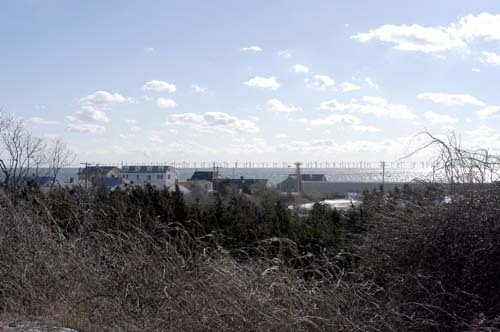
Work is slated to begin next month on a complete zoning blueprint for the state’s ocean waters, which could clear the way for a private developer to eventually build an offshore wind-energy farm.
A team of scientists, engineers and other researchers will collaborate on the Ocean/Offshore Renewable Energy Special Area Management Plan (SAMP) starting Aug. 1. The SAMP program, established by the U.S. Congress in 1972, allows states to draw up a comprehensive set of detailed regulations for how a coastal area can be used.
“The SAMP will expedite the permitting of an offshore wind farm capable of supplying 15 percent of Rhode Island’s electric energy usage, fulfilling my goal to reduce the state’s dependence on fossil fuels and foreign sources of oil and natural gas,” Gov. Donald L. Carcieri said in a statement.
The Ocean SAMP project will create the equivalent of municipal land-use zoning for the ocean. Instead of commercial, residential and industrial property zones, the SAMP will designate zones for things like marine fisheries, cable cords, protected habitats, shipping lanes and ferry routes, as well as wind farms.
“What, in essence, you’re coming up with is an allocation plan for our offshore resources,” said Grover Fugate, executive director of the R.I. Coastal Resources Management Council (CRMC), who is leading the project.
Earlier this month, the trustees of the Rhode Island Renewable Energy Fund, which is funded by an electricity-bill surcharge, agreed to provide $3.2 million in funding for the two-year project, which will be a joint partnership between the CRMC and the University of Rhode Island. Fugate said he will seek further financial assistance from private foundations and possibly the federal government. The money will be used to pay for salaries, studies and other costs.
The development of the Ocean SAMP is “the fastest, most efficient and cost-effective way to approve and site offshore renewable energy projects,” according to a report to the Office of Energy Resources, because it will proactively tackle the huge assortment of state and federal regulations that impact the Rhode Island coast.
Businesses will be able to begin the permitting process for a wind farm during the second year of the SAMP’s development, according to the report.
The alternative would be the development of an Environmental Impact Statement, which “could optimistically take at least five to seven years,” as opposed to the two-year timeline to create the SAMP, the report said.
Wrangling over an Environmental Impact Statement has resulted in years of delays for Cape Wind, the controversial wind farm development proposed for nearby Nantucket Sound.
Rhode Island, unlike most states, has had water-based zoning since 1983, and the CRMC has won international recognition for its work in implementing it. That gives Rhode Island a leg up over other states and also puts it in the forefront of wind farm development, Fugate said.
“We’re the first one off the block with this process,” he said. “The whole country is watching this.”
Until now, the state’s offshore waters have been designated as “multipurpose,” a catch-all category encompassing all the current uses for the coastal zone. But with wind farms looming and other mounting pressures on the coast, Fugate said, “It’s clear to us that what we need to do is start to get a little more fine-grained in our approach to the ocean waters.”
Although previous studies have suggested the best place to locate a wind farm would be off Block Island, Fugate said his team plans to conduct new research to make sure that’s really the case.
Environmentalists expressed guarded optimism about the SAMP process, despite their frustration with the governor’s recent veto of renewable energy legislation.
“Our interest is in getting an offshore wind farm developed in an environmentally friendly way,” said Matt Auten, an advocate for Environment Rhode Island. •