
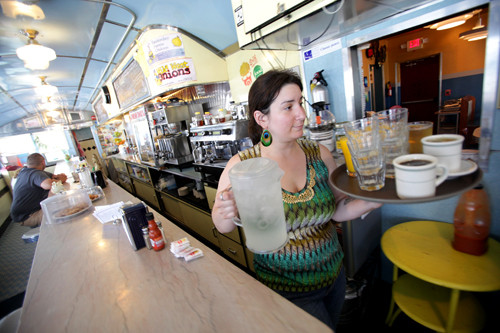
For the last two years, Carol DeFeciani has scrambled to keep the doors open at Liberty Elm Diner in the Elmwood section of Providence.
It’s not so much the sputtering economy or skittish lenders that have caused her grief. It has been the state of Rhode Island.
DeFeciani, the diner’s owner, was notified by tax collectors who visited the eatery in July 2009 that the business owed thousands of dollars in sales taxes. The revenue agents ordered the restaurant to shut down at once until the tax bill was paid.
Liberty Elm Diner was one of 1,294 Rhode Island businesses that had similar visits that July.
After working out a payment plan that allowed the diner to stay open, taking out high-interest loans, accepting gifts from friends, family and supporters and making “shared sacrifices” among her staff, DeFeciani says she recently finished paying off the $25,000 bill, including the interest and penalties.
“We had a deep hole to dig out of, and we worked very, very hard to do it,” said DeFeciani.
Now the state is at it again, showing up this month on the doorsteps of hundreds of retailers and restaurants that have failed to turn over the sales taxes they were supposed to collect on behalf of the state. The message from tax officials is the same: Lock your doors until you pay what you owe.
The R.I. Division of Taxation says it gave businesses with sales tax permits plenty of notice that they had fallen behind on tax payments.
With the one-year permits set to expire June 30, the state sent letters each month since March – 4,757 businesses received the initial notice – warning that new permits would not be issued without clearing up their tax situation.
This month, 1,295 delinquent businesses have been visited, or will be soon, and told they must cease operations immediately.
The annual effort – called the Sales Tax Permit Renewal Block Program – has paid off for the state. It brought in $4.47 million in taxes, penalties and interest in 2009, another $4.1 million in 2010, and $1.48 million so far this year, according to Peter McVay, the Division of Taxation’s associate director of revenue services.
While about 60 percent of the businesses that are ordered to close reopen almost immediately after paying back taxes, another 20 percent are closed for days or weeks while working out a payment plan, and another 20 percent never reopen.
So far in the month of July, agents have visited between 50 and 100 businesses each day, ordering them to lock their doors. Most business owners comply without incident.
“People might get testy about it,” McVay said. “But they shouldn’t be surprised.”
While most of the closures happen quietly, the Sales Tax Permit Renewal Block Program sometimes makes news.
Last year, tax agents interrupted breakfast at Jigger’s Diner, a popular East Greenwich restaurant on Main Street, and advised employees and customers the business would be closed for failing the remit sales taxes. People were allowed to finish their meals.
The diner didn’t reopen for four months.
In 2009, East Providence pet store Dr. Doolittle’s Pets & More was shut down for being in arrears on its sales taxes, although owner Donald Russell Jr. was allowed to feed the animals that were left inside.
Russell was able to reopen two weeks later, after he worked out a payment plan. Dr. Doolittle’s closed again in September 2010, this time because of the economy. The business still owed back taxes and penalties.
Some business owners who experienced closures have grumbled that state tax officials are inflexible in reaching payment agreements.
DeFeciani, the Liberty Elm owner, said she was surprised tax officials wouldn’t forgive at least some of the penalties or interest when she approached them about an installment plan.
McVay said the Division of Taxation has been willing to discuss waiving some penalties and interest earlier in the process, but not after businesses are ordered closed.
“To get to that point, they’ve ignored prior notices,” he said. “And [seeking a payment plan] is not something they’re doing on a voluntary basis.”
In 2009, the Sales Tax Permit Renewal Block Program garnered attention in part because of the number of business owners who flooded the Division of Taxation – some angry, some frustrated – after they were told they were out of business until they paid their delinquent sales taxes.
The following year, the state staggered notifications so the shutdown orders take place through July and into August, reducing the lines at the Division of Taxation. Tax officials also allow business owners to make appointments with state revenue agents, McVay said.
Things also have changed at the Liberty Elm Diner, a renovated 1947 Worcester Lunch Car that DeFeciani opened in 2007.
Business has picked up significantly since The Food Network featured the diner on its show “Diners, Drive-Ins and Dives” – a segment that filmed in 2009 just before tax officials arrived to close down the eatery.
The show has rerun three times since, bringing a fresh flood of tourists each time, DeFeciani said.
The first-time business owner said she knew she was supposed to set aside sales tax, but when the bottom dropped out of the economy in 2008, she decided to use the money to buy inventory and pay her 12 employees. The alternative was to close.
“If I didn’t do what I did, we would not exist right now,” she said. “I basically kept the doors open by doing it.” •







I’m sorry, but I have no pity for any of these folks. One of my business is a retail business and I pay my sales tax to the state on time every time. It’s easy and they give you plenty of leeway to pay. Only when you have neglected it to the point of rediculousness does the state step up. These business owners (mostly those rock-n-roll locals I lam fond of putting down by pointing out their lack of education and talent) created their own mess. I certainly hope no one blames the state for these people’s poor business practices.