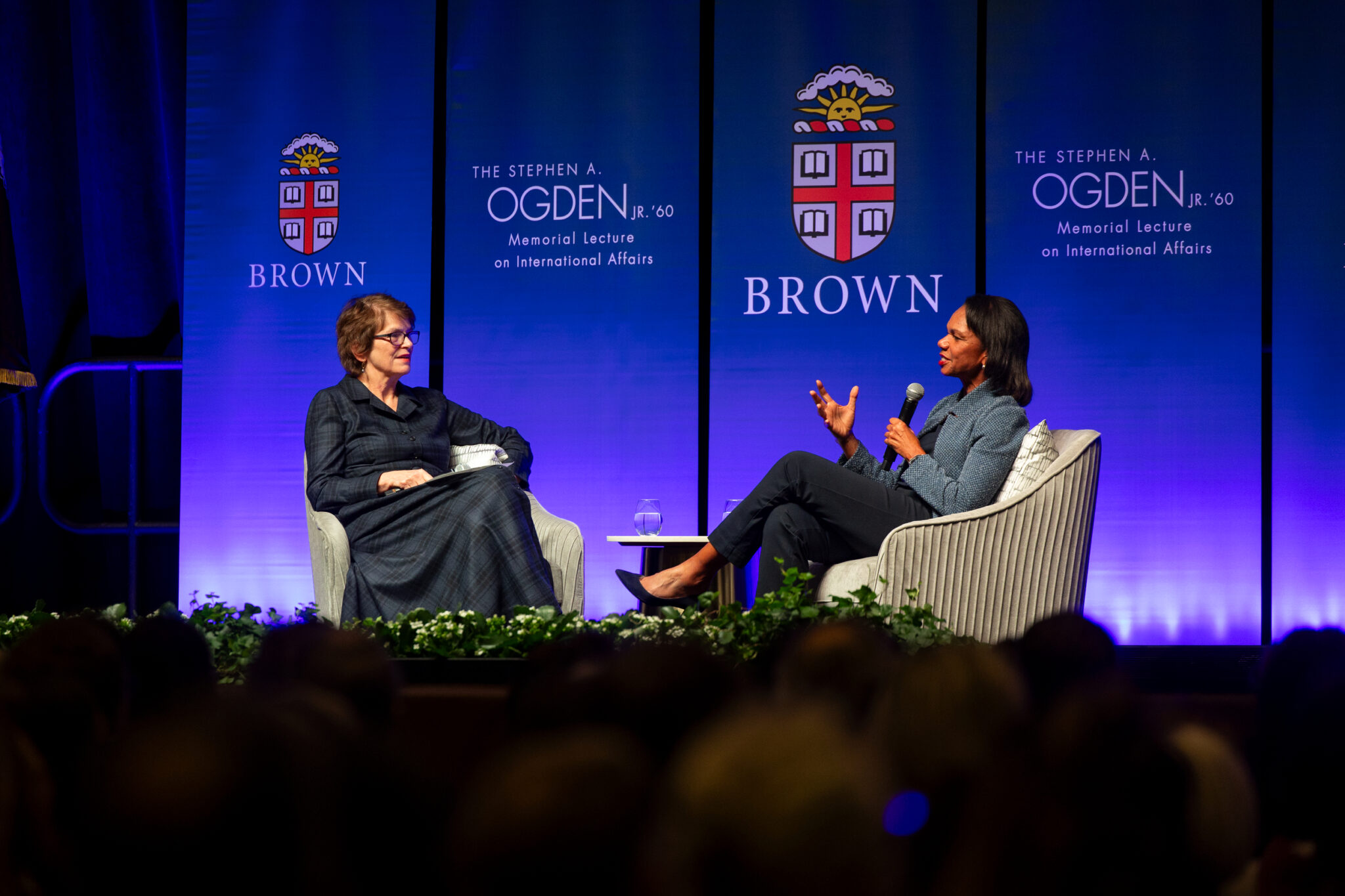
Over two decades after the United States invaded Iraq, former Secretary of State Condolezza Rice admits she has some regrets over the decision.
She wishes intelligence officials during President George W. Bush’s administration had known in 2003 that the reported weapons of mass destruction were not being rebuilt to the extent initially believed.
Building a Strong Data Foundation in the Age of AI
Artificial intelligence (AI) has become a key priority in the boardroom and across management —…
Learn More
And she laments the lives lost on both sides during the eight years of conflict, which killed over 4,400 U.S. service members and wounded over 30,000, while an estimated 200,000 Iraqi civilians died.
But Rice, 70, said she still believes the U.S. made the right decision in toppling Saddam Hussein’s regime.
“I do believe that the world is better off without Saddam Hussein,” she told the crowd of 1,200 sitting inside Brown University’s Pizzitola Sports Center Wednesday evening. “[They’re] beginning to develop a fragile democracy, but nonetheless a democracy. If we stand by them, I think they can get it right.”
Rice’s reflection on one of the century’s most controversial military actions came about during an hourlong question-and-answer session evening as part of its Stephen A. Ogden Jr. ’60 Memorial Lecture on International Affairs.
Over the years, Brown’s Ogden Lectures have featured prominent speakers such as the Dalai Lama, former U.K. Prime Minister Teresa May, and the final leader of the Soviet Union, Mikhail Gorbachev.
Rice’s successor as the nation’s top diplomat, Hillary Rodham Clinton, spoke before a crowd of 1,800 on Oct. 30.
“This year we’ve had two Ogden lectures in two consecutive weeks given by two amazing former secretaries of state,” University President Christina Paxson said in her introductory remarks. “This is certainly a first in Brown’s history.”
While Rice still backs the Iraq War, she said she feels “a real sorrow” for Afghanistan, where U.S. forces pulled out under President Joe Biden in 2021.
“If I had known we were going to be that impatient with a country that was coming out of civil war, maybe we would have done something differently,” she said. “I feel especially bad for the women of Afghanistan – we gave them a chance over 20 years.”
Many of Rice’s remarks echoed some of the responses given by Clinton the week before. She expressed a similar disdain for Russian President Vladimir Putin, saying he operates at only two speeds: oppression and intimidation.
In 2007, Bush administration officials were in Russia to address the pressure Putin’s government was placing on neighboring Georgia – parts of which Russia went on to occupy in 2008.
Rice and Putin were on opposite couches when he quickly stood up to peer over her. On instinct, she said she stood up too.
“In heels, I’m sort of 5’10” or so – he’s not,” she said, eliciting some laughs and applause.
Similar to Clinton, Rice commended the Trump administration for negotiating a cease-fire between Israel and Hamas and agreed that peace in the region will only be achieved if other Arab Gulf Nation states play a role.
Though Rice said she believes leaders in the Middle East are ready to move on from the war.
“The Arabs would like to get on with modernization,” she said.
Rice recalled a recent trip to Saudi Arabia, Abu Dhabi and Dubai, where she said Palestine was mentioned only once.
“The rest was about data centers and AI.” she said.
Rice is especially passionate about artificial intelligence and the need for the United States to be on the cutting edge of such technology, as she serves on the board of directors for C3.ai. Right now, she said it’s a race between the U.S. and China.
“I want democracy to win this race,” she said. “If there’s going to be a generally intelligent robot, I want her to speak English, not Chinese.”
But Rice, the director at the Hoover Institution on War, Revolution, and Peace at Stanford University, said she’s worried that the nation may not mobilize quickly enough to win the race if federal funding is taken from research universities.
“Fundamental research is done in universities,” she said. “You won’t find anyone more capitalistic than I am, but I don’t want all of the innovation to be in commercial entities.”
Rice took some shots at the foreign policy approaches taken by the Trump administration, even though she never said the president’s name. She criticized his decision to clamp down on student visas.
“The United States has to be a place that welcomes the best talent from all over the world,” Rice said.
She also mentioned the need to speak up for immigrants.
“This country is a country of immigrants,” she said.