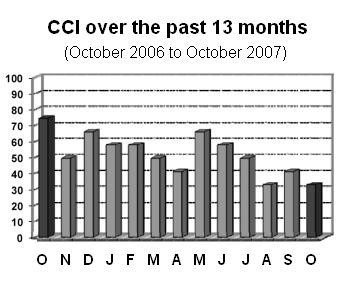
KINGSTON – The fourth quarter began on a “very disheartening note for Rhode Island,” University of Rhode Island economist Leonard Lardaro wrote in his October report, adding that, although the national economy “remains very strong but moderating, data for Rhode Island’s economy paints a very different picture.”
His Current Conditions Index – which measures the strength of the Rhode Island economy by following the behavior of 12 indicators – fell to 33 points in October, matching its August value, after rebounding in September to 42 points.
“The high point of the past four months came in July, when the Current Conditions Index was 50, its neutral value,” Lardaro wrote. “Things have clearly deteriorated since that time.
“CCI values from August through October have all been in the contracting range (below 50) as no more than five of the 12 CCI indicators have improved in any of these months.”
October saw improvement in four indicators, all work-force related: Private service-producing employment increased 1.3 percent from their year-ago level; the average manufacturing wage rose 3.9 percent; the state’s labor force grew by 0.3 percent; and despite the larger pool of workers, the Rhode Island unemployment rate fell from the year-ago 5.1 percent to 4.9 percent this October. “The fact that our labor force rose makes the decline in our unemployment rate even more significant,” Lardaro noted.
Yet, Lardaro noted, declines were seen in each of the four components that serve as leading indicators.
• The number of employment service jobs – a category that includes temporary workers – “fell by an additional 10.5 percent, its third monthly decline and a long way from its string of double-digit increases … from last October through March of this year.”
• New initial claims for unemployment insurance rose for the 11th time in the past 12 months, despite a recent adjustment in eligibility of senior citizens.
• Single-unit permits for housing construction fell 46.3 percent compared with October 2006; “while there was a somewhat difficult ‘comp’ last year,” Lardaro said, “recent levels … remain barely above 100 units each month.”
• And total manufacturing hours – the final leading indicator in the CCI – continued to decline, falling 3.4 percent year over year. “Manufacturing weakness appears to be intensifying,” the economist said. Paired with the rise in the manufacturing wage, he noted, the decline in hours may indicate a skills shortage in the manufacturing sector.
“Other indicators have turned in fairly predictable performances,” Lardaro said. “As housing and manufacturing continue to weaken and food and energy prices rise, weakness in consumer sentiment and retail trade have intensified.” The Reuters/University of Michigan Consumer Sentiment Index fell 13.5 percent from its October 2006 level. Retail sales fell 1.9 percent in its eighth monthly decline of the past year. “And, to nobody’s surprise, government employment fell again in October.”
The bottom line, Lardaro said, is that “based on the performance of the CCI over the past four months and an analysis of other state economic indicators, I can no longer reject the possibility that Rhode Island is now in the early stages of a recession. … If this is true, balancing our state’s budget will be far more difficult than it has been up to now.”
The Current Conditions Index, created by University of Rhode Island economist Leonard Lardaro, measures the strength of the state’s economic climate; values above 50 indicate the economy is expanding. Additional information, including historic data, is available at members.cox.net/lardaro/current.