
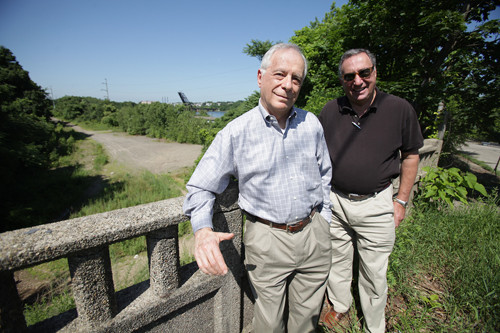
Joel and David Cohen have been anxious to redevelop two properties near the East Providence waterfront for decades. There’s just one hitch: no direct road access.
That is slated to change in fall 2012 when the R.I. Department of Transportation plans to complete the next leg of Waterfront Drive. Developers and city officials say that the 1.1 miles of new roadway could usher in a new wave of development in an area now reachable only after navigating a maze of small residential streets.
“We’ve been waiting patiently for this for decades, since we were in knickers,” Joel Cohen said.
In June, workers from contractor Cardi Corp. broke ground on the stretch of roadway that will follow an old railway line and link Warren Avenue to Dexter Avenue. The $6.6 million road will traverse barren swaths of land as well as some old mill properties, including one owned by the Cohens.
Located where Waterman Avenue meets the Seekonk River, the seven-acre property has been in the Cohen family since the late 1960s. Long underutilized, the Cohens think the new road – which will abut their property – could open the door to a development featuring commercial activity and residences.
The road will also abut a property that the brothers own on Dexter Avenue. There, the brothers think a roadway will strengthen the industrial capacity of the half-vacant, eight-acre site.
“The road is going to make a lot of difference in the East Providence economy and the state economy,” Cohen said.
In the short term, the project will create between 40 and 50 construction jobs. Of the project’s cost, $1.8 million will flow from the U.S. Economic Development Administration, $2.7 million from the city and the balance from federal and state sources. The state stepped in to build the road to lessen the burden on the city, a DOT spokesman said.
“If you build it they will come,” Rogers said. “I think there is a need for it.”
In 2003, city officials adopted a formal plan for the 300-acre Waterfront District that called for a network of smaller districts each with a different focus. Some would be set aside for industrial use, other areas for residential and others for a mix of commercial and residential development.
Rogers said he is confident that the plan will not spark controversy, as happened across the river when Providence proposed changes to its waterfront. The mayor said East Providence officials learned from their counterparts’ missteps and took pains to involve the business community in planning.
Those plans also include a ramp from Interstate 195 that leads directly to Waterfront Drive. City Planning Director Jeanne Boyle said that new ramps and an extended Waterfront Drive should boost appeal of the surrounding area.
“You’ll certainly foster more development not just in this particular section but in the entire waterfront [area],” she said.
Developers say that even beyond those acres a new roadway holds promise simply because it will strengthen a north-to-south connection in a city with a transportation pattern laid out during the horse-and-buggy days.
East Providence developer Colin Kane, a principal at Peregrine Group, said motorists have about six different options to get from the south side of town to the north side of town, “none of them obvious.”
“It’s awesome,” Kane said of the new road. “Quite frankly the hardest challenge that section of [town] has had … is the access to all of those neighborhoods.”
And it already proved important. Plans call for the development of 600 condominiums and townhouses along with retail space on a former Chevron Corp. tank farm along the waterfront. To connect the $220 million Village on the Waterfront with Waterfront Drive, developers will extend the first leg of Waterfront drive 1,800 feet south to the property line and then another 3,500 feet through the site.
“If it wasn’t for the road we wouldn’t be going to this site,” developer Michael Hennessey said.
And Tockwotton Home may have stayed away. The elder-care facility is planning to relocate from a half-mile away on East Street.
Executive Director Kevin McKay said that without the road, Tockwotton would have had difficulty moving forward with the $52.2 million project on a 12-acre plot. The home would have needed to build its own extended driveway – likely at considerable cost – and would have been isolated from the surrounding roadways.
“We don’t necessarily need it but we think it’s great because it would bring more of the community down to the waterfront,” McKay said.
And if planners have their way, the road may eventually open up even more waterfront land to easier access. The city and state are working on long-term plans that would extend Waterfront Drive north to Beverage Hill Avenue in Pawtucket. The DOT estimates that the road, with the third leg, would allow access to some 285 acres of property.
For the Cohen brothers, Waterfront Drive is turning out to be a dream come true.
“It’s definitely charged our optimism,” Joel Cohen said. •












Is this project being done in accordance with any environmental concerns?