Armed with nothing more than a poster-board-sized aerial photograph, a clipboard and some handouts, Kandee Deck offered her pitch to anyone at the Rhode Island Spring Flower & Garden Show who would listen.
“Would you like to help save Rocky Point?” she asked time and time again. Less than an hour later more than 50 passersby had provided their names in support of a new foundation that wants to convert the closed Warwick amusement park into a public waterfront oasis.
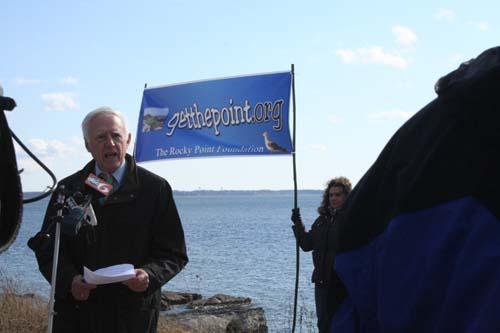
Launched publicly about a month ago, the Rocky Point Foundation’s proposal is the latest in a string of ideas to redevelop ruins of the park that closed in 1995 after nearly 150 years in operation. The foundation’s president, John Howell, said the group aims to persuade the General Assembly to put a roughly $15 million bond referendum on the November ballot that would pay for the purchase of the land. His group has deployed an army of volunteers to collect signatures from across the state and lobby lawmakers to purchase 83 acres now held in receivership by the U.S. Small Business Administration.
“You couldn’t get a better time than right now, the market is so down there are no developers looking at this,” said Howell, a Warwick resident who owns the Warwick Beacon newspaper. “If you don’t do it now, the opportunity’s not going to be there.”
Details such as who would actually sign the deed have yet to be worked out, but ultimately Howell would like to see the city own the land and merge it with the 41 acres of the former park’s waterfront property Warwick purchased in 2008 for about $4 million.
Purchasing the land is not as simple as approving a bond question, however. Federal receivership rules require the highest bidder get the land and that a federal judge approve the purchase. And if the state or some other entity offered any money for the land, it would almost assuredly trigger a request for bids on the property, said Mark Hayward, district director for the Rhode Island SBA office. And the property would all go as one piece, leaving no room for an entity to purchase the park piecemeal.
Still, the proposal to secure the land for public use has brought support from the city, said Warwick Mayor Scott Avedisian. While the city holds no formal role in the foundation, Avedisian has met with Howell and his group.
“We’ve been worried about development from the very beginning,” Avedisian said. “I’m less concerned about it at the moment because we already own the shoreline … but there’s always the possibility that somebody’s going to walk through the door and say ‘I want to build something.’ ”
After those plans fell through, the R.I. Department of Environmental Management announced it would attempt to cobble together enough money to purchase the land, connect it to the city-owned property and create a state park. Early last year the State Properties Committee granted a request by DEM Director Michael Sullivan to start surveying the land, but the agency’s request to put an open-space bond on the ballot never found its way into the budget recommended by the governor.
Sullivan told Providence Business News that the troubled economy and state budget deficits made putting forward any bond proposal difficult. And he said one focused narrowly on one specific project runs the risk of appealing to only a small portion of voters. He pointed out that in 2008 voters rejected a question to support renovations solely at Fort Adams in Newport.
“Would somebody from Newport vote to support a Rocky Point-alone initiative, or somebody from Pawtucket? I don’t know,” Sullivan said.
He also questioned the $15 million price tag, saying it went “well beyond” the appraisals conducted by DEM, though he declined to disclose specific numbers. Sullivan said DEM is still interested in purchasing the property but would also support other efforts to preserve it as open space.
It appears support from voters will be required. In its first six weeks, the Rocky Point Foundation raised about $3,000, Howell said.
The city and DEM both say they have little money to spare. So Howell has been meeting quietly with senior leadership in the General Assembly and seeking support of neighborhood groups that previously worked to stop development at Rocky Point.
Recently, the foundation received a batch of 10,000 “Get the Point” bumper stickers. Appearances at events such as the flower show will become more common as the foundation works to shore up support among the public and lawmakers. The foundation has also taken pains to reach out to groups across the spectrum before launching a formal push on Smith Hill.
Until someone acquires the land it will remain off limits to the general public. The city does not own the road leading to its 41 acres and the land abuts the SBA-controlled 83 acres, which contain some decaying buildings that pose a safety hazard, Avedisian said.
A sentimental desire to open the land to the public is what the foundation hopes will spur voters to approve the state taking on additional debt. Howell said it is not up to him to decide how the land should be used, but all that is clear, he says, is residences should not take the place where the Log Flume ride once stood, or where high school students worked their first jobs at the midway or dozens of people strolled on their first date.
Indeed, something about Rocky Point pulls at people’s heartstrings. People streaming by the foundation’s table at the flower show offered up a mix of fond memories of what was once Rhode Island’s most popular attraction.
Matt Barron recalled the park vividly as a place to kick back or attend concerts between consulting jobs in the state. Helen Lusi recalled eating at the diner with her family and taking a dip in the salt water pool with her children.
The foundation has already had some success converting such memories into tangible support. The table at the Providence flower show was technically part of a display organized by the Rhode Island Nursery & Landscape Association. The chairman of the flower show committee, Ken Quaranto, holds a soft spot for Rocky Point and agreed to host the foundation. Plus, the foundation seemed like a fitting sideshow to the association’s display, which sought to recall Crescent Park, another shuttered Rhode Island amusement park that was in East Providence.
Today, most of Crescent Park is paved over with houses where the rides – and memories – once stood. For Quaranto and other people who remember both parks, the similar destruction of Rocky Point would be devastating.
“I’ve been there so many times and I’m just disheartened to learn the developers are lurking in the background. But we will prevail,” Lusi said while clutching a handout about the foundation and promising her support. •