When the U.S. Navy base in Quonset shut down in the 1970s and its land was turned over to the state for economic development, there were still thousands of Seabees – members of the U.S. Naval Construction Battalion, i.e. CBs – living in Rhode Island.
“The vast majority of them were enlisted men, not officers, which meant that they went out and became carpenters and plumbers in Rhode Island,” Jim Rugh, vice president of the Seabee Museum & Memorial Park, said recently. “And they felt a real kinship with the base. It had been a part of their lives for four years to 20 years, depending on how long they were enlisted.”
Those Seabees, he added, recognized a unique local history of the battalion – originally formed, named and given its signature bee insignia in Quonset – and its Quonset huts as something that should be preserved. Now, years later, an all-volunteer nonprofit group is in the middle of a two-year fundraising effort going strong despite the economy. The group already has enough cash to paint its seven Quonset huts camouflage at $3,000 each and to install a fully insulated hut to put its collection on display year-round.
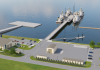
With ongoing growth at that museum, the nearby Quonset Air Museum and a decade of work in creating the USS Saratoga Experience – a project that’s been in jeopardy since March – the state could become a strong draw for tourists interested in military history. So far, however, the independent museums have done little cooperatively, and the museum planned around USS Saratoga, a World War II-era aircraft carrier, is looking for a home.
The Seabee and the Quonset Air museums share a few board members, but that’s the extent of their official relationship, Rugh said. And there is no formal connection between the planned Saratoga museum and the two others, USS Saratoga Museum Foundation Inc. Chief Frank Lennon said.
Rugh added it is unclear whether the museums would ever be able to collectively market their offerings, “although certainly [the Saratoga] is an ambitious plan. Certainly a major tourist draw would help everyone in the area.”
Lennon said the initial decision to berth the Saratoga aircraft carrier at Quonset was not driven by the nearby museums. But, he added, the interaction between the museums can be “as much or as little as they want it to be. … The greater the critical mass, the more successful the entire complex will be.”
R.I. Director of Tourism Mark Brodeur says a collection of museums could draw military veterans to Rhode Island. Along with the Providence-Warwick Conventions & Visitors Bureau and the Newport County Convention & Visitors Bureau, Brodeur has been pitching Rhode Island to military groups that are planning reunions. And many of those groups have some connection to Rhode Island, he added.
“For instance, we know that officers – if you were an officer in the Navy for more than 20 years – will have done at least one tour of duty here in Newport,” Brodeur said. “So they gravitate back to these areas.”
Brodeur said Rhode Island has other “wonderful hidden gems” for military history buffs. The John Hay Library at Brown University, for example, has a military section with about 10,000 wooden toy soldiers dressed in period garb from countries throughout the world. “A large, traveling public are retired military,” Brodeur added. “And they enjoy convening in the area – it’s actually a market that we go after.” He said the state doesn’t have statistics for military-related travel.
Where the USS Saratoga Experience will fit in is unclear. The Quonset Development Corporation, which oversees Quonset Business Park, in March voted to cancel the “reservation” for the USS Saratoga’s berth. Lennon last week said he was “puzzled” by the QDC decision, especially when creating the new museum would require spending more than $6 million in private funds and create 80 jobs immediately and another 500 jobs in the community.
“More importantly,” he said, “this investment does not require a dome of state money.”
In its March 16 vote, The QDC said the land is too valuable to reserve any longer because of economic growth that has and will be taking place at the port.
Lennon, however, said his group is optimistic that the QDC decision won’t kill the project.
As for the Seabee Museum, fundraising has been good despite the down economy.
A little longer than a year into a two-year fundraising drive that will enable it to build a new, larger Quonset hut, the Seabee Museum has surpassed its initial fundraising goal – $125,000 – with much of the money that’s poured in coming from military veterans around the state. Its organizers have chosen to rely only donations and grants – the R.I. Council for the Humanities awarded it a grant earlier this year – instead of borrowing, Rugh said.
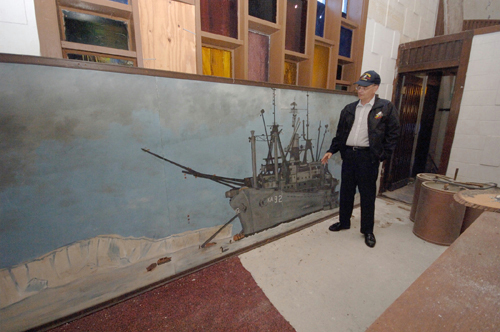
Along with staying open year-round and installing a new Quonset hut, the Seabee Museum’s long-term plans include displaying pontoon platforms built in Quonset. During World War II, the Seabees built thousands of the cubic, six-foot pontoons that could interlock to create large floating platforms. “And after the war, they were all surplus” and were sold or lost, Rugh said. “We have seven and, as far as we know, we have the only seven still left.” One of those seven is being used as the base for the Seabee statue at the museum’s gate.
There are still active Seabee bases – one in California and one in Missouri – that have their own museums, but Rugh said the unique local history of Rhode Island’s Seabees should distinguish the Quonset museum. “The others are more all-encompassing about the history of all Seabee functions.”
At the same time, the museum is in the process of repainting in camouflage the seven Quonset huts that it now has. Four have been completed by North Kingstown’s Pro-Paint Plus for about $3,000 each. The museum is also installing a memorial to the Seabees that have been killed in Iraq and Afghanistan – 14 Seabees have been killed – that should be completed by early July.
“It’s been a busy year for a bunch of old, retired Seabees,” Rugh said. “But we’re trying to do this on our own.” •