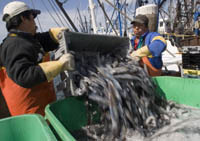
WORKERS FROM Deep Sea Fish of Rhode Island dump squid just purchased from fishermen at Galilee into large containers of ice. The Wakefield seafood company sells about 70 percent of its squid to Greece, Italy, Spain and China.
$25 million worth of R.I. fish, squid and other items sold worldwide in 2005
New Englanders like their fish and seafood fresh off the boat, but the next time you eat shrimp, swordfish, even cod, it may be fresh off a shipping container from China. If you order calamari while visiting Italy, on the other hand, you could get squid from Rhode Island.
Building a Strong Data Foundation in the Age of AI
Artificial intelligence (AI) has become a key priority in the boardroom and across management —…
Learn More
Last year, Rhode Island companies exported about $25 million worth of fish and seafood – most of it herring, mackerel and squid – around the world, especially to Asia and Europe.
Deep Sea Fish of Rhode Island Inc., for example, sends roughly 70 percent of its squid to Greece, Italy, Spain, Portugal and China. But where products go largely depends on who offers the highest price, said Eric Reid, president of the Wakefield-based company, which handles about 4,000 metric tons of seafood per year.
Companies like Deep Sea export squid because New England fishermen catch more than domestic markets need, said David Beutel, of the University of Rhode Island’s Commercial Fisheries Center in Kingston. Herring and mackerel are big exports, he said, because American consumers generally don’t like oily fish.
But because market prices are stronger in the United States, Reid said, Deep Sea has been exporting less. Currency exchange rates also affect the export volume, he said.
When the U.S. dollar depreciates, it creates a better atmosphere for exports because countries with a stronger currency, such as European countries, will buy more from the United States because it’s cheaper, said Leonard Lardaro, an economist at URI.
Though Deep Sea isn’t exporting as much as it used to, U.S. Census Bureau statistics show the state’s total seafood exports rose by about 41 percent from 2004 to 2005. The numbers have risen and fallen sharply since 1997, however, hitting a low of $13 million in 2000. To some extent, Beutel said, the fluctuations may reflect the size of each year’s catch.
Barry Costa-Pierce, director of the R.I. Sea Grant Program, which provides a one-stop shop in terms of information for fisheries, aquaculture and seafood traders, said in the long term, seafood exports are flat.
“We’re not increasing our exports,” he said.
Beutel said the National Oceanic & Atmospheric Administration’s National Marine Fisheries Service regulates the number of a species that can be harvested from the ocean, in efforts to protect them from overfishing. Those quotas can affect the number of seafood exported.
On the flip side, some local companies have sharply increased their seafood imports.
“We’re seeing a dramatic increase in product out of China,” said Mark Soderstrom, president of Southstream Seafoods Inc. in Warwick, which contracts with Russian factory trawlers to catch ocean perch, Atlantic and Pacific cod, and other fish species and then ships them to China for processing.
Soderstrom said the company expects to import about 400 containers of processed, frozen fish from China this year, up from 340 last year, and about 200 in 2004. Each container carries about 20 to 23 metric tons, or about 44,000 pounds, of seafood, which is sold to restaurant chains and grocery stores across the United States.
Close to 90 percent of the product Southstream imports comes from China, he said, because labor is cheaper, and China has the manpower to hand-fillet the fish, as opposed to using machines to fillet fish, as it is done in the United States.
Soderstrom said hand-cutting fish creates a higher yield because workers are able to cut closer to the bone. And they cut more accurately, he added, whereas machine-cut product might contain bones.
All American Foods Inc. also is buying more seafood from China these days, said purchasing director William Rivelli. The Maine-based company imports about 70 percent of its frozen cod, haddock, tuna, swordfish and shrimp from China, he said, whereas about 10 years ago it imported less than 50 percent.
The increase has to do with availability and price, he said. “It is cheaper to import from other countries. Our tariffs are conducive to bringing in products.”
Chinese processing companies have fine-tuned the freezing process, Soderstrom said, so there are no longer problems with “twice-frozen” fish.
In addition, he said fish processed in China can be sold for $1 or $2 less per pound than fish processed in Denmark, Norway and Iceland.
“If we relied here in the U.S. for our fish based on domestic catches, the average person couldn’t afford it,” he said. “It would be through the roof price-wise.”