For all we know, nanomaterials may have existed for ages. The ancient Indians, for example, developed a whole scheme of medicine based on gold and smoke that uses nanoparticles.
But to really understand nanomaterials, engineer them and put them to work fighting disease and saving lives, you need to have technology that has only been developed in recent years, said Srinivas Sridhar, physics department chair at Northeastern University.
“If you make something, you have to be able to see it,” Sridhar told his audience at the Northeast Bioengineering Conference, held April 4 to 6 at Brown University.
What has enabled nanotechnology to flourish, he said, is the combination of major advances in microscopy, in computation and in nanofabrication, which allows scientists to see the particles they’re working with, design them on a nano scale, and build them.
Combine those advances, in turn, with huge advances in genomics – accelerated by the Human Genome Project – and cutting-edge work in proteomics, which looks at how the body works on a molecular scale, protein by protein, Sridhar said, and you have the basis for today’s nanomedicine “revolution.”
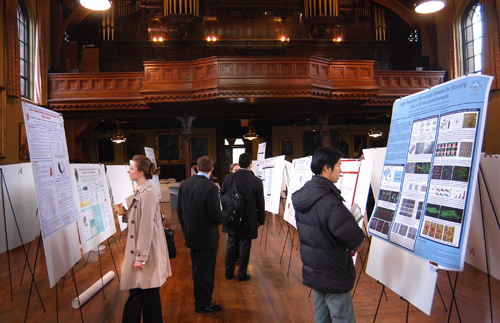
Sridhar, who is also vice provost for research at Northeastern and heads a National Science Foundation-backed IGERT Nanomedicine Center there, was the first of several expert speakers at the Brown conference, which organizer Thomas Webster, associate professor of engineering and the orthopedics at Brown, said drew about 300 people.
It was the biggest turnout since the conference was created 34 years ago, Webster said, in part because fundraising made it possible to charge students just $35 to register.
“Everything we do in this conference stems from trying to give students a good experience with their first conference,” he said.
This is the first time that Brown has hosted the annual conference, and it was very timely, Webster said, given Brown’s efforts to grow its life-sciences programs and promote collaboration between the medical school and engineering and physical-sciences departments.
Along with Sridhar’s presentation on nanomedicine, there was a talk by Arto Nurrmiko, the L. Herbert Ballou University Professor of Engineering and Physics at Brown, about new implantable brain sensors being developed at the university.
Professor Paul D. Calvert, chair of the materials and textile department at the University of Massachusetts Dartmouth, spoke about using ink-jet printing technology to “print” stem cells and proteins.
Another speaker, Gavin Braithwaite, a vice president of research at the Cambridge Polymer Group in Boston, spoke about a new, injectable treatment for lower-back pain that could spare many patients from surgery.
Sridhar’s talk, one of the highlights of the conference, framed nanomedicine as a “new paradigm” in health care whose promise has drawn multimillion-dollar investments. It’s a very interdisciplinary field, he said, and it’s closely tied to genomics.
Scientists start by identifying specific genes involved in diseases, then look at the biological processes, at the molecular level, linked to each disease, and identify potential therapies. Nanotechnology can help at every stage, from diagnostics – detecting disease when it’s just beginning, rather than when it’s full-blown and harder to cure – to imaging, targeted drug delivery and real-time assessments of the efficacy of therapies, Sridhar said.
Only selected materials can be used in nanomedicine because of toxicity concerns, Sridhar noted, but there are still plenty of “biocompatible” options, from gold particles to liposomes and polymers. And along with particles, there are nanosurfaces of great value to medicine, such as those being used on drug-eluting stents. •