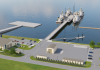
With the U.S. Maritime Administration in the process of redefining the country’s “Maritime Highway” – a mapping project that will create national short sea shipping routes – a few Rhode Island businesses and the Quonset Development Corporation (QDC) are pushing for the inclusion of local ports.
The QDC, backed by the R.I. Economic Development Corporation, and three Providence industrial businesses have asked, separately and in writing, to have ports in Providence and North Kingstown to be included on the maps, a necessary step to be included in approved shipping routes.
It’s now up to the U.S. Maritime Administration, known as MARAD, to decide whether Rhode Island could be a hub for the shipping method.
Last October the U.S. Department of Transportation granted MARAD approval to designate marine highway corridors. There isn’t a deadline set for the announcements about which ports will be included, QDC spokeswoman Dyana Koelsch said last week.
While being included on the maps is necessary to accommodate short sea shipping, it is unclear if that would commit communities to pursue that business. Koelsch said that if Quonset is designated as a Marine Highway port, QDC would “retain control of the Port of Davisville, and also what ships it would allow to call there.” QDC would also decide how much would be invested in infrastructure. It’s also unclear exactly who would run a short sea shipping port at Quonset. QDC would probably run it, but a private business might be brought in instead, Koelsch said. Local cost and return estimates – including the number of jobs and impacts to highway traffic – haven’t yet been calculated.
A spokesman for MARAD did not immediately return a call seeking comment.
Widely used in Europe, short sea shipping relies on vessels – smaller than deep-draft container ships – that would carry 53-foot trailers along the coast. Instead of offloading containers at a large port and having them trucked along Interstate 95, international shipments would instead be parceled out to the ship that would travel along the coast.
“These vessels would have roll-on-roll-off, 53-foot trailers,” Promet Marine Services President David A. Cohen said. “And they would carry hundreds of trailers and would travel, basically, like a bus route. Eight o’clock in the morning, they are in Providence, 5 o’clock in the afternoon they are in New London, etc., etc., up and down the eastern coast.”
While a short sea shipping port requires only “roll-on, roll-off” trailers, a traditional container port – like the one Gov. Donald L. Carcieri has opposed at the Quonset location in North Kingstown – would have required buying a crane and bringing in “lift-on, lift-off” containers. The Providence Journal in 2003 reported that infrastructure improvements for a Quonset container port would have cost about $160 million.
And with short sea shipping in Quonset, there likely wouldn’t be any need for further dredging, Koelsch said.
In Providence, support for short sea shipping has come from Allens Avenue’s Promet Marine Services, Sprague Energy and Waterson Terminal Services, the company that oversees ProvPort, the nonprofit Port of Providence.
Cohen said several Allens Avenue properties, including Promet’s, could handle the shallow-draft vessels needed for short sea shipping. And ProvPort, which has the deepest port in New England since a 2006 dredging, could easily handle the ships, he added. “There’s a multiplicity of available properties between here and Quonset,” he said, adding, “Although we’re not looking to compete with Quonset.”
In a February letter to MARAD, Waterson Facility Director Stephen Curtis wrote, “Our facility is best suited to respond to this opportunity because of our distinct advantages; large laydown areas, deep channel and dock access, strong tenant base, ability to attract smaller niche cargoes and our close proximity to [Interstate 95].”
The discussion about bringing short sea shipping to Rhode Island revved up in early 2008, when members of the Providence Working Waterfront Alliance – an advocacy group for water-dependent industrial use in Providence that includes Promet – brought members of the Short Sea Cooperative Program (SCOOP), a Washington, D.C.-based collective, to tour ProvPort and Allens Avenue.
In his report, Borgerson pegged both Providence and Quonset Point as ports that “could gain substantially from a revitalized coastal shipping industry.” But that report, which also included Fall River, New Bedford, Boston, New London and New Haven as potential short sea ports, wasn’t explicit about how Rhode Island’s ports could benefit.
R.I. Economic Development Corporation interim Executive Director J. Michael Saul last week declined a request to be interviewed about short sea shipping. In a statement, however, he said adding the Port of Davisville to the marine highway system will “provide economical options” for businesses around the state and region.
He said, “In addition, there are added environmental benefits to moving goods via ship rather than along Interstate 95.”
But Promet’s Cohen said, “there are certain tariffs in and out of various ports” that might make the shipping method unattractive to businesses. Those added costs are one of the short sea shipping issues that have been debated nationally. In July 2008, the U.S. House of Representative’s Committee on Transportation and Infrastructure sent a letter to members of the House Committee on Ways and Means, urging its members to consider cutting down the Harbor Maintenance Tax – a duty that’s 0.125 percent of the cargo’s declared value – and make the shipping method more economically viable.
“Marine highways may prove to be an effective way to lessen the growth of congestion without the expense of building more miles of highways,” the letter said. “It is estimated that fuel use for moving a ton of cargo by truck is 20 miles per gallon, by rail [it] is 435 miles per gallon and by barge is as much as 1,000 miles per gallon.”
For now, Rhode Island’s QDC and businesses – officials in New Bedford have also expressed interest – are waiting for MARAD’s decisions.
“We’ve signified to MARAD to please keep your eye on the Port of Providence,” said Cohen, who co-signed one of the letters. “With our deep-draft channel, rail access and direct access to I-95, it’s such a strategic location.” •

No posts to display
Sign in
Welcome! Log into your account
Forgot your password? Get help
Privacy Policy
Password recovery
Recover your password
A password will be e-mailed to you.
- Featured Event -